BIS Certification
 CDSCO
CDSCO
 PESO
PESO
 CPCB
CPCB
 LMPC
LMPC
 WPC Approval
 Global Approvals
 TEC
TEC
 ARAI
ARAI
 BEE
BEE
 ISO Certification
 DGCA Certification
 NOC For Steel
 APEDA Registration























 Business Registration
 FSSAI Mark Certification












 (32).jpg)
 Legal Services
 Trademark Registration
 Copyright Registration
 Patent Registration
 By
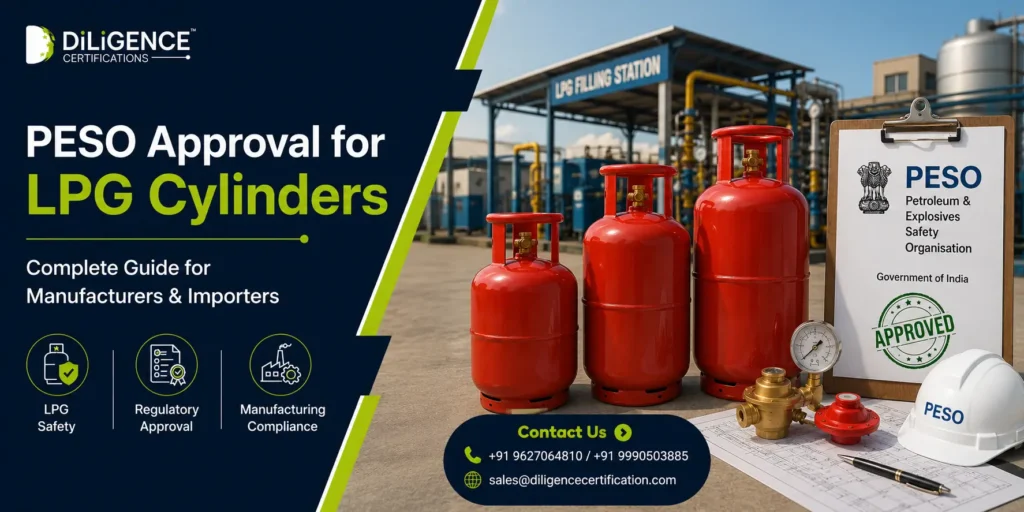
By - The approval for LPG cylinders issued by PESO is a statutory requirement to ensure the LPG cylinders are compliant with Indian regulations prior to manufacturing/importing/supplying/using the LPG cylinders.
- Companies engaged in business with LPG cylinders must abide by the Petroleum Rules, 2002 and seek the approval from the Petroleum and Explosives Safety Organisation (PESO) in order to avoid any potential legal action.
- The following guide provides information regarding the PESO Approval for LPG Cylinders process, its eligibility criteria, documentation, fees and other important details.
Introduction
A few months ago, one of our clients contacted us regarding their shipment of LPG cylinders which were imported from abroad. Though the shipment of cylinders was already delivered at the Indian port, the customs did not release the same as it did not have the necessary PESO Approval for LPG Cylinders. It resulted in delays in the shipments as well as unnecessary costs.
This problem occurs much more frequently than we think. Companies manufacturing, importing, distributing gas and even using the cylinder in their industry think that the quality standard only is sufficient. However, LPG cylinders are classified as hazardous pressure vessels and thus approval is very important in such cases.
PESO stands for Petroleum and Explosives Safety Organization. The organization manages the manufacturing, import, storage, transportation and usage of products having petroleum, compressed gases and explosives. The process of getting approval of the organization ensures the safety of the cylinders throughout their lifecycle.
It does not matter whether you manufacture LPG cylinders in India or import them from other countries. PESO Approval for LPG Cylinders becomes an important legal requirement in most of the cases. It is better to understand the process of approval beforehand.
What is PESO Approval for LPG Cylinders?
PESO Approval for LPG Cylinders is an official regulatory approval given by the Petroleum and Explosives Safety Organisation, operating as a sub-department of the Department for Promotion of Industry and Internal Trade (DPIIT) of the Government of India.
PESO approval guarantees that LPG cylinders conform to relevant Indian safety standards, technical specifications, testing standards, and quality requirements before they are manufactured, imported, marketed, or used in the country.
Whereas product certification is related to generic products, PESO approval concentrates on operational safety. LPG is under very high pressure and extremely flammable; hence any manufacturing flaw may cause dangerous accidents. This is why each cylinder needs strict design, materials, pressure testing, and quality checks before issuing an approval.
Businesses working with LPG cylinders need to ensure compliance not only at the manufacturing stage but also during storage, transport, filling, and distribution.
PESO Approval for LPG Cylinders is a guarantee that LPG cylinders meet Indian safety and technical standards. This measure helps prevent accidents, ensures legal compliance, and allows businesses to manufacture and import cylinders free from problems with regulations.
Why is PESO Approval Mandatory?
LPG is one of the most widely used fuels across domestic, commercial, and industrial sectors. Millions of cylinders are transported every day across India. Because these cylinders contain compressed flammable gas, strict safety controls are essential.
Without regulatory oversight, defective cylinders could enter the market and create significant risks for consumers, businesses, and transport operators.
PESO approval helps ensure that:
- LPG cylinders are manufactured according to approved engineering designs.
- Approved raw materials are used during production.
- Every cylinder successfully passes hydrostatic and pressure tests.
- Safety valves and accessories meet prescribed standards.
- Manufacturing facilities follow recognised quality control procedures.
- Imported cylinders comply with Indian regulatory requirements before distribution.
From a business perspective, obtaining approval is not simply about meeting legal obligations. It also builds confidence among distributors, government agencies, oil marketing companies, and industrial buyers.
Many procurement agencies prefer working only with manufacturers whose products meet all applicable statutory requirements, making compliance a commercial advantage as well as a legal necessity.
Who Needs PESO Approval for LPG Cylinders?
The provision affects various sectors of business that form part of the LPG chain of supply.
Manufacturers of LPG Cylinders
Firms that manufacture new LPG cylinders need to receive approval prior to initiating their commercial production. Such firms will be evaluated for production capacity, testing facilities, and quality control systems.
Importers of LPG Cylinders
Firms importing LPG cylinders from foreign manufacturers must get all relevant approvals prior to their entry into the Indian market.
Manufacturers of Cylinder Valves
Valves are very important safety devices. Firms that manufacture LPG cylinder valves may need to have separate approvals for their products.
LPG Bottling Units
Units that are involved in filling up LPG cylinders must adhere to relevant PESO regulations regarding storage, handling, inspections, and operations.
Suppliers of Industrial Gas Equipment
Firms supplying pressure vessels, industrial gas handling equipment, or special purpose LPG storages may need PESO approvals.
Types of LPG Cylinders Covered Under PESO Approval
Different categories of LPG cylinders fall under regulatory supervision depending on their intended application and design.
These generally include:
- Domestic LPG cylinders
- Commercial LPG cylinders
- Industrial LPG cylinders
- Composite LPG cylinders
- Refillable LPG cylinders
- Imported LPG cylinders
- High-capacity LPG storage cylinders
- Special-purpose LPG pressure vessels
Each category may have different technical requirements, testing procedures, and approval documentation based on applicable Indian standards and safety regulations.
Eligibility Criteria for PESO Approval for LPG Cylinders
Prior to submitting their applications for PESO approval for LPG cylinders, it is essential that the companies ensure that they meet the necessary criteria laid down by the relevant regulatory authorities. Fulfillment of the criteria from the outset ensures that there is no delay or refusal in granting approval.
The company should be a registered business entity involved in the manufacture, importation, or supply of LPG cylinders and/or pressure equipment. The LPG cylinders should be manufactured in compliance with recognized Indian standards or technically accepted standards approved by PESO.
Furthermore, the manufacturing unit should have the production infrastructure, quality control mechanism, testing equipment and technical manpower. Importation of the LPG cylinders would require compliance with safety requirements of India.
Companies usually become eligible for PESO approval in LPG cylinders if they can show that they have:
- A valid registration as a business entity.
- Authorization to manufacture or import the product.
- Design of the cylinder along with technical drawings approved.
- Testing facilities in-house or from any recognized testing authority.
- Quality assurance and inspection procedures.
- Petroleum Rules, 2002 and Indian Standards compliance.
- Importers of LPG cylinders need to submit further documentation regarding
- to overseas manufacturing facilities and product conformity may also be required.
Documents Required for PESO Approval for LPG Cylinders
Documentation preparation is the single most crucial step in gaining approvals. Deficiency in documents and wrong submissions are two of the main reasons behind delayed processes.
While the exact list of documents can differ depending on the cylinder type and the nature of the business of the applicant, here is the list of documents generally required.
Business Documents
- Certificate of Incorporation/Registration
- GST registration certificate
- PAN card
- Factory License (in case applicable)
- Import export code (IEC), for importers
Technical Documents
- Technical specifications of the products
- Engineering drawings/drawings with calculations
- Manufacturing process
- Material specifications
- Welding process specification
- Quality control manual
Testing and Quality Documents
- Hydrostatic test report
- Burst pressure test report
- Material test report
- NDT reports
- Inspection reports
- Test calibration report of test equipment
Compliance Documents
- Indian standard compliance certificate for applicable standards
- Past certificate of approval (in case applicable)
- Authorisation letter
- Product catalogue and technical brochures
The best way is to have all these documents ready before making an application. We at Diligence Certifications have seen applications being delayed because of just one technical drawing/test report being missing.
Step-by-Step PESO Approval Process for LPG Cylinders
Most companies perceive the approval process as complex due to the technical nature of the process. However, it becomes easy to follow if the process is handled systematically through the following stages.
Stage 1: Product Assessment
The first step is to determine if there is need for approval from PESO and which regulations and standards apply to the LPG cylinders.
This stage involves analyzing the product design, usage, production, and statutory requirements.
Stage 2: Preparation of Technical Documents
The applicant will prepare the required technical documents such as engineering drawings and other technical data.
Any inaccuracy in the preparation of this document leads to further inquiries by the regulating authority, making the process lengthy.
Stage 3: Product Testing
Testing of LPG cylinders will be done based on the applicable standards.
These tests may include:
- Hydrostatic pressure testing
- Burst pressure testing
- Leak testing
- Strength testing
- Material testing
- Inspection
Those cylinders that pass the prescribed technical requirements advance to the next stage.
Step 4: Application Form Submission Online
Documentation and testing having been completed, the application form is now submitted online via the prescribed PESO portal together with other relevant documents and government fees, where applicable.
This step involves checking whether all relevant mandatory information has been included in the application.
Step 5: Technical Assessment
Technical assessment of the documents, specifications, test results and certification status is done by PESO.
Should there be need for more information on certain matters, a query will be sent out to the applicant.
Step 6: Factory Inspection (Where Necessary)
For manufacturers, factory inspection may be done to establish:
- Manufacturing facilities
- Testing facilities
- Quality control mechanisms
- Storage facilities
- Production process
- Safety measures
Step 7: Issuance of PESO Approval
After successful completion of all technical assessments, inspections and compliance check-ups, PESO then grants the approval.
This then enables the organization to produce and market the cylinders as per the terms of the licence issued.
Testing and Inspection Requirements
Tests have a central place in this process since LPG cylinders are meant for storing highly flammable gas under pressure.
All LPG cylinders should be able to prove their ability to operate safely under such conditions during their entire lifetime.
Depending on the product class, the testing might include:
Hydrostatic Pressure Test
It will check whether the cylinder will safely bear the internal pressure without deformations and leaks.
Burst Pressure Test
Here the cylinder will be tested at higher than usual pressure to estimate its strength.
Leakage Test
It will reveal the possible gas leakage from the cylinder and its valve assembly.
Material Tests
They will establish whether the raw materials meet the requirements for chemical composition and mechanical properties.
Dimensions Test
Here the dimensions, thickness of walls, neck and foot rings and other characteristics will be tested.
Welds Test
It is performed using approved inspection procedures.
Applicable Rules and Standards
PESO Approval for LPG Cylinders is governed by multiple legal and technical provisions.
Some of the important regulations include:
- Petroleum Act, 1934
- Petroleum Rules, 2002
- Gas Cylinders Rules, 2016
- Applicable Indian Standards (IS)
- PESO technical guidelines
- Relevant safety notifications issued by the Government of India
Applicants should always verify the latest regulatory requirements, as standards and procedural guidelines may be updated from time to time.
Common Reasons for Application Rejection
Many approval delays are avoidable. From our experience assisting manufacturers and importers, the same issues appear repeatedly.
Some of the most common reasons include:
- Incomplete technical documentation.
- Incorrect engineering drawings.
- Missing test reports.
- Non-compliance with applicable Indian Standards.
- Deficiencies identified during factory inspection.
- Inconsistent quality control procedures.
- Incorrect product specifications.
- Delayed response to clarification requests.
- Submission of outdated compliance documents.
A thorough pre-submission review can prevent most of these issues and improve the likelihood of obtaining approval without unnecessary delays.
Processing Time for PESO Approval for LPG Cylinders
The PESO Approval for LPG Cylinders is affected by a number of issues such as the kind of cylinder, adequacy of documentation, testing needs, and further clarifications from the PESO.
Documentation that includes all technical documents and valid test results will be processed quicker than those that would need multiple revisions. In cases where further factory testing or evaluations would be needed, this would take some more time.
To avoid any delay, it would be helpful for the companies to:
- Check their technical documents prior to submission.
- Make sure that their test results have been conducted at legitimate laboratories.
- Respond promptly to any clarification requests.
- Have their engineering documents up-to-date.
- Maintain proper quality documentation in the entire process of production.
- Planning the approval process prior to manufacturing/importing LPG cylinders is essential to ensure there are no delays in shipment.
Government Fees for PESO Approval
There is no single fixed government fee applicable to every application. The fee depends on factors such as:
- Type of LPG cylinder
- Product category
- Number of models
- Scope of approval
- Testing requirements
- Inspection requirements
In addition to statutory costs, companies need to take into account costs involved in product testing, document preparation, laboratory assessment, inspection, and technical advice if required.
Estimation of the case specific cost prior to filing an application will be helpful for planning.
Validity and Renewal of PESO Approval
PESO Approval for LPG Cylinders can be valid depending upon the kind of approval and the relevant regulations that apply.
Firms must continually adhere to the terms of approval even when they have received the necessary approval. Any major modification in the construction, production methods, raw materials used, plant of manufacture, or safety components can necessitate renewed or new approvals.
It will be sensible to keep checking the terms of approval and initiate the renewal procedure far in advance before the expiry of the same if applicable.
Benefits of PESO Approval for LPG Cylinders
Gaining PESO Approval for LPG Cylinders is more than being in compliance with the laws.
1. Compliance with Laws
Approval will enable you to comply with the Petroleum Act, Petroleum Rules, Gas Cylinders Rules and other relevant regulations, thereby avoiding any threat of penalties and enforcement actions.
2. Increased Market Credibility
In addition to being compliant, PESO approval for LPG cylinders allows proving that your products meet safety requirements and will be supplied safely to any part of India.
3. Quick Customs Clearance
If you are an importer, your required approvals will help avoid any problems associated with customs clearance of the imported goods.
4. Increased Safety of Products
Your LPG cylinders have been tested and inspected according to the established criteria.
5. Greater Business Opportunities
Lots of tenders are put out there, by both governmental organizations and private companies, and the majority of them need you to be compliant. Thus, getting this certification means that you can now take on bigger tenders and contracts.
6. Fewer Risks for Your Business
With proper testing, your cylinders have fewer risks of failure, recalls, litigation, etc.
Why Choose Diligence Certifications?
Compliance with the regulatory standards for LPG cylinders may pose a technical challenge to new entrants into the market. An oversight in the application or testing stage may result in delay.
At Diligence Certifications, we facilitate your compliance journey by offering:
- Guidance through the whole process of getting approval from the PESO.
- Technical support with documentations and applications.
- Connection with accredited test laboratories.
- Facilitation of inspection and compliance reviews.
- Prompt response to any queries.
- Assistance in renewal of compliance.
Our objective is to simplify the approval process while helping businesses meet regulatory requirements efficiently and accurately.
Conclusion
Approval from PESO for LPG Cylinders is an important requirement for LPG cylinder producers, importers, and companies who use them in their business operations. This is because LPG cylinders are pressurised gas cylinders and there are always inherent risks associated with them.
An application that is well prepared with proper technical data, testing and compliance with relevant regulations increases the chances of getting approval easily and without much trouble.
If your company is looking to manufacture/import/market LPG cylinders in India, then getting approval must be considered an important aspect of your business plan and not just a post production step.
Do you need help with PESO Approval for LPG Cylinders?
At Diligence Certifications, we will be glad to assist you with all aspects of PESO approval for LPG cylinders.
Frequently Asked Questions
What is PESO Approval for LPG Cylinders?
It is a regulatory approval issued by the Petroleum and Explosives Safety Organisation (PESO) to ensure LPG cylinders comply with prescribed safety and technical standards before manufacture, import, or use in India.
Who needs PESO Approval for LPG Cylinders?
Manufacturers, importers, suppliers, LPG bottling plants, and businesses dealing with approved LPG cylinders may require PESO approval depending on their activities and product category.
Which documents are required for PESO approval?
Typical documents include business registration certificates, technical drawings, product specifications, material test certificates, quality manuals, inspection reports, and applicable compliance documents.
How long does the approval process take?
The timeline varies depending on documentation quality, testing requirements, inspections, and the complexity of the application.
Is factory inspection mandatory?
Manufacturing facilities may be inspected to verify production capability, testing infrastructure, and quality management systems before approval is granted.
Can imported LPG cylinders be sold without PESO approval?
No. Imported LPG cylinders must comply with applicable Indian regulations and obtain the required approvals before being marketed or used.
What happens if an application is rejected?
The applicant must address the observations raised by the authority, update the required documents or product specifications, and submit the revised application as per the applicable procedure.
Can PESO approval be renewed?
Yes. Where renewal is applicable, businesses should apply before expiry and continue complying with all approval conditions.
Why is product testing important?
Testing verifies that LPG cylinders can safely withstand pressure, meet quality standards, and perform reliably during storage, transportation, and use.
How can Diligence Certifications help?
Diligence Certifications provides end-to-end assistance with documentation, technical reviews, testing coordination, application filing, compliance support, and follow-up throughout the approval process.