BIS Certification
 CDSCO
CDSCO
 PESO
PESO
 CPCB
CPCB
 LMPC
LMPC
 WPC Approval
 Global Approvals
 TEC
TEC
 ARAI
ARAI
 BEE
BEE
 ISO Certification
 DGCA Certification
 NOC For Steel
 APEDA Registration























 Business Registration
 FSSAI Mark Certification












 (32).jpg)
 Legal Services
 Trademark Registration
 Copyright Registration
 Patent Registration
 By
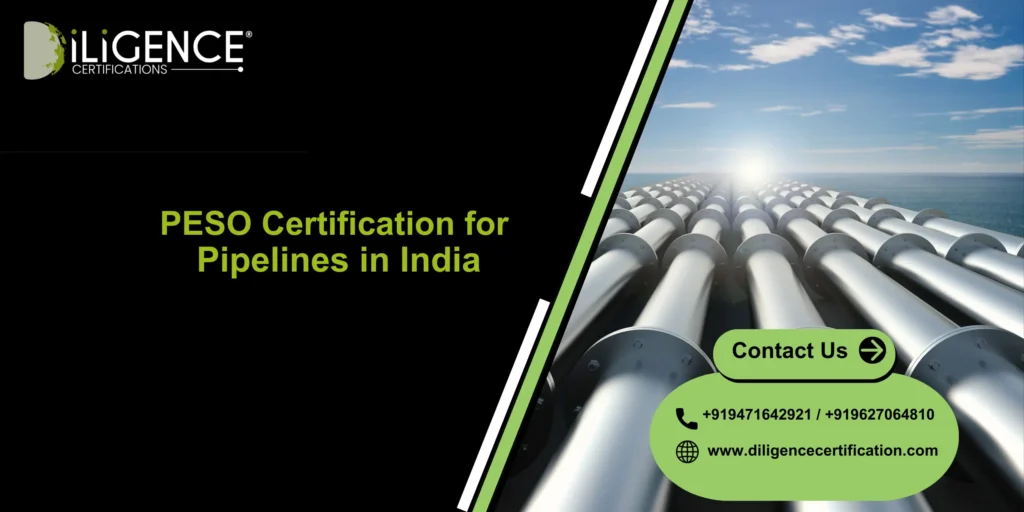
By - PESO Certification for Pipelines is required for safe handling, installation, and operation of pipelines carrying petroleum, gas, or hazardous substances.
- Pipeline approval focuses on safety design, route layout, pressure control, emergency systems, and compliance documents.
- PESO checks drawings, technical details, inspection reports, and safety arrangements before granting approval.
- Incorrect documents, wrong drawings, and non-compliance with safety rules can delay or reject the approval.
- Diligence Certification helps businesses complete the PESO pipeline approval process with proper documentation and expert support.
Introduction | PESO Certification for Pipelines
Pipelines are widely used in industries for transporting petroleum products, gas, chemicals, and other hazardous materials. These pipelines must be designed, installed, tested, and operated safely because even a small leakage or technical failure can create serious fire, explosion, environmental, and business risks.
In India, PESO plays an important role in regulating petroleum, explosives, compressed gases, and hazardous installations. PESO works under the Department for Promotion of Industry and Internal Trade, Ministry of Commerce and Industry.
PESO Certification for Pipelines in India is required to ensure that pipeline systems follow prescribed safety standards and regulatory requirements. It helps industries operate legally, safely, and responsibly.
What is PESO Certification for Pipelines?
PESO Certification for Pipelines is an official approval process for pipelines used for transporting petroleum, gas, or other regulated hazardous substances. This approval confirms that the pipeline design, layout, material, safety systems, inspection records, and operating conditions meet PESO requirements.
Pipeline approval may include review of drawings, technical specifications, safety distances, pressure ratings, route details, emergency arrangements, and inspection reports. PESO’s Petroleum Rules SOP mentions documents such as approved drawings, pipeline integrity management, inspection reports, and as-built P&IDs for relevant pipeline approvals.
Key Points
- It is related to safety and legal compliance.
- It applies to pipelines carrying regulated petroleum or hazardous substances.
- PESO reviews technical and safety documents before approval.
- Approval helps prevent leakage, fire, explosion, and operational hazards.
- It is important for refineries, terminals, industrial units, gas networks, and fuel handling facilities.
Why is PESO Certification for Pipelines Required?
PESO Certification for Pipelines is required because pipelines carry substances that can be highly flammable, pressurized, or dangerous. Without proper design and approval, pipelines can create major safety risks for workers, nearby people, property, and the environment.
The approval process ensures that pipeline installation is not done casually. Every important point, such as route selection, pipe material, pressure control, valves, safety equipment, testing, and emergency response, must be checked properly.
Key Points
- To ensure safe transportation of petroleum, gas, and hazardous materials.
- To comply with Indian safety rules and PESO requirements.
- To reduce the risk of fire, explosion, leakage, and accidents.
- To support legal operation of pipeline systems.
- To build trust with regulators, clients, investors, and business partners.
- To avoid project delays caused by non-compliance.
- To maintain proper technical and safety records.
Importance and Benefits of PESO Certification for Pipelines
| Importance | Benefits |
| Legal compliance | Helps businesses operate pipelines as per applicable Indian regulatory requirements. |
| Safety assurance | Reduces risk of leakage, fire, explosion, and pressure-related accidents. |
| Technical verification | Ensures pipeline design, material, drawings, and safety systems are properly reviewed. |
| Smooth project approval | Helps avoid unnecessary delay during installation or commissioning. |
| Worker protection | Creates safer working conditions for employees and operators. |
| Environmental protection | Reduces chances of spills, gas leakage, and contamination. |
| Business credibility | Shows that the company follows safety and compliance standards. |
| Inspection readiness | Keeps documents, drawings, and reports organized for authority review. |
| Operational control | Supports safe maintenance, monitoring, and emergency response. |
| Risk reduction | Minimizes penalties, shutdowns, rejection, and business loss. |
Process of PESO Certification for Pipelines
Step 1: Applicability Check
First, the business must check whether the pipeline comes under PESO approval requirements. This depends on the material being transported, pressure level, storage connection, terminal connection, pipeline route, and applicable rules.
Step 2: Collection of Technical Details
The applicant must collect all important technical details of the pipeline. This may include pipeline length, diameter, route layout, material grade, operating pressure, design pressure, product details, safety devices, valve locations, and connected facilities.
Step 3: Preparation of Drawings
Proper drawings are required for review. These may include layout drawings, route maps, P&ID, sectional drawings, safety distance drawings, and installation details. Drawings must be clear, accurate, and aligned with actual site conditions.
Step 4: Documentation Preparation
The next step is preparing all required documents. This may include company documents, technical specifications, safety reports, inspection reports, test certificates, land or site documents, emergency plan, and undertaking or declarations where applicable.
Step 5: Application Filing
After documentation, the application is submitted to PESO through the prescribed process. Details must match the documents and drawings. Any mismatch can create objections or delay.
Step 6: Technical Review by PESO
PESO reviews the application, drawings, technical documents, safety measures, and compliance details. If any clarification is required, the applicant must reply properly with corrected documents.
Step 7: Inspection or Verification
In many cases, inspection or technical verification may be required. The authority checks whether the pipeline installation matches approved drawings and required safety standards.
Step 8: Compliance Correction
If any non-compliance is found, the applicant must correct it. This may include drawing revision, document correction, safety system improvement, or additional technical clarification.
Step 9: Approval or License Grant
Once PESO is satisfied with the documents, drawings, inspection, and compliance status, approval is granted. After approval, the pipeline must be maintained and operated as per approved conditions.
Step 10: Renewal and Ongoing Compliance
PESO compliance does not end after approval. Businesses must maintain inspection records, safety systems, emergency plans, and renewal requirements wherever applicable.
Challenges of Getting This Certification Without a Consultant
Getting PESO Certification for Pipelines without expert support can be difficult because the process is highly technical. It requires correct interpretation of rules, accurate drawings, proper documentation, and coordination with technical teams.
Many businesses face delays because they submit incomplete documents or prepare drawings that do not match the actual site. PESO approval is not just a formality. It is a safety-based regulatory process.
Key Challenges
- Difficulty in understanding applicable PESO rules.
- Confusion about required forms, drawings, and documents.
- Incorrect route layout or technical details.
- Mismatch between site condition and submitted drawings.
- Missing inspection reports or test certificates.
- Poorly prepared P&ID or safety distance drawings.
- Delay in replying to PESO objections.
- Lack of coordination between engineering, safety, and compliance teams.
- Risk of rejection due to incomplete application.
- Delay in project commissioning and business operations.
Why Choose Diligence Certification for PESO Certification for Pipelines?
Diligence Certification provides professional support for businesses that need PESO Certification for Pipelines in India. Pipeline approval requires technical accuracy, proper documentation, and regulatory understanding. Our team helps you manage the process in a structured and practical way.
We support businesses from the first applicability check to final approval coordination. Our aim is to reduce errors, avoid unnecessary delays, and make the approval process smooth.
Key Points
- Expert guidance for PESO pipeline approval.
- Support in document preparation and review.
- Assistance in technical drawing coordination.
- Help with application filing and compliance response.
- Guidance for inspection and authority queries.
- End-to-end support for manufacturers, operators, importers, and industrial units.
- Better chances of faster and smoother approval.
- Transparent communication throughout the process.
Conclusion
PESO Certification for Pipelines in India is important for safe, legal, and reliable pipeline operations. Pipelines carrying petroleum, gas, or hazardous substances must follow strict safety and regulatory requirements. Proper approval helps prevent accidents, protect workers, reduce environmental risk, and maintain business continuity.
The process involves technical documents, drawings, safety details, inspections, and authority review. Any mistake in documentation or design details can lead to objections, delays, or rejection.
Diligence Certification helps businesses complete the PESO pipeline approval process with proper planning, accurate documentation, and expert compliance support. For companies dealing with regulated pipeline systems, PESO approval is not optional compliance; it is a critical safety and business requirement.
Frequently Asked Questions
What is PESO Certification for Pipelines?
PESO Certification for Pipelines is an approval process for pipelines used to transport petroleum, gas, or regulated hazardous substances safely and legally.
Is PESO approval mandatory for pipelines in India?
Yes, PESO approval is required for applicable pipelines dealing with regulated petroleum, gas, or hazardous materials.
Who needs PESO Certification for Pipelines?
Refineries, terminals, gas companies, fuel handling units, industrial plants, and businesses using regulated pipelines may need PESO approval.
What documents are required for PESO pipeline approval?
Documents may include application details, layout drawings, route maps, P&ID, technical specifications, inspection reports, safety documents, and company records.
Why are drawings important in PESO pipeline approval?
Drawings help PESO verify pipeline route, layout, safety distance, pressure control, valves, and technical design details.
Can a pipeline operate without PESO approval?
Operating an applicable regulated pipeline without PESO approval can create legal, safety, and business risks.
How long does PESO pipeline approval take?
The timeline depends on document accuracy, technical complexity, inspection requirements, and response to PESO queries.
What happens if documents are incomplete?
Incomplete or incorrect documents can lead to objections, delay, or rejection of the application.
Does PESO approval require inspection?
Inspection or technical verification may be required depending on the pipeline type, location, and applicable approval conditions.
How can Diligence Certification help?
Diligence Certification helps with applicability checks, documentation, drawing coordination, application filing, inspection support, and approval follow-up.