BIS Certification
 CDSCO
CDSCO
 PESO
PESO
 CPCB
CPCB
 LMPC
LMPC
 WPC Approval
 Global Approvals
 TEC
TEC
 ARAI
ARAI
 BEE
BEE
 ISO Certification
 DGCA Certification
 NOC For Steel
 APEDA Registration























 Business Registration
 FSSAI Mark Certification












 (32).jpg)
 Legal Services
 Trademark Registration
 Copyright Registration
 Patent Registration
 By
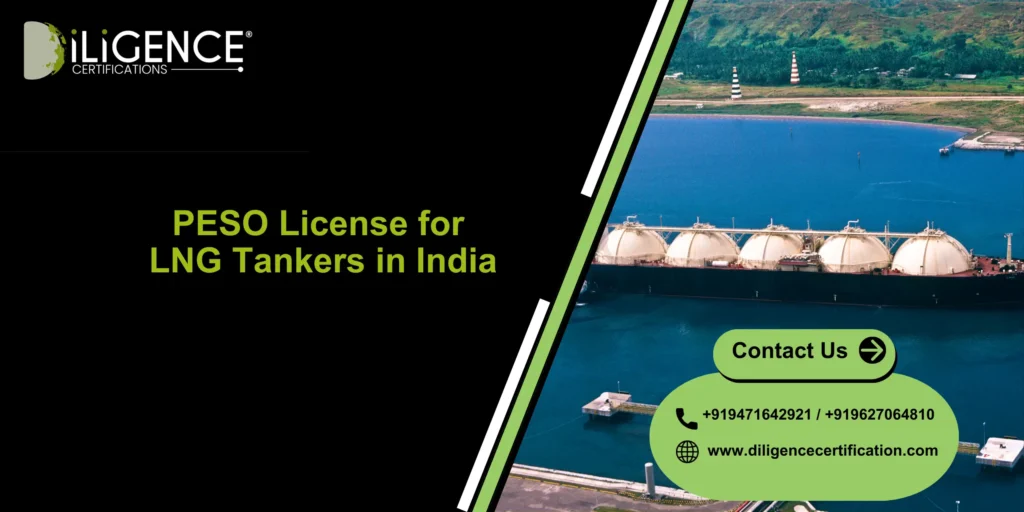
By - PESO License for LNG Tankers is required for safe transportation of Liquefied Natural Gas under regulated safety conditions.
- LNG tankers carry cryogenic gas, so tanker design, safety fittings, valves, insulation, and pressure control must meet strict standards.
- PESO approval helps prevent leakage, fire, explosion, pressure failure, and transport accidents.
- The license process includes document preparation, technical drawing review, inspection, compliance verification, and approval.
- Diligence Certification helps businesses manage PESO documentation, filing, coordination, and approval support.
Introduction
Liquefied Natural Gas Transportation is always considered a dangerous process because LNG itself has to be transported at extremely low temperatures. Even the smallest design fault or mistake concerning LNG tank handling or loading/unloading will become a safety problem. That’s why the PESO License for LNG Tankers in India is a very important regulatory document for enterprises transporting LNG.
In fact, the Petroleum and Explosives Safety Organisation in India is responsible for regulating the use of petroleum, explosives, compressed gases, pressure vessels, liquefied natural gas, compressed natural gas, autogas and associated facilities. The license itself proves not only compliance with laws but also the suitability of the tanker and safety standards.
What is PESO License for LNG Tankers?
PESO License for LNG Tankers is one of the licensing requirements that must be obtained by any entity intending to convey Liquefied Natural Gas using cryogenic tankers or any other form of permissible transport mechanism.LNG is basically liquefied natural gas that has been converted from its gaseous state to liquid form for purposes of easy storage and transport due to the cryogenic nature of the commodity which is also flammable.
PESO manages such tasks to mitigate potential hazards during filling, transport, off loading and emergencies. There are many guidelines available on the PESO official website.
Key points:
- It applies to businesses transporting LNG in India.
- It checks tanker design, safety fittings, construction quality, and compliance.
- It helps confirm that the LNG tanker is safe for road transportation.
- It supports legal operation and reduces rejection during inspection.
- It is important for LNG suppliers, transporters, energy companies, and industrial gas operators.
Why is PESO License Required for LNG Tankers?
PESO License should be applied because LNG transport is associated with public safety, occupational safety, transport safety, and environmental safety. The gas expands quickly in its gaseous state after being converted from liquid form. In case it is not well-designed or maintained, there will be pressure, leakage, fire, or even an explosion.
It is also worth noting that the government has accepted the transportation of liquefied gas, such as LNG, using safe transport systems, like ISO containers for domestic movement.
Key points:
- LNG is flammable and must be transported under controlled safety conditions.
- Cryogenic temperature can damage unsuitable material and fittings.
- Pressure safety devices must work correctly during transport.
- Emergency shut-off and venting systems must be properly installed.
- PESO approval helps businesses avoid legal penalties, transport delays, and safety incidents.
Importance and Benefits of PESO License for LNG Tankers
| Importance | Benefits |
| Legal permission | Allows lawful transportation of LNG tankers in India |
| Safety compliance | Reduces risk of leakage, fire, explosion, and pressure failure |
| Business credibility | Builds trust with clients, suppliers, and government authorities |
| Technical verification | Ensures tanker design, drawings, valves, and safety systems are checked |
| Operational continuity | Helps avoid vehicle detention, project delay, or compliance objections |
| Risk reduction | Protects workers, drivers, nearby public, and transport routes |
| Documentation control | Maintains proper records for inspection and renewal |
| Market access | Supports LNG logistics, industrial gas supply, and energy projects |
Process of PESO License for LNG Tankers
The PESO License process for LNG tankers must be handled carefully because technical and safety details are checked before approval.
- Applicability Check
First, confirm whether the tanker, transport activity, route, and LNG handling system need PESO approval. - Document Collection
Collect company documents, tanker details, vehicle details, ownership proof, technical specifications, safety system details, and other required papers. - Technical Drawing Preparation
Prepare tanker design drawings, layout, valve details, pressure safety arrangements, emergency systems, and related technical documents. - Application Filing
Submit the application through the required PESO process with correct forms, supporting documents, and technical information. - Scrutiny by PESO
PESO reviews the application, drawings, documents, and compliance details. Any mismatch or missing document may lead to clarification. - Inspection or Verification
The tanker may require inspection or technical verification to check construction, fittings, safety devices, markings, and compliance. - Clarification Handling
If PESO raises queries, proper replies and corrected documents must be submitted within the required time. - License Grant
After successful review and compliance confirmation, PESO grants the license or approval for LNG tanker operation. - Post-License Compliance
The license holder must maintain safety standards, inspection records, renewal timelines, and operating conditions.
Challenges of Getting This Certification Without a Consultant
Getting PESO License for LNG Tankers without expert support can be difficult because the process is technical, document-heavy, and safety-sensitive. A small error in drawings, forms, vehicle details, tanker specifications, or safety system description can delay the approval.
Key challenges:
- Confusion about applicable rules and license category.
- Incorrect or incomplete technical drawings.
- Missing tanker safety details or valve specifications.
- Lack of knowledge about cryogenic tanker requirements.
- Delay in responding to PESO clarification.
- Rejection risk due to wrong documentation.
- Difficulty coordinating with manufacturers, transporters, and technical teams.
- Poor understanding of inspection requirements.
- Renewal and post-approval compliance mistakes.
- Business delay due to non-compliance or incomplete filing.
Why Choose Diligence Certification for PESO License for LNG Tankers?
Diligence Certification provides professional support for PESO License for LNG Tankers with a practical and compliance-focused approach. LNG tanker approval needs technical accuracy, proper documentation, and regular coordination with the concerned authority. Our team helps simplify this complete process for manufacturers, transporters, importers, and LNG operators.
Key points:
- End-to-end support for PESO license documentation and filing.
- Expert guidance for LNG tanker compliance requirements.
- Assistance in technical drawing and document review.
- Support in application preparation and authority coordination.
- Help in handling queries, corrections, and compliance gaps.
- Practical guidance for inspection readiness.
- Transparent process with professional follow-up.
- Support for renewals and post-license compliance.
- Experience in petroleum, gas, pressure vessel, and hazardous material approvals.
- Reduced risk of delay, rejection, and documentation errors.
Conclusion
PESO License for LNG Tankers in India is essential for businesses involved in LNG transportation. It ensures that the tanker is designed, equipped, inspected, and operated as per safety requirements. Since LNG is cryogenic and flammable, regulatory approval is important for public safety, business continuity, and legal operation.
A properly approved LNG tanker helps reduce accident risk, improves client confidence, and supports smooth transportation operations. However, the process needs accurate documents, technical drawings, safety details, and proper filing. Diligence Certification helps businesses complete the PESO License process with better clarity, compliance, and professional support.
Frequently Asked Questions
What is PESO License for LNG Tankers?
It is a regulatory approval required for safe and legal transportation of Liquefied Natural Gas through approved LNG tankers.
Is PESO License mandatory for LNG tankers in India?
Yes, LNG tanker transportation requires proper PESO compliance because LNG is a hazardous cryogenic and flammable gas.
Who needs PESO License for LNG Tankers?
LNG transporters, gas suppliers, energy companies, industrial gas operators, and businesses handling LNG tanker movement need this approval.
Why is LNG tanker approval important?
It ensures the tanker has proper safety systems, pressure control, insulation, valves, and emergency arrangements.
What documents are required for PESO License?
Company documents, tanker details, technical drawings, safety system details, vehicle documents, and compliance papers are generally required.
Does PESO inspect LNG tankers?
Inspection or technical verification may be required depending on the tanker type, application, and compliance requirements.
Can LNG be transported without PESO approval?
Operating without required approval can create legal, safety, and business risks.
How long does the PESO License process take?
The timeline depends on documentation accuracy, technical review, inspection requirements, and query response.
What happens if PESO raises a query?
The applicant must submit corrected documents, technical clarification, or additional compliance details.
How can Diligence Certification help?
Diligence Certification helps with applicability checks, documentation, application filing, query handling, inspection support, and approval coordination.