BIS Certification
 CDSCO
CDSCO
 PESO
PESO
 CPCB
CPCB
 LMPC
LMPC
 WPC Approval
 Global Approvals
 TEC
TEC
 ARAI
ARAI
 BEE
BEE
 ISO Certification
 DGCA Certification
 NOC For Steel
 APEDA Registration























 Business Registration
 FSSAI Mark Certification












 (32).jpg)
 Legal Services
 Trademark Registration
 Copyright Registration
 Patent Registration
 By
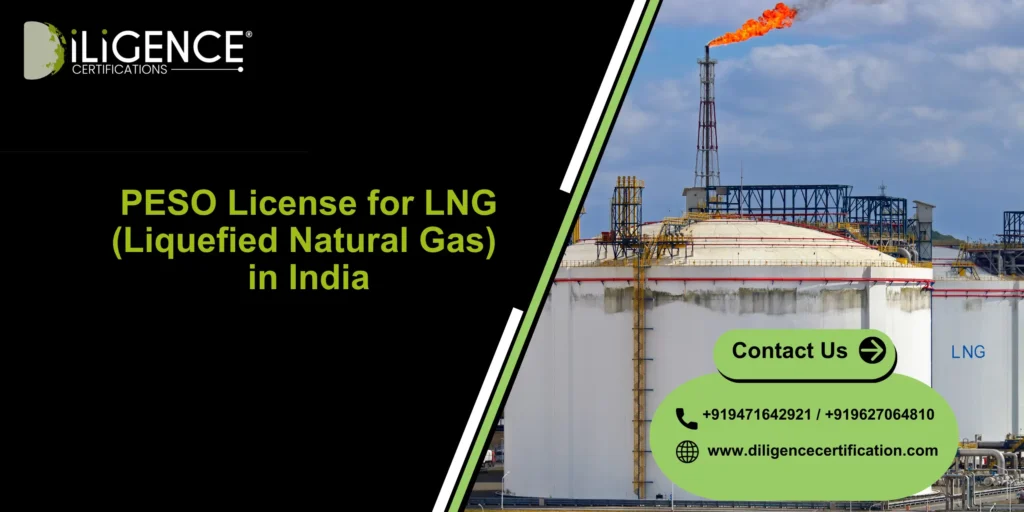
By - PESO License for LNG is required for safe storage, handling, transportation, dispensing, and use of Liquefied Natural Gas in India.
- LNG is a cryogenic and flammable fuel, so strict safety compliance is important to prevent leakage, fire, explosion, and pressure-related accidents.
- PESO approval covers technical drawings, site safety, storage vessels, tankers, valves, pipelines, pressure systems, and safety fittings.
- Businesses dealing with LNG without proper PESO compliance may face legal action, operational delays, rejection of approvals, or safety risks.
- Diligence Certification helps businesses manage documentation, application filing, technical coordination, inspection support, and approval follow-up.
Introduction
PESO License for LNG is becoming an important fuel in India because it is cleaner, efficient, and useful for industries, transport, energy projects, and commercial fuel systems. However, LNG is not an ordinary fuel. It is stored at very low temperatures and can become hazardous if it is not handled under proper safety conditions.
For this reason, businesses involved in LNG storage, transportation, dispensing, import, or handling must follow PESO safety requirements. PESO stands for Petroleum and Explosives Safety Organisation. It functions under the Department for Promotion of Industry and Internal Trade, Ministry of Commerce and Industry, Government of India. PESO regulates hazardous substances, petroleum products, compressed gases, cryogenic vessels, and pressure systems to ensure public and industrial safety.
A PESO License for LNG helps businesses operate legally and safely. It proves that the LNG facility, tanker, storage vessel, equipment, and safety systems meet the required standards. For manufacturers, importers, transporters, LNG station owners, energy companies, and industrial users, this license is an important part of compliance.
What is PESO License for LNG?
PESO License for LNG is an official license needed for any business entity engaged in activities involving Liquefied Natural Gas. LNG is natural gas that has been liquefied through cooling at very low temperatures. The benefit is that the gas can easily be stored or transported in liquid state; however, there is always the risk of danger considering the nature of LNG which is cryogenic, flammable, and pressurized.
The licensing process ensures that safety standards are adhered to in the design and operation of the facilities or equipment handling LNG.
Key points:
- It is required for LNG storage tanks, LNG tankers, LNG dispensing stations, LNG terminals, and related installations.
- It applies to businesses handling LNG in bulk or regulated quantities.
- It ensures that cryogenic vessels, pipelines, and safety fittings are suitable for LNG use.
- It reduces the risk of fire, gas leakage, pressure failure, and unsafe handling.
- It helps businesses meet legal and operational safety requirements.
Why is PESO License Required for LNG?
PESO License for LNG should be obtained is due to the fact that LNG, when improperly dealt with, is a very dangerous fuel. Even if LNG is extensively used as a safer form of fuel, it still needs to be handled carefully. Any leaks, improper insulation, faulty valves, incorrect installation, or unauthorized equipment may result in severe dangers.
Acquiring the PESO License means making sure that the system is safe from the technical standpoint prior to starting up a business. The license will ensure protection for employees, fuel handlers, residents, property, and the environment.
Key points:
- LNG is flammable and needs proper safety control.
- Cryogenic temperature can damage unsuitable material and equipment.
- PESO approval helps confirm that tanks, tankers, vaporizers, valves, and pipelines are safe.
- It is important for legal operation of LNG storage, transport, and dispensing systems.
- It reduces the chance of accidents, shutdowns, penalties, and approval rejection.
- It builds confidence among clients, authorities, insurers, and business partners.
Importance and Benefits of PESO License for LNG
| Importance | Benefits |
| Legal Compliance | Allows the business to operate LNG-related activities as per applicable safety regulations. |
| Safety Assurance | Helps prevent leakage, fire, explosion, pressure failure, and cryogenic injury risks. |
| Smooth Business Operation | Reduces the chance of regulatory objections, project delays, and operational shutdowns. |
| Technical Validation | Ensures that drawings, vessels, valves, pipelines, and safety systems meet required standards. |
| Better Market Trust | Builds confidence among customers, industrial buyers, transport partners, and government authorities. |
| Insurance and Tender Support | Helps in insurance processing, project approvals, and participation in industrial contracts. |
| Risk Reduction | Minimizes financial, legal, and safety risks connected with LNG operations. |
| Long-Term Compliance | Supports safe operation, inspection readiness, renewal, and future expansion. |
Process to Get PESO License for LNG in India
The PESO License for LNG process depends on the type of activity, such as storage, transportation, dispensing, import, or installation. However, the general process includes technical assessment, documentation, application filing, inspection, and approval.
Step 1: Requirement Analysis
The first step is to identify the exact LNG activity. The requirement may be different for LNG storage tanks, LNG road tankers, LNG dispensing stations, LNG terminals, or industrial LNG systems. The business must understand which approval, license, or permission is applicable.
Step 2: Document Preparation
After identifying the requirement, the necessary documents are prepared. These may include company documents, site layout, technical drawings, equipment details, pressure vessel certificates, safety details, fire safety arrangements, and other project-specific records.
Step 3: Technical Drawing and Layout Review
PESO places strong importance on technical drawings and layout plans. The drawing should clearly show the LNG storage area, safety distance, installation position, pipelines, valves, emergency exits, fire protection system, and nearby structures.
Step 4: Application Filing
The application is filed with PESO along with required documents and technical details. Any wrong information, missing document, or incorrect drawing can delay the approval process.
Step 5: Scrutiny by PESO
PESO reviews the application, documents, drawings, and safety arrangements. If any clarification is required, the applicant must provide the correct response within the required timeline.
Step 6: Inspection and Compliance Verification
In many cases, PESO may require site inspection or technical verification before granting final approval. The facility must be ready with proper installation, safety systems, approved equipment, signage, emergency arrangement, and compliance records.
Step 7: Approval or License Grant
After successful review and compliance verification, PESO grants the required approval or license. The business can then operate the LNG facility or activity as per approved conditions.
Step 8: Renewal and Ongoing Compliance
PESO compliance does not end after getting the license. The business must maintain safety standards, renew the license on time, follow approved operating procedures, and update PESO in case of modification or expansion.
Documents Required for PESO License for LNG
The exact document list depends on the type of LNG activity, but generally includes:
- Company registration documents
- Applicant identity and authorization details
- Site ownership, lease, or possession proof
- Site layout plan and technical drawings
- Details of LNG storage tanks or tankers
- Pressure vessel and cryogenic equipment details
- Safety valve, pipeline, and fitting specifications
- Fire safety and emergency response details
- No Objection Certificate, if applicable
- Manufacturer or equipment test certificates
- Installation and commissioning details
- Undertaking, declarations, and compliance documents
- Any other document required by PESO based on the project
Challenges of Getting This Certification Without a Consultant
Getting a PESO License for LNG without expert support can be difficult because LNG compliance involves both legal and technical requirements. A small mistake in drawing, document format, equipment details, or safety distance can lead to rejection or repeated clarification.
Many businesses face delays because they do not understand which approval is applicable to their activity. LNG storage, transport, dispensing, and terminal operations may require different technical documents and compliance checks. Without professional guidance, the application process can become time-consuming and confusing.
Key challenges:
- Difficulty in identifying the correct PESO license category.
- Errors in technical drawings, layout plans, and safety distance calculations.
- Missing equipment certificates or pressure vessel details.
- Confusion in LNG-specific safety and cryogenic compliance requirements.
- Delay in responding to PESO queries and objections.
- Lack of coordination between technical teams, manufacturers, and authorities.
- Risk of rejection due to incomplete or incorrect documentation.
- Difficulty in preparing the site for inspection.
- Poor understanding of renewal, amendment, and post-license compliance.
- Loss of time, money, and project deadlines due to repeated corrections.
Why Choose Diligence Certification for PESO License for LNG?
Diligence Certification provides professional support for businesses that need PESO License for LNG in India. Our team understands the importance of accurate documentation, technical clarity, and timely coordination with authorities. LNG compliance requires careful handling because it involves safety, pressure systems, cryogenic equipment, and flammable fuel risks.
We help businesses from the initial compliance check to final approval. Our support includes document preparation, application filing, drawing coordination, technical review, query handling, inspection support, and renewal assistance. The aim is to make the process smoother, faster, and more reliable for manufacturers, importers, LNG transporters, storage operators, industrial users, and fuel station businesses.
Key reasons to choose Diligence Certification:
- End-to-end support for PESO License and approval.
- Expert guidance for LNG storage, tanker, dispensing, and handling compliance.
- Accurate documentation and application filing.
- Technical drawing and layout coordination support.
- Assistance in PESO query reply and clarification handling.
- Support for inspection readiness and compliance verification.
- Reduced risk of rejection, delay, and documentation errors.
- Practical guidance for renewal, amendment, and future expansion.
- Professional team with strong regulatory and technical experience.
- Reliable compliance support for Indian and global businesses.
Conclusion
PESO License for LNG is an important approval for any business involved in the storage, transportation, dispensing, or handling of Liquefied Natural Gas in India. LNG is a cleaner and efficient fuel, but it is also cryogenic and flammable. This makes safety compliance essential for every LNG project.
The license helps ensure that the facility, tanker, vessel, pipeline, valve, and safety system are suitable for safe LNG operations. It also protects the business from legal issues, operational delays, safety accidents, and approval-related problems.
For businesses, PESO compliance should not be treated as only paperwork. It is a complete safety and legal requirement. With expert support from Diligence Certification, companies can manage the process more smoothly and reduce the risk of mistakes, rejection, and delays.
Frequently Asked Questions (FAQs)
What is PESO License for LNG?
PESO License for LNG is an approval required for safe storage, transportation, dispensing, or handling of Liquefied Natural Gas in India.
Is PESO License mandatory for LNG businesses?
Yes, PESO compliance is required for regulated LNG activities because LNG is a cryogenic and flammable fuel.
Who needs a PESO License for LNG?
LNG storage operators, tanker owners, fuel stations, terminals, industrial users, importers, and businesses handling LNG may require PESO approval.
Why is LNG considered hazardous?
LNG is stored at extremely low temperatures and can create fire, leakage, pressure, and cryogenic safety risks if handled incorrectly.
What does PESO check before approval?
PESO checks documents, technical drawings, equipment safety, storage systems, pressure vessels, safety fittings, site layout, and compliance arrangements.
Can I operate an LNG facility without PESO approval?
Operating without required PESO approval can create legal, safety, and business risks, including penalties and operational stoppage.
How long does PESO License approval take?
The timeline depends on document accuracy, project type, technical review, site readiness, inspection, and PESO query response.
What documents are required for LNG PESO License?
Common documents include company records, site layout, technical drawings, equipment certificates, safety details, and application forms.
Does the PESO License need renewal?
Yes, PESO licenses generally require timely renewal as per applicable license conditions and regulatory requirements.
How can Diligence Certification help with LNG PESO License?
Diligence Certification helps with document preparation, application filing, technical coordination, query handling, inspection support, and approval assistance.