BIS Certification
 CDSCO
CDSCO
 PESO
PESO
 CPCB
CPCB
 LMPC
LMPC
 WPC Approval
 Global Approvals
 TEC
TEC
 ARAI
ARAI
 BEE
BEE
 ISO Certification
 DGCA Certification
 NOC For Steel
 APEDA Registration























 Business Registration
 FSSAI Mark Certification












 (32).jpg)
 Legal Services
 Trademark Registration
 Copyright Registration
 Patent Registration
 By
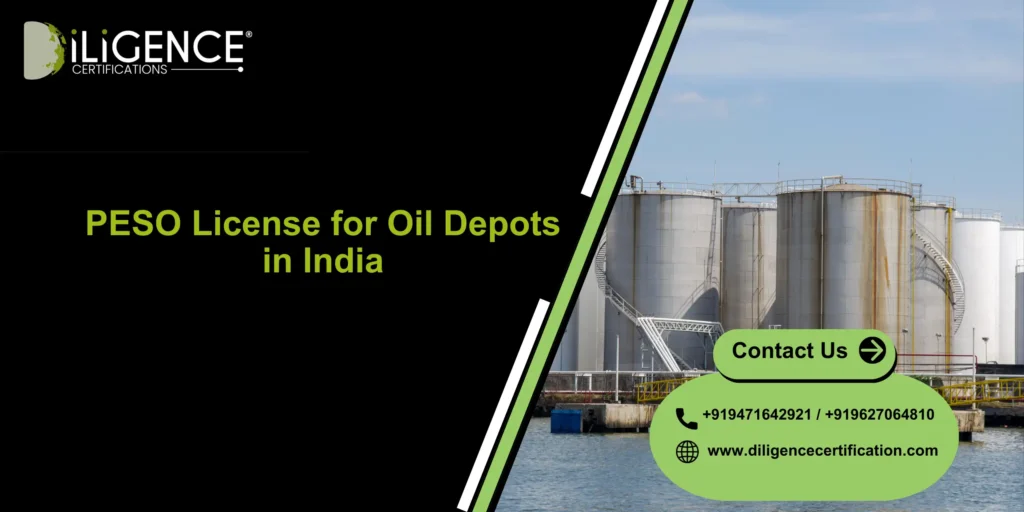
By - A PESO License for Oil Depots is required for oil depots storing petroleum products above prescribed limits under the Petroleum Rules, 2002.
- Oil depots must follow strict safety rules for storage tanks, pipelines, fire systems, distance norms, and handling areas.
- PESO approval helps prevent fire, explosion, leakage, and environmental safety risks.
- Proper documents, site layout, tank details, safety arrangements, and technical drawings are important for approval.
- Diligence Certification supports businesses with documentation, filing, coordination, and compliance guidance for PESO licensing.
Introduction
The oil depots are crucial in storing and distributing various products like diesel, petrol, furnace oil, lubricants, and all other products made out of petroleum. The products are used for industries, transport, electricity generation, construction work, and various other commercial purposes. But storage of oil cannot be considered a regular commercial operation because of the fact that the products are combustible and involve huge safety risks without proper statutory approvals.
For India, the Petroleum and Explosives Safety Organisation or PESO governs various safety rules for storage, handling, and transportation of the products. PESO operates under the jurisdiction of the department for promotion of industry and internal trade, and it offers statutory approval on matters related to petroleum and explosives. The PESO portal mentions about the statutory approval on petroleum storage tank as per form XV of Petroleum Rules, 2002.
Having a PESO license for an oil depot guarantees that the safety norms are fulfilled by the depot prior to storage and distribution. This helps in ensuring safety to workers, property around, customers and business owner alike.
What is PESO License for Oil Depots?
A PESO License for Oil Depots is an official approval issued by PESO for storing petroleum products in bulk at a depot. An oil depot may include storage tanks, loading and unloading points, pipelines, pumps, safety equipment, fire protection systems, and internal movement arrangements.
This license confirms that the depot design, tank installation, safety distance, fire system, electrical fittings, and operating conditions are suitable for petroleum storage. The Petroleum Rules, 2002 define requirements for storage and licensing of petroleum products in India. PESO’s SOP also explains that certain petroleum storage activities require licensing, while only very small exempted quantities may not need a license.
Key points:
- It applies to bulk storage of petroleum products at oil depots.
- It is required before starting storage and distribution operations.
- It covers safety of tanks, layout, handling systems, and fire protection.
- It helps businesses meet legal petroleum storage compliance.
- It reduces risks related to leakage, fire, explosion, and unsafe operations.
Why is PESO License Required for Oil Depots?
A PESO License is required because oil depots store flammable petroleum products in large quantities. Even a small error in storage design, ventilation, grounding, safety distance, or fire control can create a major accident. PESO approval ensures that the depot is technically safe and legally compliant before business operations begin.
Without PESO approval, an oil depot may face closure, penalties, rejection from business contracts, insurance issues, and serious legal consequences during accidents. For petroleum storage, compliance is not only a paperwork requirement. It is a safety requirement that protects life, property, and business continuity.
Key points:
- It is legally required for regulated petroleum storage.
- It confirms safe design and installation of storage tanks.
- It ensures proper fire-fighting and emergency arrangements.
- It reduces accident risk during loading, unloading, and storage.
- It helps businesses operate without regulatory disruption.
Importance and Benefits of PESO License for Oil Depots
| Importance | Benefits |
| Legal compliance | Allows the depot to operate as per Petroleum Rules, 2002 |
| Safety assurance | Reduces fire, leakage, and explosion risks |
| Business credibility | Builds trust with clients, oil companies, and authorities |
| Insurance support | Helps during insurance assessment and risk review |
| Operational approval | Supports smooth storage, handling, and distribution |
| Accident prevention | Ensures safer tank design, distance, and emergency planning |
| Regulatory protection | Reduces chances of penalties, notices, or closure |
| Better documentation | Keeps depot records, drawings, and approvals organized |
Process to Get PESO License for Oil Depots
The PESO licensing process for oil depots requires careful planning and technical documentation. A small mistake in layout, capacity details, tank design, or safety distance can delay approval.
Step-by-step process:
- Applicability Check
First, check whether the oil depot requires PESO approval based on petroleum class, quantity, storage type, and business activity. - Site and Layout Planning
Prepare the depot layout with tank position, safety distances, loading/unloading area, fire-fighting system, boundary, entry-exit points, and nearby structures. - Document Collection
Collect land documents, company documents, identity proof, site plan, tank details, safety details, and other required technical documents. - Technical Drawing Preparation
Prepare drawings as per PESO requirements. These may include site layout, tank layout, pipeline route, safety distance details, and fire protection arrangements. - Application Filing
Submit the PESO application with all required documents and technical details through the prescribed process. - Scrutiny by PESO
PESO reviews the application, documents, drawings, storage capacity, petroleum class, and safety arrangements. - Inspection or Clarification
If required, PESO may ask for clarification, correction, or inspection before approval. - Compliance Correction
Any observation raised by PESO must be resolved properly with corrected documents or technical changes. - License Approval
After successful review and compliance, PESO grants the license for oil depot operations. - Post-License Compliance
The depot must continue following safety conditions, renewal timelines, record maintenance, and operational rules.
Common Documents Required
Documents may vary depending on product type, storage capacity, location, and depot structure. Common documents include:
- Company registration documents
- Applicant identity and address proof
- Land ownership or lease documents
- Site layout plan
- Tank layout and capacity details
- Petroleum product details
- Fire safety arrangement details
- No objection certificate, if applicable
- Technical drawings
- Undertaking or declarations
- Previous approvals, if any
- Application form and prescribed government fee details
Challenges of Getting This Certification Without a Consultant
Getting a PESO License for Oil Depots without expert support can be difficult because the approval is technical and safety-based. It is not only about submitting a form. The application must match the actual site condition, petroleum class, tank capacity, safety distance, and fire protection requirements.
Key challenges:
- Confusion about correct petroleum classification.
- Incorrect tank capacity or storage details.
- Errors in layout drawings and safety distances.
- Missing land, fire, or technical documents.
- Delay due to incomplete PESO application.
- Lack of clarity on applicable rules and forms.
- Rejection or repeated clarification from PESO.
- Difficulty in coordinating corrections and compliance replies.
- Poor understanding of post-license safety conditions.
- Risk of starting operations without proper approval.
Why Choose Diligence Certification for PESO License for Oil Depots?
Diligence Certification provides professional support for businesses that need PESO License for Oil Depots in India. Oil depot approval requires technical understanding, correct documentation, and proper coordination with regulatory requirements. Diligence Certification helps simplify the process and reduce avoidable delays.
Key points:
- Expert guidance for PESO license applicability.
- Support in document checklist and file preparation.
- Assistance in technical drawing and layout coordination.
- Proper review of tank, capacity, and safety details.
- Filing support for PESO application.
- Coordination for clarification and compliance response.
- Practical guidance for petroleum storage requirements.
- End-to-end support from application to approval.
- Transparent and professional compliance assistance.
- Post-approval support for renewal and future compliance.
Conclusion
A PESO License for Oil Depots is essential for any business storing petroleum products in bulk. It ensures that the oil depot follows legal and safety requirements under the Petroleum Rules, 2002. Since oil depots deal with flammable materials, compliance must be handled carefully from the planning stage itself.
Proper site layout, technical drawings, tank details, fire safety systems, documentation, and PESO filing are important for smooth approval. Any mistake can delay the license or create compliance risk.
Diligence Certification helps businesses manage the PESO licensing process with accurate documentation, technical coordination, and end-to-end compliance support. For oil depot owners, manufacturers, distributors, and fuel storage operators, professional guidance can save time, reduce rejection risk, and ensure safe legal operations.
Frequently Asked Questions
What is PESO License for Oil Depots?
It is an official approval issued by PESO for storing petroleum products safely and legally in an oil depot.
Is PESO License mandatory for oil depots?
Yes, it is required when petroleum storage crosses prescribed limits under applicable petroleum safety rules.
Who issues PESO License in India?
The Petroleum and Explosives Safety Organisation issues PESO licenses for petroleum storage and related activities.
Which law applies to oil depot licensing?
Oil depot licensing mainly comes under the Petroleum Act, 1934 and Petroleum Rules, 2002.
What products are stored in oil depots?
Oil depots may store petrol, diesel, furnace oil, lubricants, and other petroleum-based products.
Can an oil depot operate without PESO approval?
Operating without required PESO approval can lead to legal action, closure, penalties, and safety risk.
What are the main requirements for approval?
Main requirements include proper site layout, tank details, safety distance, fire system, documents, and compliance with PESO norms.
How long does PESO approval take?
The timeline depends on document accuracy, site compliance, product type, storage capacity, and PESO review.
Why is consultant support useful?
Consultant support helps avoid documentation errors, layout mistakes, wrong filing, and unnecessary approval delays.
Does Diligence Certification help with PESO License for Oil Depots?
Yes, Diligence Certification provides end-to-end support for PESO documentation, filing, coordination, and compliance guidance.