BIS Certification
 CDSCO
CDSCO
 PESO
PESO
 CPCB
CPCB
 LMPC
LMPC
 WPC Approval
 Global Approvals
 TEC
TEC
 ARAI
ARAI
 BEE
BEE
 ISO Certification
 DGCA Certification
 NOC For Steel
 APEDA Registration























 Business Registration
 FSSAI Mark Certification












 (32).jpg)
 Legal Services
 Trademark Registration
 Copyright Registration
 Patent Registration
 By
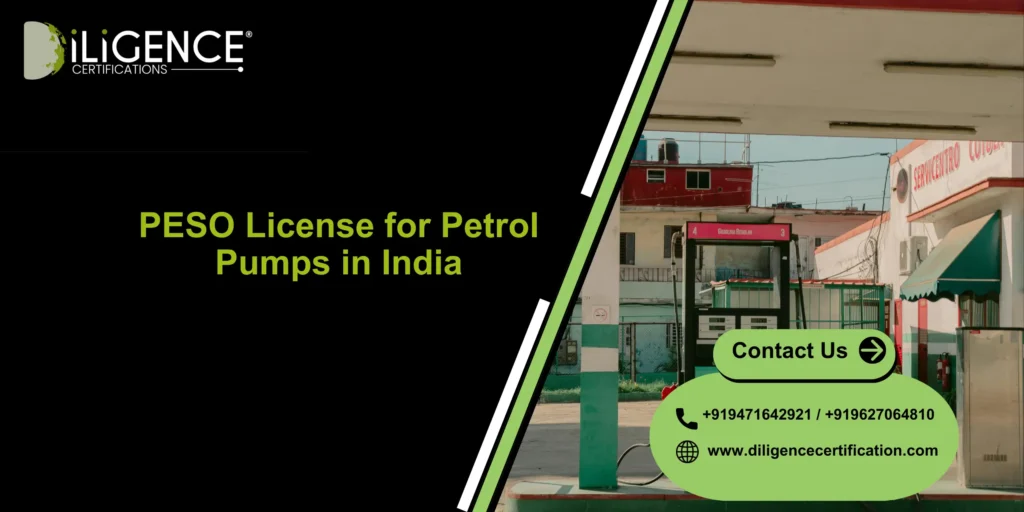
By - APESO License for Petrol Pumps is mandatory for petrol pumps storing and dispensing petroleum products in India.
- Petrol pumps generally require approval under Petroleum Rules, 2002, including Form XIV for petroleum service stations.
- PESO checks safety arrangements related to underground tanks, dispensing units, pipelines, vents, fire safety, and site layout.
- Without PESO approval, a petrol pump may face rejection, delay, penalty, or closure risk.
- Proper documentation and site compliance reduce inspection issues and help in faster approval.
Introduction | PESO License for Petrol Pumps
PESO License for Petrol Pumps work with flammable fuels, such as petrol and diesel, there is always an element of safety concern regarding the process involved. To counter this issue, the Indian government regulates the operations of petrol pumps in India via the PESO, or Petroleum and Explosives Safety Organisation.
It would not be appropriate to assume that a petrol pump is similar to other businesses. This type of business requires careful site selection, storage tank, dispensing arrangement, fire and electrical safety measures, compliance with distance from structures, and approved drawings. The PESO License for Petrol Pumps guarantees that the fuel station is safe for employees, customers, structures, vehicles, and the environment.
What is PESO License for Petrol Pumps?
PESO Licence for Petrol Pumps is an authorization granted by law for storage of petroleum in tanks associated with pump arrangements which are utilized to fuel automobiles. The National Single Window System refers to Form XIV of the Petroleum Rules, 2002 for service stations dealing with petroleum.
This license is proof of compliance with petroleum storage guidelines, tank installation, dispensing units, pipelines, vents, electrical fittings, and fire protection.
Key points:
- It is required before operating a petrol pump legally.
- It applies to fuel stations storing and dispensing petroleum products.
- It verifies site safety and technical compliance.
- It is linked with Petroleum Rules, 2002.
- It helps prevent fire, explosion, leakage, and unsafe handling risks.
- It is important for both new petrol pumps and major site modifications.
Why is PESO License Required for Petrol Pumps?
Petrol and diesel are hazardous substances. Petrol vapour can easily catch fire if safety systems are not properly maintained. A small mistake in storage, venting, earthing, electrical wiring, or dispensing layout can create serious risk. PESO License is required to control these risks through proper technical approval and inspection.
Key points:
- To legally store petroleum at the fuel station.
- To ensure underground or above-ground tanks are installed safely.
- To verify distance norms from buildings, roads, drains, boundaries, and public areas.
- To confirm safe dispensing of fuel to motor vehicles.
- To reduce fire and explosion risks.
- To protect employees, customers, and nearby property.
- To avoid penalties, rejection, or business interruption.
- To build trust with oil companies, authorities, and customers.
Importance and Benefits of PESO License for Petrol Pumps
| Importance | Benefits |
| Legal approval | Allows petrol pump operation as per Petroleum Rules |
| Safety compliance | Reduces fire, leakage, and explosion risks |
| Approved layout | Ensures proper placement of tanks, dispensers, vents, and pipelines |
| Business continuity | Helps avoid shutdowns due to non-compliance |
| Inspection readiness | Makes the site prepared for authority checks |
| Public safety | Protects customers, workers, vehicles, and nearby areas |
| Better credibility | Builds confidence with oil marketing companies and regulators |
| Risk control | Reduces accident, insurance, and liability issues |
| Smooth operations | Helps maintain safe fuel storage and dispensing |
| Long-term compliance | Supports renewal, modification, and future expansion |
Process of Getting PESO License for Petrol Pumps
- Check applicability
First, confirm the type of petrol pump, fuel storage capacity, tank details, dispensing system, and applicable license form. - Collect basic documents
Prepare business details, site ownership or lease documents, identity proof, address proof, company documents, and fuel station details. - Prepare site layout and technical drawings
Drawings must show tanks, pump units, pipelines, vent pipes, buildings, boundaries, electrical rooms, driveways, roads, and safety distances. - Review safety requirements
Fire safety, earthing, electrical fittings, emergency access, tank installation, and ventilation must be checked before submission. - Submit application
The application is filed with the required documents, drawings, and technical details through the applicable PESO/NSWS route. - Document scrutiny
PESO reviews the application, drawings, and supporting documents. If any issue is found, clarification or correction may be asked. - Site inspection if required
PESO officials may inspect the petrol pump site to verify actual installation and safety compliance. - Correction of observations
If PESO raises observations, the applicant must correct them properly and submit compliance. - License approval
After successful review and compliance, PESO issues the license for petrol pump operation. - Post-license compliance
The petrol pump must maintain safety standards, renew the license on time, and inform authorities before major modifications.
Common Documents Required
- Application form
- Business registration documents
- GST certificate, if applicable
- Identity and address proof
- Site ownership, lease, or possession document
- Approved site layout plan
- Tank details and capacity
- Pump and dispenser details
- Pipeline and venting details
- Fire safety details
- NOC or approvals from other authorities, if applicable
- Oil marketing company-related documents, if applicable
- Technical drawings signed by competent persons, where required
Challenges of Getting This Certification Without a Consultant
Getting PESO License for petrol pumps can be difficult if the applicant does not understand technical safety rules and documentation. Even a small error in layout, tank distance, document format, or application details can lead to delay or rejection.
Key challenges:
- Selecting the wrong license category or form.
- Incorrect site layout or missing technical details.
- Non-compliance with safety distance requirements.
- Incomplete tank, pipeline, and dispenser information.
- Missing fire safety and electrical safety details.
- Delay in replying to PESO observations.
- Difficulty understanding Petroleum Rules, 2002.
- Poor coordination between civil, electrical, safety, and documentation teams.
- Risk of inspection failure due to site mismatch.
- Lack of renewal and post-approval compliance planning.
Why Choose Diligence Certification for PESO License for Petrol Pumps?
Diligence Certification provides professional support for PESO License for Petrol Pumps businesses that need PESO License for petrol pumps in India. Our team helps clients understand applicability, prepare documents, review technical details, coordinate drawings, and manage the complete application process.
Key points:
- End-to-end PESO licensing support.
- Proper guidance on petrol pump license requirements.
- Assistance in document preparation and application filing.
- Technical review of site layout and safety details.
- Support for PESO queries and observations.
- Coordination for faster and smoother approval.
- Help in avoiding common mistakes and rejection risks.
- Support for renewals, amendments, and compliance updates.
- Experienced team for petroleum and hazardous material approvals.
- Practical guidance for petrol pump owners, operators, and businesses.
Conclusion
PESO License for Petrol Pumps in India is not only a legal requirement but also a major safety approval. Since petrol pumps store and dispense flammable petroleum products, proper approval from PESO is essential before starting operations. The license helps ensure safe tank installation, safe dispensing, correct layout, fire protection, and compliance with Petroleum Rules.
For petrol pump owners and operators, getting PESO approval in the right way saves time, reduces risk, and protects the business from penalties or operational delays. With expert support from Diligence Certification, the complete process becomes easier, more accurate, and more reliable.
Frequently Asked Questions
What is PESO License for petrol pumps?
It is a legal approval required for storing and dispensing petroleum products at a petrol pump in India.
Is PESO License mandatory for petrol pumps?
Yes, petrol pumps need PESO approval because they store and handle flammable petroleum products.
Which form is used for petrol pump PESO License?
Petroleum service stations are linked with Form XIV under Petroleum Rules, 2002.
Who issues PESO License in India?
The license is issued by the Petroleum and Explosives Safety Organisation.
Why is PESO approval important for petrol pumps?
It ensures safety in fuel storage, dispensing, tank installation, and fire prevention.
Can a petrol pump operate without PESO License?
No, operating without required PESO approval can create legal and safety risks.
What documents are required for PESO petrol pump license?
Common documents include application form, site layout, tank details, business documents, ownership or lease proof, and safety details.
Does PESO inspect petrol pump sites?
Inspection may be required to verify actual site conditions and safety compliance.
Is PESO License required for petrol pump modification?
Yes, major changes in tanks, layout, storage capacity, or dispensing system may require approval or amendment.
How can Diligence Certification help?
Diligence Certification helps with documentation, application filing, technical review, PESO coordination, and approval support.