BIS Certification
 CDSCO
CDSCO
 PESO
PESO
 CPCB
CPCB
 LMPC
LMPC
 WPC Approval
 Global Approvals
 TEC
TEC
 ARAI
ARAI
 BEE
BEE
 ISO Certification
 DGCA Certification
 NOC For Steel
 APEDA Registration























 Business Registration
 FSSAI Mark Certification












 (32).jpg)
 Legal Services
 Trademark Registration
 Copyright Registration
 Patent Registration
 By
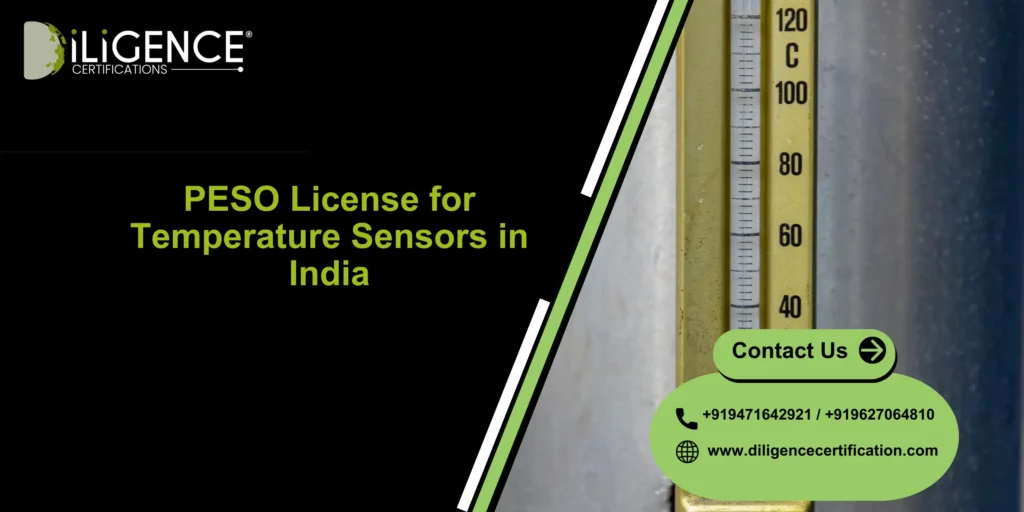
By - PESO License for Temperature Sensor used in hazardous areas such as petroleum, gas, chemical, and explosive environments.
- Temperature sensors used in explosive atmospheres must be approved as safe electrical apparatus before installation.
- PESO approval helps confirm that the sensor design, protection method, test reports, and technical drawings meet safety requirements.
- Importers, manufacturers, EPC contractors, and industrial users may need PESO approval before using or selling such sensors in India.
- Without proper PESO certification, equipment may face rejection, project delays, legal issues, and safety risks.
Introduction | PESO License for Temperature Sensor
These temperature sensors find application in refineries, gas plants, chemical works, storage facilities, fuel stations, pharmaceutical factories, and numerous other industries. Their primary function is monitoring temperature conditions so that equipment and process systems are able to function safely.
Where temperature sensors are employed in hazardous environments, it is insufficient for them merely to meet standard quality requirements. Rather, they should be constructed in such a way as to minimize any possibility of sparking or heat generation that could cause an ignition.
According to Indian regulations, all electrical apparatuses used in petroleum works and hazardous areas should receive approval from the Chief Controller of Explosives in accordance with relevant standards. According to PESO regulations, “all electrical apparatuses used in petroleum refining and storage installations, fuel stations and similar establishments are required to have prior approval.”
What is PESO Certification for Temperature Sensors?
PESO certificate for temperature sensors is the certification for the approval of temperature sensors meant for hazardous or explosive environments in India. This approval is proof that the sensor can be installed in hazardous or explosive environment since it will not ignite the presence of flammable gases, vapors, petroleum, or other materials that pose explosion risks.
Examples of temperature sensors are resistance temperature detectors, thermocouples, temperature transmitters, flameproof temperature sensors, intrinsically safe temperature sensors, among others. In case such temperature sensors are to be used in a hazardous location, PESO approval may be required depending on certain factors like its design, installation place, among others.
Approval of the sensor involves checking whether there are adequate documentation and other factors like quality documents.
Key Points
- PESO stands for Petroleum and Explosives Safety Organisation.
- It works under the Department for Promotion of Industry and Internal Trade, Government of India.
- PESO approval is required for Ex electrical apparatus used in hazardous areas.
- Temperature sensors may fall under Ex electrical equipment when used in explosive atmospheres.
- Approval helps prove that the product is safe for Indian hazardous-area use.
Why is PESO Certification Required for Temperature Sensors?
PESO certification is mandatory as temperature sensors are usually mounted in hazardous areas in industries. In such areas, a spark or heating parts can result in fire, explosion, damage to equipment, or injury to people.
A temperature sensor might appear uncomplicated in its design, but it is connected to other equipment like circuits, transmitters, wires, junction boxes, and control systems. Without proper design to cater to hazardous areas, the temperature sensor might ignite a spark.
PESO certification ensures that the product undergoes evaluation before being mounted in such hazardous places. PESO certification will help the industry comply with Indian laws and plant safety regulations.
Certifications from international organizations like ATEX or IECEx may assist in the application process, but in India, it is mandatory to get separate PESO certification for such products intended for hazardous areas.
Key Points
- It is required for hazardous-area safety.
- It supports legal compliance in India.
- It reduces fire and explosion risks.
- It helps manufacturers and importers sell approved products.
- It protects industrial users from using unsafe equipment.
- It supports project approvals, audits, and inspections.
Importance and Benefits of PESO Certification
| Importance | Benefits |
| Legal compliance | Helps meet Indian safety approval requirements for hazardous areas. |
| Product safety | Confirms that the sensor is suitable for explosive atmospheres. |
| Market acceptance | Helps manufacturers and importers sell to Indian industrial buyers. |
| Project approval | Supports approval in refinery, gas, chemical, and petroleum projects. |
| Risk reduction | Reduces chances of fire, explosion, rejection, and unsafe installation. |
| Customer trust | Builds confidence among EPC contractors, plant owners, and safety teams. |
| Import clearance support | Helps importers prove product compliance where required. |
| Documentation strength | Creates a clear approval record for audits and inspections. |
| Competitive advantage | Makes the product more acceptable for regulated industrial use. |
| Long-term compliance | Supports safer operation, maintenance, and renewal planning. |
Process of PESO Certification for Temperature Sensors
The PESO certification process depends on whether the product is manufactured in India or imported from another country. The process may also vary based on the type of sensor, protection method, test certificate, product marking, and existing international approvals.
Step 1: Product Applicability Check
First, the product is checked to confirm whether PESO approval is required. This includes reviewing the product type, use area, hazardous zone, protection method, and technical specifications.
Step 2: Document Collection
The manufacturer or importer must collect technical and legal documents. These may include product drawings, test reports, Ex certificate, quality certificate, company documents, authorization letter, product catalogue, user manual, and declaration.
Step 3: Review of Test Reports and Certificates
PESO generally requires valid test certificates and reports from accepted laboratories or certification bodies. For Ex equipment, the protection type and standard compliance must match the intended hazardous-area use.
Step 4: Preparation of Application
The PESO application is prepared with complete product details, manufacturer information, model numbers, ratings, markings, certificate references, and supporting documents.
Step 5: Online Filing
The application is submitted through the required PESO process. The official SOP for Ex electrical apparatus includes online application and supporting documents such as test certificates, test reports, and certified drawings.
Step 6: Department Review
PESO reviews the application, documents, technical details, and compliance evidence. If any issue is found, clarification or additional documents may be requested.
Step 7: Query Resolution
If PESO raises a query, the applicant must respond with correct technical explanations and revised documents where needed.
Step 8: Approval Grant
After successful review, PESO grants approval for the specific temperature sensor model, protection type, rating, and intended use.
Step 9: Compliance Maintenance
After approval, the manufacturer or importer must maintain product consistency, correct marking, valid certificates, and approval conditions.
Challenges of Getting This Certification Without a Consultant
Getting PESO certification for temperature sensors without expert help can be difficult because the process is highly technical. It is not just a normal registration. It involves hazardous-area classification, Ex protection concepts, test reports, drawings, product markings, legal documents, and regulatory interpretation.
Many applications get delayed because of incorrect product details, mismatch in model numbers, incomplete drawings, wrong certificate references, or unclear authorization documents.
Key Challenges
- Difficulty in identifying whether PESO approval is applicable.
- Confusion between ATEX, IECEx, and PESO requirements.
- Incorrect selection of product category or protection type.
- Missing or incomplete test reports.
- Errors in certified drawings and product markings.
- Mismatch between catalogue, certificate, and application details.
- Delays due to technical queries from the department.
- Lack of understanding of hazardous-area terminology.
- Difficulty in handling foreign manufacturer documentation.
- Risk of rejection because of weak application preparation.
Why Choose Diligence Certification for PESO certification for temperature sensors?
Diligence Certification helps manufacturers, importers, and industrial suppliers manage PESO certification for temperature sensors in a structured and professional way. Our focus is to make the approval process clear, accurate, and less stressful for your business.
We support the complete process from applicability checking to documentation, application preparation, filing support, query handling, and approval coordination. This helps reduce avoidable delays and improves the quality of your submission.
Key Points
- Expert guidance for PESO and hazardous-area equipment approval.
- Proper review of temperature sensor specifications and Ex markings.
- Support for Indian and foreign manufacturers.
- Assistance in documentation, filing, and technical query handling.
- Better coordination for test reports, drawings, and certificates.
- Clear process planning from start to approval.
- Reduced risk of rejection due to documentation mistakes.
- End-to-end support for importers, manufacturers, and project suppliers.
- Practical compliance advice for petroleum, gas, and industrial applications.
- Reliable post-approval support for future compliance needs.
Conclusion
PESO certification for temperature sensors in India is important when the sensors are used in hazardous areas where petroleum, gas, vapours, chemicals, or explosive atmospheres may be present. It is not only a regulatory formality but also a safety requirement.
A certified temperature sensor gives confidence to plant owners, importers, manufacturers, EPC contractors, and safety teams. It confirms that the product has been reviewed for hazardous-area use and is suitable for regulated industrial environments.
Because the process involves technical documents, Ex certificates, drawings, and regulatory checks, professional support can save time and reduce errors. Diligence Certification helps businesses complete PESO certification for temperature sensors with proper planning, accurate documentation, and complete application support.
Frequently Asked Questions
What is PESO certification for temperature sensors?
PESO certification for temperature sensors is an approval required for sensors used in hazardous or explosive areas in India.
Is PESO approval mandatory for all temperature sensors?
No. It is mainly required when the temperature sensor is used in hazardous areas covered under applicable petroleum, gas, or explosive safety rules.
Which industries need PESO-approved temperature sensors?
Refineries, gas plants, chemical factories, petroleum storage terminals, fuel stations, pharmaceutical plants, and hazardous process industries may need them.
Can ATEX or IECEx replace PESO approval in India?
No. ATEX or IECEx may support the application, but Indian hazardous-area use generally needs PESO approval where applicable.
What documents are required for PESO certification?
Documents may include test reports, Ex certificates, certified drawings, product catalogue, user manual, company documents, authorization letter, and technical specifications.
Who can apply for PESO certification?
Indian manufacturers, importers, authorized Indian representatives, or companies dealing with hazardous-area equipment can apply, depending on the case.
How long does PESO certification take?
The timeline depends on document readiness, product type, test reports, application accuracy, and department queries.
Why do PESO applications get delayed?
Applications often get delayed due to incomplete documents, wrong markings, certificate mismatch, unclear drawings, or pending technical clarifications.
Does every model of temperature sensor need approval?
Approval is generally model-specific or series-specific, depending on design, rating, protection method, and certificate coverage.
How can Diligence Certification help?
Diligence Certification supports applicability checks, documentation, application filing, technical review, query handling, and approval coordination for PESO certification.