BIS Certification
 CDSCO
CDSCO
 PESO
PESO
 CPCB
CPCB
 LMPC
LMPC
 WPC Approval
 Global Approvals
 TEC
TEC
 ARAI
ARAI
 BEE
BEE
 ISO Certification
 DGCA Certification
 NOC For Steel
 APEDA Registration























 Business Registration
 FSSAI Mark Certification












 (32).jpg)
 Legal Services
 Trademark Registration
 Copyright Registration
 Patent Registration
 By
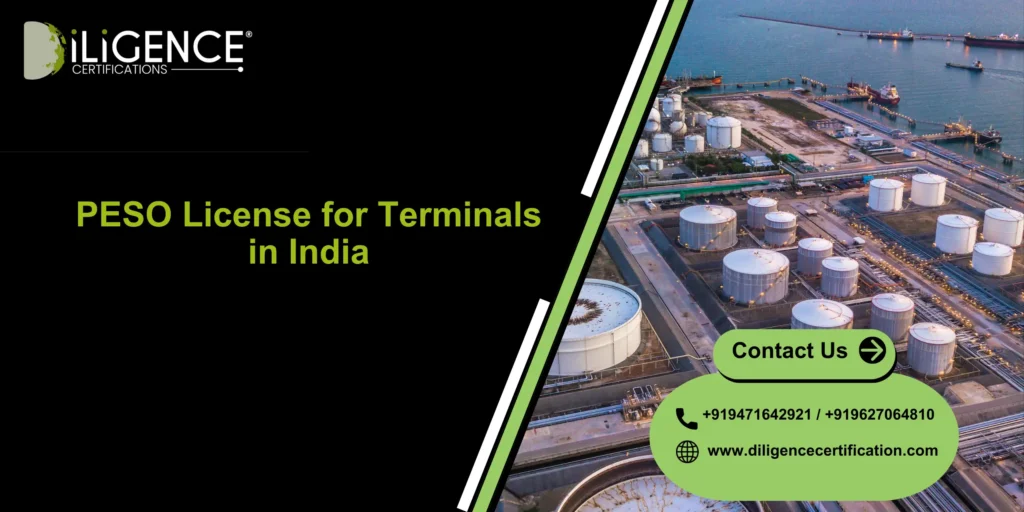
By - PESO License for Terminals is required for safe storage, handling, loading, unloading, and transfer of petroleum or hazardous products at terminal facilities.
- PESO works under the Petroleum and Explosives Safety Organisation, which regulates petroleum, explosives, gas cylinders, pressure vessels, and related hazardous operations in India.
- Terminals must follow safety rules related to tank design, fire protection, electrical fittings, pipelines, distance norms, emergency systems, and operational control.
- Without PESO approval, terminal operations may face legal restrictions, safety risks, inspection objections, business delays, or closure.
- A consultant helps prepare documents, drawings, safety details, NOC coordination, application filing, and inspection support to reduce rejection risk.
Introduction | PESO License for Terminals
The terminal is an important facility utilized for the receipt, storage, transfer, loading, and distribution of petroleum products, chemicals, gases, or any other hazardous substance regulated by law. Such terminals can be linked with ports, refineries, depots, pipelines, transport infrastructure, or industrial supply chains. Since the terminals work with hazardous material, safety clearance cannot be ignored. PESO License for Terminals in India is a mandatory requirement to ensure that the terminal is designed, installed, and maintained in accordance with safety standards.
The emphasis of PESO is laid on fire safety, explosion safety, leakage safety, environmental safety, and public safety. The PESO portal contains statutory information, SOPs, and regulatory clearances related to petroleum and explosives safety in India. Companies dealing with petroleum terminals, fuel terminals, LPG terminals, chemical terminals, or storage and handling terminals require PESO approval.
A duly licensed terminal enhances legal security, safety, client confidence, and business sustainability.
What is a PESO License for Terminals?
A PESO License for Terminals is an official approval issued for facilities that store, handle, transfer, load, unload, or distribute petroleum products, gases, or other regulated hazardous materials. The license confirms that the terminal layout, tanks, pipelines, loading arms, safety systems, electrical equipment, fire protection arrangements, and operating procedures comply with applicable safety rules.
Key points:
- It applies to terminals handling petroleum, LPG, flammable liquids, gases, and other regulated hazardous substances.
- It covers storage tanks, pipelines, dispensing or loading systems, unloading bays, and safety infrastructure.
- It checks whether the terminal follows distance norms, fire safety requirements, and approved layout drawings.
- It helps prevent accidents caused by leakage, vapor accumulation, static electricity, wrong fittings, or poor handling.
- It is important for importers, storage operators, oil companies, port terminal operators, logistics businesses, and industrial users.
Why is PESO License for Terminals Required?
PESO License for Terminals is required because terminals involve hazardous operations that can create serious fire, explosion, leakage, and public safety risks. A terminal is not only a storage point; it is also a transfer and handling point where product movement happens through tankers, pipelines, pumps, valves, loading arms, and control systems. Any mistake in design or operation can create major safety consequences.
Key points:
- To legally store and handle petroleum or hazardous substances.
- To ensure safe terminal design and approved technical layout.
- To protect workers, nearby properties, vehicles, and public areas.
- To comply with fire safety, electrical safety, and emergency control requirements.
- To avoid legal penalties, shutdowns, application rejection, or operational delay.
- To support insurance, customer contracts, vendor approvals, and business credibility.
Importance and Benefits of PESO License for Terminals
| Importance | Benefits |
| Legal compliance | Allows terminal operations under applicable PESO safety rules. |
| Safety assurance | Reduces risk of fire, explosion, leakage, and unsafe handling. |
| Business continuity | Helps avoid operational stoppage due to missing approvals. |
| Regulatory confidence | Shows that the facility has followed required safety norms. |
| Better infrastructure control | Ensures correct tank layout, pipeline design, safety fittings, and fire systems. |
| Inspection readiness | Helps the business face PESO inspection with proper documentation. |
| Market credibility | Builds trust with oil companies, logistics partners, industrial clients, and authorities. |
| Risk reduction | Reduces chances of accidents caused by poor design or non-compliant equipment. |
| Insurance support | Licensed and compliant facilities are easier to assess for risk coverage. |
| Long-term operations | Supports renewals, expansions, modifications, and future approvals. |
Process to Get PESO License for Terminals in India
The PESO License for Terminals process may vary depending on the type of terminal, product category, storage capacity, tank type, location, and applicable rules. However, the general process follows a structured compliance route.
1. Product and Applicability Check
The first step is to identify the product stored or handled at the terminal. This may include petrol, diesel, LPG, naphtha, chemicals, flammable liquids, or other hazardous substances. The class of product, flash point, quantity, and storage method decide the approval requirement.
2. Site and Layout Review
The terminal site must be checked for surrounding area, road access, boundary distance, nearby buildings, fire risk, public safety, and environmental conditions. Proper site planning is important before applying for PESO approval.
3. Preparation of Technical Drawings
Technical drawings are a major part of PESO approval. These may include site layout, tank layout, piping arrangement, loading and unloading area, safety distance, fire protection system, electrical area classification, and emergency facilities.
4. Document Collection
Documents generally include company details, land documents, site plan, safety documents, NOC, technical specifications, tank details, equipment details, fire safety arrangements, and authorization documents. The exact list depends on the terminal type.
5. NOC and Local Approvals
Depending on the location and product, the applicant may require local authority NOC, fire department approval, pollution-related documents, land-use confirmation, or other supporting permissions.
6. Application Filing
After document preparation, the application is submitted to PESO through the prescribed process. The application must be accurate because errors in product details, capacity, drawings, or safety distance may lead to objections.
7. Technical Scrutiny by PESO
PESO reviews the application, layout, drawings, documents, safety systems, and technical compliance. If there are gaps, objections may be raised and must be corrected properly.
8. Site Inspection
PESO officials may inspect the terminal to verify construction, storage tanks, safety equipment, electrical fittings, fire systems, loading area, pipeline arrangement, and compliance with approved drawings.
9. Query Resolution
If PESO raises any technical query, the applicant must submit corrections, clarifications, revised drawings, or additional documents. Proper reply is important to avoid delay.
10. License Grant
Once PESO is satisfied with the documents, layout, inspection, and safety compliance, the license is granted. The license must be maintained, renewed, and updated if there are modifications or capacity changes.
Common Documents Required
The document requirement depends on PESO License for Terminals category, product, capacity, and location. Common documents may include:
- Company registration documents
- Applicant identity and authorization proof
- Land ownership, lease, or possession documents
- Site layout plan
- Storage tank details and drawings
- Pipeline and loading/unloading arrangement
- Safety distance details
- Fire safety plan
- Electrical safety details
- NOC from local authority, if applicable
- Factory license or trade license, if applicable
- Pollution control documents, if applicable
- Technical specifications of tanks, pumps, valves, and fittings
- Emergency response plan
- Undertaking or declaration as required
- Previous approval, if renewal or amendment is involved
Challenges of Getting PESO License for Terminals Without a Consultant
Getting a PESO License for Terminals without expert support can be difficult because terminal compliance is highly technical. It is not limited to filling an application form. The facility design, drawings, safety distance, tank specification, fire system, electrical equipment, and operational plan must match regulatory expectations.
Key challenges:
- Wrong selection of product class or license category.
- Incomplete or technically weak layout drawings.
- Lack of clarity about safety distance requirements.
- Missing local NOC or supporting approvals.
- Non-compliant electrical fittings or hazardous area equipment.
- Confusion in tank capacity, pipeline layout, and loading area details.
- Poor documentation during inspection.
- Delay in replying to PESO objections.
- Risk of rejection due to mismatch between drawing and actual site.
- Difficulty in handling amendments, renewals, or capacity expansion.
For terminal businesses, such mistakes can affect project timelines, investment planning, and operational readiness.
Why Choose Diligence Certification for PESO License for Terminals?
Diligence Certification provides professional compliance support for businesses that need PESO License for Terminals in India. Terminal licensing requires technical understanding, document accuracy, coordination with authorities, and practical knowledge of safety compliance. A small mistake in layout, product category, or document filing can delay the approval.
Diligence Certification helps simplify the process from applicability check to license support PESO License for Terminals. The team assists with documentation, application filing, drawing coordination, technical review, query handling, and inspection support. This helps businesses reduce confusion and move through the approval process in a more organized way.
Key reasons to choose Diligence Certification:
- End-to-end support for PESO licensing and regulatory compliance.
- Guidance for petroleum, LPG, gas, chemical, and hazardous storage terminal approvals.
- Assistance in document preparation and application filing.
- Coordination for layout drawings and technical compliance.
- Support for PESO queries, objections, and inspection preparation.
- Practical guidance for renewals, amendments, and expansion approvals.
- Experience in handling complex regulatory documentation.
- Focus on reducing rejection risk and approval delays.
- Clear communication and structured compliance process.
- Support for Indian and global businesses entering regulated markets.
Safety Compliance Points for Terminal Operators
Terminal operators should not treat PESO License for Terminals as a one-time approval. Compliance must continue after the license is granted. Any modification in tanks, capacity, product category, pipeline route, safety system, or layout may require approval or amendment.
Important safety compliance points include:
- Maintain approved layout and do not make unauthorized modifications.
- Keep fire safety systems functional and regularly checked.
- Use approved electrical equipment in hazardous areas.
- Train workers for emergency response and safe handling.
- Maintain proper signage, warning boards, and restricted access.
- Keep records of inspection, maintenance, and safety checks.
- Ensure tankers and loading operations follow safety procedures.
- Monitor leakage, pressure, vapor control, and grounding systems.
- Renew the license before expiry.
- Inform authorities before major changes in storage or operations.
A terminal can remain compliant only when safety systems, documentation, and daily operations are managed properly.
Conclusion
PESO License for Terminals in India is an essential approval for businesses involved in storage, handling, loading, unloading, or transfer of petroleum products, LPG, gases, chemicals, or other regulated hazardous substances. Since terminals handle large quantities and high-risk operations, PESO approval ensures that the facility follows safety standards related to layout, tanks, pipelines, fire protection, electrical systems, and emergency control.
A properly licensed terminal gives legal permission, improves safety, builds business credibility, and supports smooth operations. However, the process can be technical and document-heavy. Errors in drawings, NOC, product classification, or site compliance can create delays. Working with an experienced compliance consultant helps businesses complete the approval process with better accuracy and confidence.
For terminal operators, PESO compliance is not only a legal requirement. It is a safety responsibility and a business necessity.
Frequently Asked Questions
What is a PESO License for Terminals?
PESO License for Terminals is an approval required for facilities that store, handle, load, unload, or transfer petroleum, gas, or hazardous substances in India.
Is PESO License mandatory for petroleum terminals?
Yes, petroleum terminals generally require PESO approval because they involve storage and handling of flammable and regulated products.
Who issues PESO License in India?
The license is issued by the Petroleum and Explosives Safety Organisation, which regulates petroleum, explosives, gases, and related hazardous operations in India.
What types of terminals need PESO approval?
Fuel terminals, LPG terminals, oil terminals, chemical terminals, petroleum storage terminals, and hazardous material handling terminals may require PESO approval.
What documents are required for PESO terminal license?
Common documents include company details, land papers, site layout, tank details, safety drawings, fire safety documents, NOC, and technical specifications.
How long does PESO License approval take?
The timeline depends on product type, site readiness, document accuracy, technical scrutiny, inspection, and query resolution.
Can a terminal operate without PESO License?
Operating without required PESO approval can create legal, safety, and business risks, including objections, penalties, or operational restrictions.
Is site inspection required for PESO License?
Yes, inspection may be required to verify that the terminal is built and maintained as per approved drawings and safety requirements.
Is PESO License renewal required?
Yes, PESO licenses must be renewed as per validity conditions. Any change in capacity, product, or layout may also require amendment.
Why hire a consultant for PESO License for Terminals?
A consultant helps with documentation, drawings, application filing, technical coordination, inspection support, and query handling to reduce delay and rejection risk