BIS Certification
 CDSCO
CDSCO
 PESO
PESO
 CPCB
CPCB
 LMPC
LMPC
 WPC Approval
 Global Approvals
 TEC
TEC
 ARAI
ARAI
 BEE
BEE
 ISO Certification
 DGCA Certification
 NOC For Steel
 APEDA Registration























 Business Registration
 FSSAI Mark Certification












 (32).jpg)
 Legal Services
 Trademark Registration
 Copyright Registration
 Patent Registration
 By
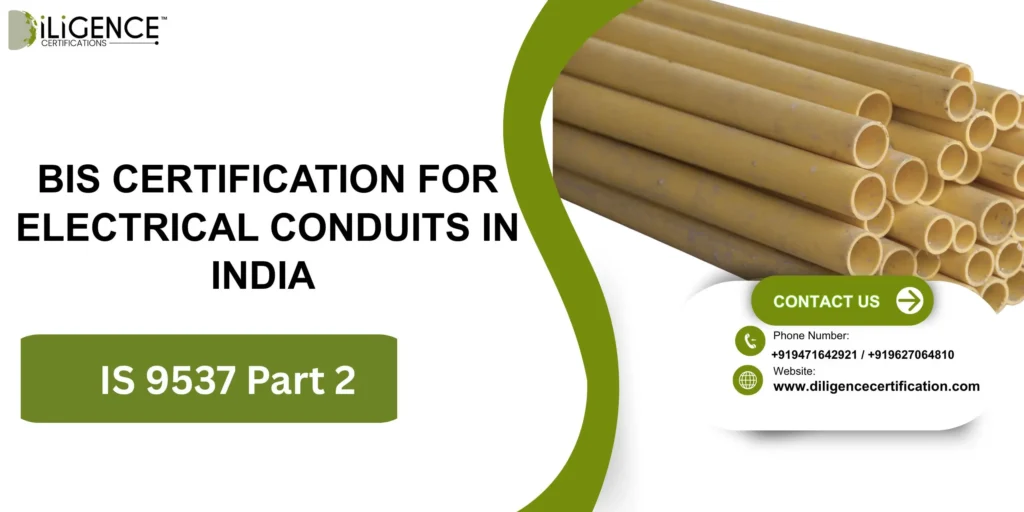
By IS 9537 Part 2 defines the standards that rigid non-metallic electrical conduits have to meet in terms of their material properties, mechanical strength, flame resistance, impact resistance, and dimensional accuracy.
BIS certification is a sign of the product quality and safety, thus providing the most dependable protection of the electrical wiring systems against mechanical damages, heat, moisture, and fire hazards.
The ISI mark is compulsory for the production or import of electrical conduits in India. Hence, it is a necessary condition for legal compliance and consumer safety.
Getting BIS certification is an organized procedure where every point is important-paperwork, product testing, factory inspection, approval, and licence granting. Standard-compliant conduits facilitate brand trust, lower the risk of installation failures, and ensure the safety of the electrical system over time in residential, commercial, and industrial projects.
Introduction
Electrical conduits are essential components that help in shielding the wiring systems of the electricity from scenarios like getting damaged by the exterior, absorbing water, heating up, and fire hazards. The quality of the conduits used in any building or infrastructure project these days is the factor that mostly determines the level of electrical safety and system reliability.
Among the popular choices for electrically insulated and long lasting protective coverings for wiring are rigid non-metallic conduits which are generally made of PVC.
Such conduits, if put to use in harsh environments, should according to standard IS 9537 Part 2 be capable of meeting at least the specified requirements with regard to their mechanical, thermal, and dimensional characteristics. A conduit so equipped with a BIS certification mark from the Bureau of Indian Standards meets the criteria of being not only safe and durable but also of being the right kind of installation for the electrical wiring that is going to be in use for a long time anywhere in India. Bureau of Indian Standards
What are Electrical Conduits IS 9537 Part 2?
Electrical Conduits
IS 9537 Part 2 is an Indian Standard that lays down the attribute requirements for non-metallic rigid electrical conduits used in the installations. The standard specifies parameters related to:
- Material composition - The absolute requirement for the material to be strong electrically and durable.
- Mechanical properties - The material should be capable of withstanding an impact and give a high value for the crushing strength.
- Flame retardance - The material should be of a type that will emit less flame and less smoke thus reducing fire hazards.
- Heat resistance - The material should be able to keep its shape and functioning even after being at a high temperature for some time.
- Dimensional accuracy - The conduit’s diameter, thickness, and dimensions have to be in conformance with the standard.
- Surface finish - The surface of the conduit has to be smooth, consistent, and free from any defects.
- Testing and inspection methods - The methods used for the testing and inspection have to give the same quality for all the production batches.
With the use of IS 9537 Part 2, electrical conduits are able to keep their mechanical strength, insulation properties, and safety features stable during their service period.
ISI Mark Certification for Electrical Conduits
Conforming to IS 9537 Part 2 are electrical conduits that are covered under the ISI Mark Certification Scheme and are the ones which can be sold and used in India in a legal way. BIS certification is a guarantee of:
- Compliance with the safety and performance standards set out in the regulations
- Safe and secure electrical wiring system installations
- The product is durable and resistant to mechanical, thermal, and fire hazards
- There is a consistent level of quality control during every batch of production
- These can be accepted in housing, business and government sectors projects
Once in possession of a valid BIS licence, manufacturers and importers are allowed to put the ISI mark on their products.
Why is BIS Certification Mandatory for Electrical Conduits?
Employing non-certified electrical conduits may bring about the following major risks:
- Conduits cracking or deforming when they are subjected to a stressful situation or heated
- Elevated chance of electrical short circuits and fire outbreaks
- Deterioration of the insulation and eventual damage of the wiring
- Increased costs of maintenance and replacement
- Project rejection resulting from regulatory non-compliance
BIS certification is an indication of:
- Complete conformity with IS 9537 Part 2
- The certified product can resist mechanical, thermal, and environmental stresses
- Improved safety of the electrical installation
- The certified product is accepted by the market and given the legal approval
- It is capable of serving and performing well for a long period of time
Importance and Benefits of BIS Certification
| Importance | Benefits |
| Compliance with IS 9537 Part 2 | Ensures electrical safety and insulation reliability |
| Standardized manufacturing | Maintains consistent quality and performance |
| Mechanical and thermal reliability | Reduces risk of conduit failure |
| Regulatory compliance | Prevents legal penalties and project rejection |
| Brand credibility | Builds customer trust and market reputation |
Step-by-Step BIS Certification Process
Step 1: Documentation
Collect the informative details about the company, the manufacturing process, product specifications, and quality control documents that conform to BIS standards.
Step 2: Product Testing
Samples of electrical conduits are tested for various attributes such as impact resistance, flame retardance, heat resistance, and dimensional accuracy in laboratories that are recognized by BIS.
Step 3: Application Submission
File the BIS application along with the test reports and other supporting documents at the online BIS portal.
Step 4: Scrutiny & Factory Inspection
The factory where officers of BIS conduct inspection to confirm if the production processes, testing facilities, and quality control systems are as per the standards.
Step 5: Grant of Licence
BIS issues the licence that permits the use of the ISI mark on the certified electrical conduits after a successful inspection and compliance verification.
Documents Required for BIS Certification
- Company registration and incorporation certificates
- Manufacturing unit address and layout details
- Manufacturing process flow chart
- Product technical specifications and drawings
- List of manufacturing and testing equipment
- Test reports from laboratories accredited by BIS
- Quality control procedures
- If applicable, brand authorization or trademark documents
Timeline, Validity & Renewal
Certification Timeline: 25-35 working days (testing and inspection dependent)
Licence Validity: 1-2 years
Conclusion
BIS Certification for Electrical Conduits in India as per IS 9537 Part 2 is very much indicative of the product being safe, of good quality, and performing well. The certified conduits are the ones that can be counted on to provide good insulation, be resistant to mechanical and thermal stresses, and ensure electrical safety for a long time.
In a country where the safety of the electrical installation is regulated by very strict rules, the use of BIS-certified conduits is not only a legal obligation-it is a wise security, reliability, and brand image investment. Compliance with IS 9537 Part 2 is beneficial to manufacturers, builders, and contractors as it allows them to provide safer electrical installations and thus, gain the trust of customers and achieve business growth in the long run.
Frequently Asked for Questions
What is BIS Certification for electrical conduits?
Through this, safety and quality of the electrical conduits are confirmed based on IS 9537 Part 2.
What are electrical conduits IS 9537 Part 2?
These are non-metallic rigid conduits that adhere to requirements of mechanical, thermal, and dimensional standards.
Why is BIS Certification mandatory for electrical conduits?
That is the only way to keep users safe from harm, meet legal requirements, and have product quality stable.
What are the benefits of BIS-certified electrical conduits?
Among other things, they are long-lasting, non-flammable, and good electrical insulators.
Which materials are used for non-metallic electrical conduits?
The single most widely used material is rigid PVC for the purposes of strength and safety.
What are the tests for BIS Certification for Electrical Conduits?
They include impact resistance, flame retardance, heat resistance, and dimensional accuracy.
Are non-certified electrical conduits allowed to be used?
Using them will cause safety problems and legal issues.
How long is a BIS Certification valid for electrical conduits?
BIS certification for electrical conduits is valid for about 1-2 years before it needs to be renewed.
What are the documents required for BIS Certification of electrical conduits?
These documents include company registration, product specification, test report, and quality control documents.
How does BIS Certification improve electrical safety?
In this way, elements such as fire, heat, and mechanical stress will be resistant to the conduits ensuring they are safe for a long period.