BIS Certification
 CDSCO
CDSCO
 PESO
PESO
 CPCB
CPCB
 LMPC
LMPC
 WPC Approval
 Global Approvals
 TEC
TEC
 ARAI
ARAI
 BEE
BEE
 ISO Certification
 DGCA Certification
 NOC For Steel
 APEDA Registration























 Business Registration
 FSSAI Mark Certification












 (32).jpg)
 Legal Services
 Trademark Registration
 Copyright Registration
 Patent Registration
 By
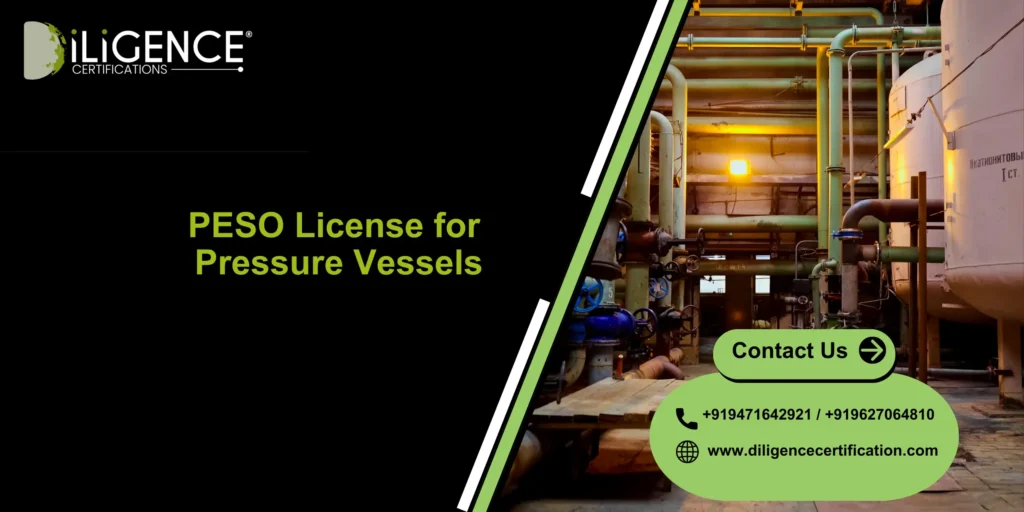
By - PESO License for Pressure Vessels is required for pressure vessels used for storing or transporting compressed gases and cryogenic liquids under SMPV(U) Rules, 2016.
- Pressure vessels must meet approved design, construction, testing, inspection, safety fitting, marking, and installation requirements.
- PESO compliance helps prevent gas leakage, bursting, fire, explosion, and unsafe industrial operation.
- Manufacturers, importers, installers, users, and operators may need PESO approval depending on the activity and vessel use.
- Correct documentation, drawings, test certificates, inspection reports, and competent person certification are important for approval.
Introduction
Pressure vessels are widely used in industries where gases, liquids, or vapours are stored under pressure. These vessels are common in oil and gas, chemical plants, LPG installations, CNG stations, LNG facilities, oxygen plants, manufacturing units, hospitals, and industrial storage systems. Because these vessels operate under high pressure, even a small design error, leakage, wrong fitting, or poor installation can create serious safety risks.
In India, the Petroleum and Explosives Safety Organisation, known as PESO, regulates the safety approval of pressure vessels used for compressed gases and related hazardous applications. The main regulatory framework is the Static and Mobile Pressure Vessels (Unfired) Rules, 2016, also known as SMPV(U) Rules, 2016. PESO’s own SOP states that these rules cover storage and transportation of compressed gases, including cryogenic liquids, in static and mobile pressure vessels.
What is PESO License for Pressure Vessels?
A PESO License for Pressure Vessels is a formal license needed for the manufacture, installation, storage, transportation, and use of specific static or mobile non-fired pressure vessels. The vessels are used in containing gases or liquids under pressure and are governed by stringent safety regulations before they can be put into use.
The pressure vessels may comprise LPG bullets, air receivers, cryogenic cylinders, CNG cascades, chlorine cylinders, ammonia tanks, nitrogen vessels, oxygen tanks, and other industrial vessels that are used for storing or transporting compressed gases.
Key points:
- PESO regulates pressure vessels to ensure safe design, fabrication, testing, installation, and operation.
- Static pressure vessels are fixed at one location, while mobile pressure vessels are used for transportation.
- The approval applies mainly to unfired pressure vessels, not boilers.
- The vessel must be designed and tested as per accepted codes such as IS 2825, ASME Section VIII, PD5500, EN standards, or other standards accepted by the Chief Controller, as stated in PESO’s SMPV FAQ.
- Approval is not only a legal formality; it is a safety requirement for high-risk industrial equipment.
Why is PESO License Required for Pressure Vessels?
PESO License is mandatory since pressure vessels have the potential to become hazardous due to improper design, testing, maintenance, and operation. The high pressure within the vessels leads to bursting, leakage, fires, explosions, poisonous gas releases, and severe accidents in the workplace. The PESO License guarantees the use of vessels which are technically safe and compliant in India.
SMPV(U) Rules, 2016 include both static and mobile pressure vessels for storage and transportation of compressed gases and cryogenic liquids. Therefore, PESO compliance is necessary in industries handling gases under pressure.
Key points:
- It ensures the vessel is designed as per accepted engineering standards.
- It verifies that fabrication, welding, testing, and inspection are properly completed.
- It confirms that safety fittings such as pressure relief valves, gauges, and emergency systems are installed correctly.
- It reduces accident risks during storage, filling, handling, and transportation.
- It helps companies avoid legal issues, operational shutdowns, rejection of equipment, and penalties.
Importance and Benefits of PESO License for Pressure Vessels
| Importance | Benefits |
| Legal compliance | Helps industries operate pressure vessels as per Indian regulatory requirements. |
| Safety assurance | Reduces risk of leakage, bursting, fire, explosion, and gas release. |
| Technical approval | Confirms that the vessel design, drawings, test certificates, and inspection reports are acceptable. |
| Industrial acceptance | Builds trust with clients, plant owners, contractors, and government departments. |
| Import support | Helps importers bring pressure vessels into India with proper regulatory approval. |
| Operational continuity | Prevents delays in commissioning, installation, and commercial operation. |
| Quality control | Ensures that the pressure vessel is manufactured and tested under proper technical supervision. |
| Risk reduction | Protects workers, nearby assets, machinery, and public safety. |
| Business credibility | Shows that the company follows recognised safety and compliance standards. |
| Long-term support | Helps with renewals, inspections, modifications, and future compliance requirements. |
PESO License Process for Pressure Vessels
The PESO approval process depends on the type of vessel, use, location, capacity, pressure rating, gas handled, and whether the vessel is manufactured in India or imported. However, the general process follows a structured compliance route.
- Applicability Check
First, the vessel type, gas, pressure, capacity, usage, and installation site are reviewed to confirm whether PESO approval is required under SMPV(U) Rules. - Document Collection
Required documents are collected, including company details, technical specifications, vessel drawings, design calculations, test certificates, material certificates, welding details, safety fitting details, inspection reports, and layout drawings. - Design and Drawing Review
The pressure vessel design is checked against applicable standards such as IS, ASME, EN, PD5500, or other accepted codes. - Testing and Inspection
The vessel may require hydro testing, pneumatic testing, non-destructive testing, radiography, welding inspection, and competent person certification. - Application Filing
The PESO application is prepared and submitted with the required forms, drawings, certificates, and technical documents. - PESO Scrutiny
PESO reviews the application, checks technical compliance, and may raise queries if documents are incomplete or unclear. - Site Inspection or Verification
For installation or operation approval, site inspection may be required to verify safety distance, layout, fittings, emergency arrangements, and installation compliance. - Query Reply and Correction
If PESO raises objections, corrected documents, revised drawings, or additional certificates must be submitted. - Approval or License Grant
After satisfactory review, PESO grants the required approval, license, or permission. - Post-Approval Compliance
The license holder must maintain records, follow safety conditions, renew approvals, and complete periodic inspections as required.
Documents Required for PESO Pressure Vessel Approval
Common documents may include:
- Company registration documents
- Factory license or site details
- Technical specification of pressure vessel
- General arrangement drawing
- Design calculation
- Fabrication drawing
- Material test certificate
- Welding procedure specification
- Welder qualification record
- Hydro test or pressure test certificate
- NDT and radiography reports
- Safety valve and pressure gauge certificate
- Inspection certificate from competent person or approved inspector
- Layout plan and installation drawing
- Details of gas stored or transported
- Import documents, if applicable
- Undertaking, authorisation letter, and application form
Challenges of Getting This Certification Without a Consultant
Getting PESO approval for pressure vessels without expert support can become difficult because the process is technical, document-heavy, and regulation-based. A small error in drawing, design code, pressure rating, testing certificate, or application filing can delay the approval.
Key challenges:
- Wrong selection of applicable PESO rule or form.
- Incomplete technical documents and certificates.
- Incorrect design code reference or missing calculation.
- Poorly prepared drawings and layout plans.
- Missing competent person inspection certificate.
- Confusion between static and mobile pressure vessel requirements.
- Delay in replying to PESO technical queries.
- Lack of coordination between manufacturer, importer, installer, and end user.
- Rejection due to mismatch in vessel capacity, pressure, gas type, or safety fitting details.
- Difficulty in handling renewals, amendments, or modifications.
Why Choose Diligence Certification for PESO Pressure Vessel License?
Diligence Certification provides end-to-end support for PESO License and pressure vessel approval in India. Our team helps manufacturers, importers, plant owners, EPC contractors, and industrial operators complete the compliance process with proper documentation and technical coordination.
Key points:
- Expert guidance for PESO and SMPV(U) Rules compliance.
- Support for applicability checks before filing.
- Assistance in preparing documents, drawings, certificates, and technical files.
- Coordination for testing, inspection, and competent person certification.
- Help in responding to PESO queries and objections.
- Support for Indian and foreign manufacturers.
- End-to-end assistance from documentation to approval.
- Practical compliance support for LPG, CNG, LNG, oxygen, nitrogen, ammonia, chlorine, and industrial gas vessels.
- Transparent process with proper documentation control.
- Post-approval support for renewal, amendment, and compliance maintenance.
Conclusion
PESO License for pressure vessels is a critical approval for industries using compressed gases, cryogenic liquids, and high-pressure storage or transportation systems. It ensures that the vessel is safe, technically suitable, legally compliant, and ready for industrial use. Since pressure vessels involve high safety risks, businesses should not treat PESO approval as a simple paperwork process.
Correct design, testing, inspection, documentation, and application filing are essential for smooth approval. With professional guidance from Diligence Certification, companies can reduce delays, avoid rejection, and complete the PESO approval process with better confidence.