BIS Certification
 CDSCO
CDSCO
 PESO
PESO
 CPCB
CPCB
 LMPC
LMPC
 WPC Approval
 Global Approvals
 TEC
TEC
 ARAI
ARAI
 BEE
BEE
 ISO Certification
 DGCA Certification
 NOC For Steel
 APEDA Registration























 Business Registration
 FSSAI Mark Certification












 (32).jpg)
 Legal Services
 Trademark Registration
 Copyright Registration
 Patent Registration
 By
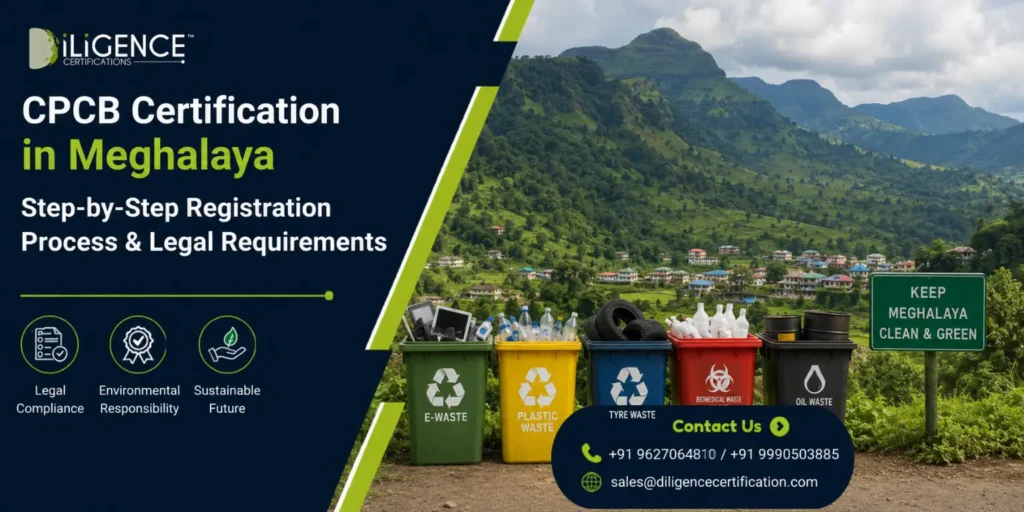
By - CPCB Certification in Meghalaya can assist industries to be compliant with all the environmental regulations before beginning any commercial activity.
- Industries such as manufacturing industries, recycling units, waste management plants, hospitals, mining, and chemical industries may need various environmental clearances.
- Awareness about the certification process right from the start will prevent industries from facing legal hassles and delay in projects.
Introduction: CPCB Certification in Meghalaya
Think about spending many months setting up a manufacturing unit in Meghalaya, installing machines, hiring workers, and being ready to start the operations. At the last moment, you learn that your business won’t be able to run since the required environmental approvals are not acquired yet. Such situations are not uncommon among businesses.
Obtaining all kinds of environmental approvals is no longer a mere formality. If your company deals with any kind of pollution in the form of air emissions, wastewater, hazardous waste, or something else, it needs to get the required approvals to start the operations. This ensures that the industrial development is done without harming the environment and people’s health.
Getting CPCB Certification in Meghalaya can be extremely useful when it comes to pollution control and ensuring compliance with the laws. If you set up a new manufacturing unit, enlarge your existing one, or manage a recycling business, getting the required environmental approvals is vital.
This guide will provide you with all the information needed.
What is CPCB Certification?
“CPCB Certification” means all environmental approvals granted under laws for the regulation of pollution control issued by the Central Pollution Control Board (CPCB), which are enforced by the relevant State Pollution Control Board.
Such environmental approvals are required to be obtained by industries to set up and run their industrial establishments according to:
- Air pollution control
- Water pollution management
- Waste disposal
- Hazardous waste handling
- Resource conservation
- Environmental monitoring
Compliance must be seen as an investment in sustainable development rather than a regulatory burden. There are many instances where government agencies, banks, and even corporate customers will demand environmental compliance in order to do business together.
Main Objectives of CPCB Certification in Meghalaya
The main goal of CPCB certification in Meghalaya is to ensure that the industrial growth does not come at the expense of the natural resources in the state.
Goals of CPCB certification include:
- Preventing industrial pollution.
- Preservation of groundwater and surface water.
- Air emissions from industries must be controlled.
- Sustainable management of hazardous wastes.
- Encouraging sustainable industrial development.
- Compliance with environmental laws.
- Improving the health and safety of people.
These are some of the goals that become even more important for industries working in ecologically sensitive areas such as Meghalaya.
Types of CPCB Certification
Depending on the nature of your business, one or more environmental approvals may be required.
Consent to Establish (CTE)
Explanation
Consent to Establish (CTE) is an agreement obtained prior to construction or installation of any industrial facility. CTE indicates that the proposed industrial facility has met all environmental criteria and can be established.
In the absence of CTE, many industrial facilities may be subjected to legal problems.
Applicable Industries
CTE generally applies to:
- Manufacturing industries
- Food processing units
- Pharmaceutical companies
- Chemical industries
- Plastic processing units
- Textile industries
- Mining-related businesses
- Recycling facilities
- Engineering industries
- Paper and packaging units
Key Highlights
- Required before construction.
- Mandatory before machinery installation.
- Based on pollution category.
- Helps secure environmental compliance from the beginning.
- Reduces future regulatory risks.
Consent to Operate (CTO)
Explanation
Consent to Operate (CTO) is required after the unit has been established and before commercial production begins. It confirms that pollution control measures have been implemented according to approved standards.
Operating without CTO may result in penalties, notices, or closure directions from the concerned authorities.
Applicable Industries
CTO is commonly required for:
- Manufacturing plants
- Food industries
- Hospitals
- Hotels
- Chemical industries
- Automobile workshops
- Mining operations
- Waste treatment facilities
- Printing industries
- Engineering units
Key Highlights
- Required before commencing production.
- Verifies pollution control systems.
- Subject to periodic renewal.
- Supports legal industrial operations.
- Demonstrates environmental responsibility.
Hazardous Waste Authorization
Explanation
Organizations that are involved in generation, collection, transportation, recycling, storage, and disposal of hazardous waste must have Hazardous Waste Authorization. Hazardous Waste Authorization helps ensure the proper management of hazardous waste without posing any risk to the health of humans and the environment.
Mismanagement of hazardous waste can be punished with serious penalties and liabilities.
Applicable Industries
Typical industries include:
- Chemical manufacturing
- Pharmaceutical companies
- Paint manufacturers
- Metal finishing industries
- Battery recycling units
- Electronic waste recyclers
- Oil processing units
- Engineering industries
- Automobile service centres
- Industrial waste treatment facilities
Key Highlights
- Mandatory for hazardous waste generators.
- Covers storage and disposal practices.
- Encourages safe waste management.
- Helps prevent environmental contamination.
- Ensures compliance with hazardous waste regulations.
Importance & Benefits
| Importance | Benefits |
| Ensures legal compliance | Avoids penalties and legal action |
| Controls pollution | Protects the environment |
| Improves industrial monitoring | Better operational efficiency |
| Supports responsible waste management | Reduced environmental risks |
| Builds business credibility | Improves customer confidence |
| Facilitates government approvals | Faster project execution |
| Promotes sustainable development | Long-term business growth |
| Enhances corporate reputation | Competitive advantage in the market |
Industries Requiring CPCB Certification
Every industrial enterprise in Meghalaya does not have the same set of environment clearances. This is dependent on the kind of industry, type of production process used, potential for pollution, and the waste produced by the enterprise. All Red, Orange, Green, and White industries have to conform to pollution control norms before commencing operations.
Some of the major industries that may require CPCB Certification in Meghalaya include:
- Cement and construction material manufacturing
- Mining and mineral processing units
- Food and beverage processing industries
- Pharmaceutical manufacturing companies
- Chemical and fertilizer industries
- Plastic manufacturing and recycling units
- Textile and garment processing units
- The paper and packaging industry
- Hotels and resorts
- Health care institutions
- Automobile workshops and repair shops
- Batteries production and recycling factories
- Electronic waste (E-waste) recycling plants
- The metal fabrication and engineering industry
- Stone crushing units
- Wood processing industries
- Waste management and recycling facilities
The exact approval depends on the pollution category assigned by the concerned authority and the nature of industrial operations.
CPCB Certification Process in Meghalaya
CPCB Certification in Meghalaya is not an easy task to achieve. The following are the steps that one should adhere to in order to acquire the certification without any problems.
Step 1: Identify Applicable Approval
Check whether your business requires:
- Consent to Establish (CTE)
- Consent to Operate (CTO)
- Hazardous Waste Authorization
- Multiple approvals, depending on business activities
Step 2: Collect Documents for the Process
Make sure that you have all the required documents for the business, technical, and environment. The preparation of documents ensures there is no objection to the process from the authority.
Step 3: Online Submission of the Application Form
Submit the required application form through the online portal of the Pollution Control Board, together with the fee.
Step 4: Technical Examination
The submitted application is examined by the environmental experts. In case of any clarifications or supporting documents needed, the applicant is notified to comply.
Step 5: Site Inspection
In most industries, the officials inspect the manufacturing premises to ascertain the arrangements for controlling pollution and managing waste.
Step 6: Compliance Verification
The authority checks if the industry is in accordance with the environmental laws and regulations.
Step 7: Grant of Certificate
After successful verification and approval, the relevant environmental consent or authorization is issued. The business can then legally establish or operate according to the conditions mentioned in the certificate.
Documents Required
Proper documentation is critical when you apply for CPCB Certification in Meghalaya. Errors or missing documents have been known to be one of the primary causes of delay.
Business Documents
- PAN Card
- Aadhar Card of Proprietor/Director
- Certificate of Incorporation
- Partnership Deed or LLP Agreement (if any)
- GST Certificate of Registration
- Udyam/MSME Registration (if any)
- Factory Licence (where applicable)
- Trade Licence
- Address Proof
- Board Resolution (for companies)
Technical Documents
- Manufacturing Process Flow Chart
- Plant Layout
- Site Layout Plan
- Machinery Details
- Installed Capacity
- List of Raw Materials
- Finished Product Details
- Water Balance Diagram
- Electricity Load Details
Environmental Documents
- Control of Air Pollution
- Control of Water Pollution
- Details of Effluent Treatment Plant (ETP)
- Details of Sewage Treatment Plant (STP) (if any)
- Solid Waste Management
- Hazardous Waste Management
- Environmental Monitoring Reports (if applicable)
Additional Documents
- Land Ownership or Lease Documents
- NOC from Local Authority (if applicable)
- Fire Safety Certificate
- Authorization Letters
- Previous Consent Certificates (for renewal)
- Photographs of Pollution Control Equipment
Timeline, Cost & Validity
The timeline, government fee, and validity of approvals vary depending on the industry category, project size, and applicable environmental regulations.
| Particular | Consent to Establish (CTE) | Consent to Operate (CTO) | Hazardous Waste Authorization |
| Purpose | Before establishing the unit | Before commencing operations | Handling hazardous waste |
| Approximate Processing Time | 30-90 Days | 30-90 Days | 30-60 Days |
| Government Fee | Depends on industry category | Depends on industry category | Depends on waste quantity |
| Validity | As prescribed by the authority | Periodic renewal required | As per authorization conditions |
| Renewal | May be required | Mandatory | Required before expiry |
Common Challenges
Many businesses face delays because they underestimate environmental compliance requirements. Some of the most common challenges include:
- Selecting the wrong category of consent.
- Incomplete application forms.
- Missing technical documents.
- Incorrect site layout plans.
- Improper hazardous waste management details.
- Delay in responding to authority queries.
- Non-compliance with pollution control standards.
- Lack of technical guidance during application preparation.
Working with experienced compliance professionals can significantly reduce these issues and improve approval timelines.
Why Choose Diligence Certification?
To attain environmental permits, technical skills, regulatory compliance, and documentation are required. Diligence Certification supports businesses through the entire process of certification.
1. Total Documentation Help
All the necessary documents will be prepared and verified by our team of experts to avoid mistakes and delays in the process.
2. Industry-specific Knowledge
Our professionals know about the requirement of each industry and suggest the best possible approval route.
3. End-to-end Support in Application Process
Our experts take care of everything from document collection to submission and follow-up.
4. Regulatory Advice from Professionals
Our professionals will help your business to understand its environmental responsibilities and stay regulated.
5. Quick Coordination
Our consultants will help you with coordination with relevant authorities and also answer your technical queries.
6. Continuation with Compliance
Apart from getting you approved, we can help you in renewing, amending, and other environmental approvals.
Conclusion
Getting the CPCB Certification in Meghalaya is a vital requirement for any industry looking to run their operations legally and comply with environmental regulations. Be it for your Consent to Establish (CTE) or Consent to Operate (CTO) or Hazardous Waste Authorization requirement, getting your approval on time will help avoid any legal hassles, delays, and operational disturbances.
Planning well and with our professional assistance, you can get your certification easily without any hassle. With the Diligence Certification, getting your business certification process easy becomes much easier.
Frequently Asked Questions
What is CPCB certificate?
A CPCB certificate is an environmental approval or registration that the industry needs in order to conform to pollution control regulations and waste management.
How to obtain CPCB Certification?
The CPCB certificate can be acquired through the process of identification of approval, preparation of documentation, submission of the application, inspection, and getting approval from the concerned authority.
Who can get CPCB?
The manufacturers, recyclers, importers, exporters, waste processors, and pollution-generating industries can be eligible and need CPCB approval.
What is CPCB Approval?
It is an environmental approval which enables eligible business entities to set up operations in accordance with pollution control norms.
How long does it take to get CPCB Certification in Meghalaya?
The approval period normally ranges between 30 to 90 days based on the nature of the approval and the status of the documentation submitted.
Which documents are needed for CPCB certification?
Documents like business registration papers, technical information about the project, pollution control plans, environmental documents, and other required approvals can be among those needed.
Can industries run without Consent to Operate (CTO)?
No. Industries requiring CTO are not supposed to run their businesses without prior approval.
What will happen if there is no environmental clearance?
There will be penalties, notices, closing order, etc., against the business entity for not following the rules and regulations regarding the environment.
Is CPCB Certification renewable?
Yes. Some certifications like Consent to Operate, Hazardous Waste Authorization, etc., have to be renewed based on their validity period.
What can be the role of Diligence Certification?
Diligence Certification can be instrumental in providing end-to-end assistance in obtaining certification.