BIS Certification
 CDSCO
CDSCO
 PESO
PESO
 CPCB
CPCB
 LMPC
LMPC
 WPC Approval
 Global Approvals
 TEC
TEC
 ARAI
ARAI
 BEE
BEE
 ISO Certification
 DGCA Certification
 NOC For Steel
 APEDA Registration























 Business Registration
 FSSAI Mark Certification












 (32).jpg)
 Legal Services
 Trademark Registration
 Copyright Registration
 Patent Registration
 By
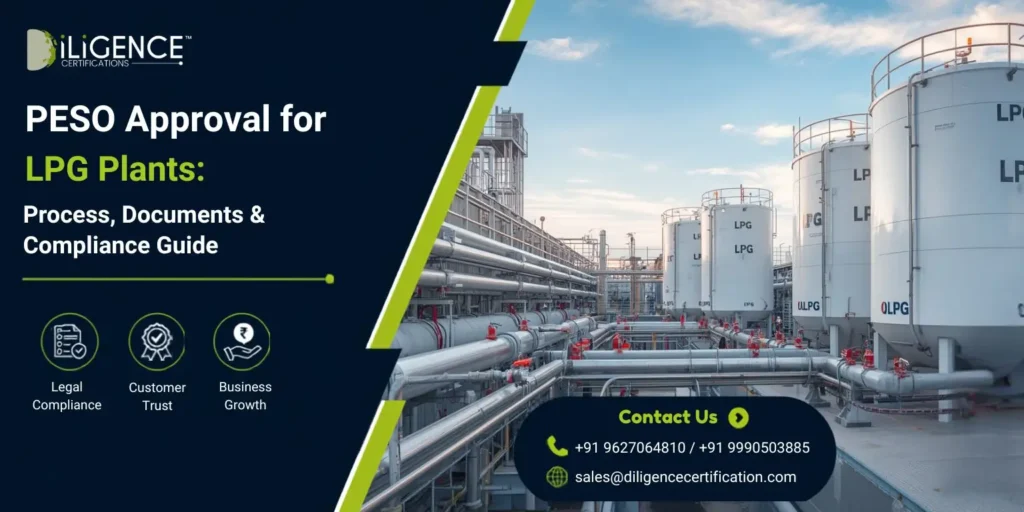
By - PESO Approval for LPG Plants is mandatory before manufacturing, storing, filling, or handling LPG in India.
- It will help the company to adhere to Indian regulations while avoiding risks involved.
- Diligence Certifications offers assistance to companies in obtaining approvals.
Introduction
Imagine spending crores on the installation of an LPG storage and bottling facility and then finding out that the facility cannot be operational due to the lack of one vital approval. This is a scenario many companies may find themselves in if they do not consider getting PESO Approval for LPG Plants.
As LPG is highly inflammable in nature, all companies which are engaged in storage, bottling, filling or distribution of the gas have to abide by the safety guidelines provided by the Petroleum and Explosives Safety Organisation (PESO). Failure to get the required approvals will lead to problems for the business.
Getting the approval of PESO for LPG plants does not only ensure adherence to the safety guidelines but also ensures protection of employees and company property. It enables uninterrupted operations in the facility without any problems or delays.
What is PESO Approval for LPG Plants?
PESO Approval for LPG Plants is an approval document issued by the Petroleum and Explosives Safety Organisation (PESO) which is a body working under the Department for Promotion of Industry and Internal Trade (DPIIT), Government of India.
The approval certifies the fact that the LPG plant has complied with all the safety guidelines that are laid down under the Explosives Act, Petroleum Rules, Gas Cylinder Rules, etc.
Simply put, PESO ensures that the LPG plant is constructed in such a way that there is a minimal chance of accidents and fires occurring in the plant.
The approval process generally includes the examination of:
- Plant layout
- Safety distances
- Storage tanks
- Pressure vessels
- LPG filling systems
- Fire protection systems
- Electrical installations
- Emergency response arrangements
- Hazard control measures
- Engineering drawings
- Technical specifications
Only after satisfying these safety requirements does PESO grant approval for the facility.
Who Needs PESO Approval for LPG Plants?
However, many companies think that only large oil companies need to be approved by PESO. In truth, approval is needed by various industries handling LPG.
The following organizations generally require PESO Approval for LPG Plants:
LPG Bottling Plants
These are companies that fill LPG cylinders for both commercial and domestic purposes.
LPG Storage Terminals
A facility that stores substantial amounts of LPG requires adherence to certain prescribed standards for LPG storage and safety.
Industrial Manufacturing Units
Industrial units that use LPG as their main fuel may require permissions based on storage capacity and type of installation.
LPG Cylinder Filling Stations
Firms involved in the filling and re-filling of cylinders should be in line with PESO rules.
LPG Distribution Companies
Firms that have set up LPG distribution infrastructure can be required to obtain approval for storage and handling sites.
Petrochemical Industries
Most petrochemical installations that keep LPG as a source of raw materials or fuel will require regulatory approvals.
Gas Processing Plants
Petroleum gas processing sites are supposed to conform to the relevant PESO safety standards.
Large Commercial Establishments
Hotel, industrial, hospital, school, and other large commercial installations keeping bulk LPG storage sites can also require approvals depending on the regulations involved.
Types of LPG Plants Covered Under PESO
The approval process may differ depending on the type and capacity of the LPG installation.
LPG Bottling Plants
These facilities receive LPG in bulk and fill cylinders for commercial or domestic distribution.
Bulk LPG Storage Plants
Designed primarily for storing LPG in pressure vessels before distribution or industrial consumption.
LPG Cylinder Testing Facilities
Plants responsible for inspecting, testing, and maintaining LPG cylinders.
LPG Import and Distribution Terminals
Large terminals handling imported LPG prior to nationwide distribution.
Industrial LPG Installations
Manufacturing plants using LPG for furnaces, boilers, heating systems, or production processes.
LPG Pipeline Installations
Facilities connected through LPG transfer pipelines requiring specialized safety assessment.
Importance and Benefits of PESO Approval for LPG Plants
| Importance | Benefits |
| Ensures Legal Compliance | Avoids legal penalties and operational disruptions |
| Improves Workplace Safety | Reduces the risk of fire, explosions, and gas leaks |
| Builds Customer Confidence | Enhances business credibility and trust |
| Supports Insurance Requirements | Simplifies insurance approval and claim processing |
| Reduces Operational Risks | Minimises downtime and maintenance costs |
| Facilitates Business Expansion | Supports future expansion and licensing |
| Protects Employees and the Environment | Creates a safer workplace and reduces environmental risks |
| Enhances Long-Term Business Sustainability | Strengthens business growth and regulatory compliance |
Documents Required for PESO Approval for LPG Plants
The documents required for PESO Approval for LPG Plants may vary depending on the project. However, the following documents are generally required:
- Company Registration Papers
- Proof of Identity and Address
- Documentation of Land Ownership/Lease
- Approved Site Layout Plan
- Plant Layout & Engineering Drawings
- Specifications for Equipment
- Documents for Fire Safety
- Risk Assessment Document
- Electrical Safety Documents
- Environmental Clearance and Pollution Control Board Consent (if required)
- Certification of Structural Stability
- Prior PESO Approval (in case of expansion/ modification of the plant)
Step-by-Step Process for PESO Approval for LPG Plants
The Approval Process of PESO for LPG Plants is an organized regulatory process. Following each step properly will ensure there will be no delay and redundant observations from the agency.
Step 1: Initial Project Planning
Prior to the start of construction, the planned LPG plant should be assessed for compliance with the existing safety regulations.
This stage involves:
- Capacity planning
- Site feasibility
- Regulatory review
- Safety distance assessment
A well-planned project is easier to approve and requires fewer design modifications later.
Step 2: Preparation of Engineering Documents
Qualified engineers prepare all required technical documents, including:
- Site layout
- Mechanical drawings
- Process flow diagrams
- Safety system layouts
- Equipment specifications
Every drawing should comply with applicable PESO guidelines.
Step 3: Document Verification
Before submission, all documents should be reviewed carefully.
Common issues include:
- Missing signatures
- Incorrect dimensions
- Mismatched drawings
- Incomplete technical details
Professional verification at this stage can save weeks of rework.
Step 4: Submission of Application
The application is submitted along with the required documents and applicable government fees.
The authority examines whether all mandatory information has been provided.
Step 5: Technical Scrutiny
PESO officers review the submitted documents in detail.
The review generally focuses on:
- Plant design
- Storage capacity
- Safety distances
- Pressure systems
- Fire protection
- Emergency planning
- Compliance with applicable rules
If any deficiencies are found, clarification or revised documents may be requested.
Step 6: Site Inspection
After satisfactory document review, PESO may conduct a site inspection.
During inspection, officials verify:
- Construction quality
- Safety installations
- Fire protection systems
- LPG storage facilities
- Pipeline arrangements
- Pressure vessels
- Emergency exits
- Warning signage
- Safety clearances
The inspection ensures that the facility matches the approved design.
Step 7: Rectification of Observations
If observations are raised during inspection, the applicant must address them before approval.
Typical observations include:
- Missing safety signage
- Incorrect piping arrangement
- Inadequate fire protection
- Insufficient safety distance
- Incomplete documentation
Prompt compliance helps avoid further delays.
Step 8: Final PESO Approval
Once all requirements have been satisfied, PESO issues the approval or licence, allowing the LPG plant to operate in accordance with applicable regulations.
Businesses should retain the approval documents for future inspections and renewals.
Timeline, Cost & Validity
Timeline
Timeline for the process depends on various factors such as the complexity of the project, quality of the documents, scheduling of inspections, and responses to observations.
The time period required can be anywhere between 6 and 12 weeks depending on the size of the project.
Cost
There is no single fixed cost for PESO Approval for LPG Plants.
The overall cost depends on factors such as:
- Plant capacity
- Type of LPG installation
- Number of storage vessels
- Engineering complexity
- Government fees
- Documentation requirements
- Consultancy services
It is advisable to obtain a project-specific quotation based on the facility’s technical details.
Validity
The validity of the approval is based on the kind of license or approval that was granted by PESO.
Companies need to watch their expiration dates to make sure they comply with all safety measures.
Consequences of Non-Compliance
Non-compliance with the PESO Approval Requirement for LPG Plants has legal, financial, and operational ramifications.
Legal Penalties
The lack of appropriate approval could lead to enforcement measures under the relevant laws, either in the form of penalties or prosecution.
Suspension of Operations
Businesses could be ordered to suspend their operations until the requisite conditions are met, thus causing delays and financial loss.
Increased Safety Risks
If proper measures are not put in place, there will be higher risks of fire, explosions, and gas leaks.
Insurance Complications
The insurance company could deny or limit the claim if the establishment is operating without the needed regulatory approvals.
Damage to Business Reputation
Non-compliance might have an impact on customer and suppliers relationships.
Delays in Expansion
Firms looking to expand capacity and start projects might face further problems if past violations come to light.
Renewal of PESO Approval for LPG Plants
Obtaining PESO Approval for LPG Plant is not the last step in ensuring compliance. The company needs to make sure that its approval stays in force, and that operations comply with all relevant safety standards.
Depending on the nature of the license or approval, renewal will need to take place at the expiration of the validity period. Failure to do so could result in disruptions to operations.
It is advisable for businesses to commence the renewal process before the validity period expires.
When Should You Apply for Renewal?
The process of renewal should start well before the expiration of the approval period, as it gives enough time to update documentation and respond to the findings made by the authorities.
Documents Commonly Required for Renewal
The renewal requirements may vary depending on the project. Generally, businesses may need:
- Approval/License for existing PESO
- Updated documents of the company
- Plant Layout (if any modifications done)
- Fire safety compliance documentation
- Equipment maintenance documentation
- Inspection documentation
- Pressurized Vessel Testing Documentation
- Calibration documentation
- Any other documentation asked for by the authorities
Situations Where Fresh Approval May Be Required
A simple renewal may not be sufficient if there are significant changes to the LPG plant, such as:
- Increase in LPG storage capacity
- Installation of additional pressure vessels
- Expansion of the plant area
- Changes in process layout
- Addition of new filling lines
- Modification of safety systems
- Relocation of the facility
In such cases, revised approvals or amendments may be required before implementing the changes.
Why Choose Diligence Certifications?
PESO Approval for LPG Plants involves technical skill and accurate documentation among other requirements. The team at Diligence Certifications makes the whole process easier for you with our comprehensive assistance.
Why businesses choose us:
- Professional help for PESO regulations
- Full documentation assistance
- Technical compliance help
- Quick and smooth approvals
- Clear communication through all stages
- Nationwide service for LPG projects
Our experienced team helps you achieve PESO Approval for LPG Plants efficiently, allowing you to focus on your business while we manage the compliance process.
Conclusion
The establishment or operation of an LPG plant is capital-intensive, and achieving compliance is important in order to secure the capital invested. PESO Approval for LPG Plants assures you that the plant is compliant with the required safety guidelines while dealing with, storing, and processing Liquefied Petroleum Gas.
In addition to the legal requirement, the process of securing such approvals will ensure that your operations run smoothly, safely, and successfully. Regardless of whether you have an existing LPG plant or are opening a new one or renewing your approval, good planning and accurate documentation will go a long way.
For any help with PESO Approval for LPG Plants, feel free to consult Diligence Certifications at any stage of the process.
Frequently Asked Questions
What is the PESO Approval for LPG Plants?
The PESO Approval for LPG Plants is a form of authorization granted by the Petroleum and Explosives Safety Organization to confirm that the LPG plants meet the prescribed requirements of safety and regulation before beginning their operations.
Is it compulsory to get PESO Approval for LPG plants?
Yes, businesses involved in the storage, bottling, handling, filling or processing of LPG are expected to have PESO Approval for LPG Plants before beginning operations.
Who is eligible for applying for PESO Approval for LPG Plants?
This includes manufacturers, LPG bottling firms, storage terminals, industries, gas processing plants and many more organizations involved in the handling of LPG.
What are the documents required for PESO Approval?
These documents are generally company registration certificate, land ownership or lease certificate, engineering drawings, plant layout, equipment specifications, fire safety documents, and other technical documents depending upon the project.
How much time does it take to get PESO Approval for LPG Plants?
Time taken in getting PESO Approval generally depends on the complexity of the project, accuracy of documents, inspection schedule, and observations raised in case of any.
What is the cost for getting PESO Approval?
This depends on many things like plant capacity, complexity of the project, government fees, and other things. It is better to have an estimate of your project.
Is it possible to run the LPG plant without PESO Approval?
The running of the plant without proper approvals may entail certain risks. Businesses need to get proper approval before commencing business activities.
What is the timeline to renew PESO Approval?
It is advisable to start the renewal process before the existing PESO Approval expires. The actual period for the renewal of the approval depends on the type of approval or licence.
Do I need to get a new PESO Approval after the expansion of my LPG plant?
In case of expansion, which entails additional storage volume or equipment, a new approval or amendment from PESO might be needed.
How Diligence Certifications can help with PESO Approval for LPG Plants?
Diligence Certifications offers full-scale assistance from preparing documents to the renewal of the PESO approval.