BIS Certification
 CDSCO
CDSCO
 PESO
PESO
 CPCB
CPCB
 LMPC
LMPC
 WPC Approval
 Global Approvals
 TEC
TEC
 ARAI
ARAI
 BEE
BEE
 ISO Certification
 DGCA Certification
 NOC For Steel
 APEDA Registration























 Business Registration
 FSSAI Mark Certification












 (32).jpg)
 Legal Services
 Trademark Registration
 Copyright Registration
 Patent Registration
 By
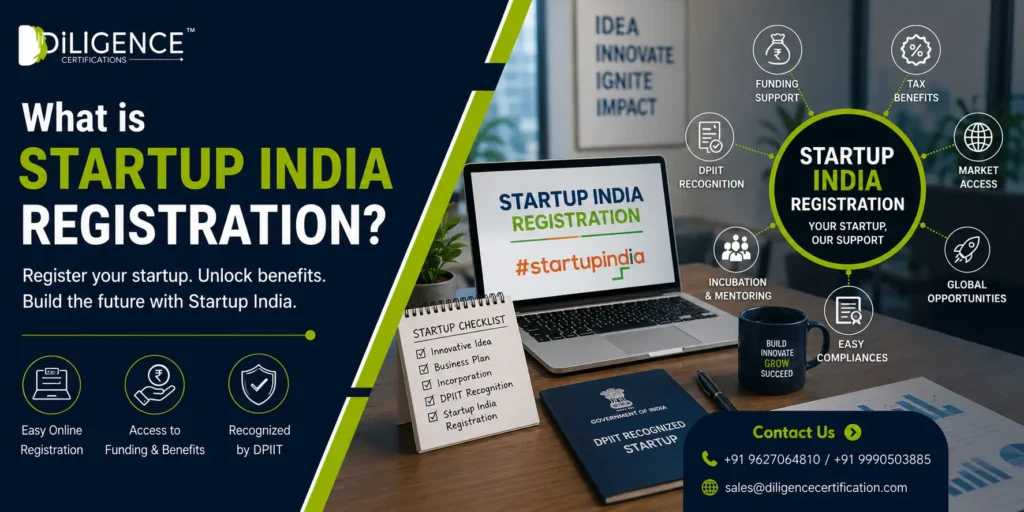
By - Startup India Registration is really helpful for new companies to get recognized by the DPIIT. This recognition brings a lot of benefits like tax advantages rules to follow chances to get money and a better reputation.
- When you are starting a company, like a technology startup or a manufacturing business or a service company, Startup India Registration can really help your business grow fast.
- Diligence Certifications is there to help companies with the Startup India Registration process. They provide advice and help with all the paperwork from start to finish.
Introduction
Lots of people who start their businesses think that just making their company official is enough.The truth is, making your company official only makes it a real business in the eyes of the law.Startup India Registration is something that lets your business get some really good things from the government.
Think of it like this:
Making your company official gives it a name. Make it real.Startup India Registration gives your startup an okay, from the government and helps it grow.This is really important to remember when you are trying to get money or special help from the government or a place to work with startups or when you do not want to pay as much in taxes.
Benefits of Startup India Registration
The reason people start businesses to apply for Startup India Registration is that it is very useful in the long run. It is not just about following the rules.
1. Tax Benefits
Businesses that are eligible for Startup India Registration can get exemptions from paying income tax. They have to follow the rules set by the government.These tax benefits can really help businesses when they are just starting out because they can use the money they save to grow and expand their business.
2. Better Access to Funding
When businesses are recognized by the government it is easier for them to get funding from investors, venture capital firms and government programs.This is because people are more likely to trust and believe in recognized businesses, which makes it easier for them to get the money they need.
3. Faster Intellectual Property Protection
Many businesses that are just starting out create unique things, like software or products.Startup India Registration helps these businesses protect their ideas and inventions which is very important for their success.
4. Easier Government Compliance
Following all the rules and regulations can be time consuming for businesses that are growing.When businesses are recognized by the government it is easier for them to follow the rules because some of the regulations are simplified.
5. Improved Business Credibility
When the government recognizes a business it makes people trust the business more like investors, banks and customers.Many people who buy things from businesses view recognized businesses as reliable because they have already been checked by the government.
6. Participation in Government Opportunities
Some government organizations help businesses by giving them opportunities to work with them.This can be very helpful for businesses because it can be hard for them to get started otherwise.
7. Networking Opportunities
When businesses are recognized by the government they become part of a group of businesses and people who are working together to innovate and create new things.This can be very valuable for businesses because they can meet people, learn new things and get help from experts, which can be more helpful than just getting money.
Who should apply for Startup India registration?
Startup India registration is an idea for businesses that make new and interesting products or services.It is also good for businesses that can grow and become really big.
Some common applicants are:
- Technology startups
- SaaS companies
- AI startups
- Manufacturing businesses
- Healthcare startups
- EdTech companies
- AgriTech businesses
- FinTech startups
- D2C brands
- energy startups
- Logistics companies
- Research-driven businesses
- Export-oriented startups
Even old businesses can apply for Startup India registration if they do something new and different, use new technology or can grow really big.
Startup India registration is an option for these businesses because it helps them grow and become successful.Startup India registration is what these businesses need to move and make their ideas work.
Startup India Registration Eligibility Criteria
Before applying, every entrepreneur should determine whether the business satisfies the eligibility requirements.
Generally, a startup should meet the following conditions:
- Registered Business Entity
The business must be registered as:
- Private Limited Company
- Limited Liability Partnership (LLP)
- Registered Partnership Firm
- Business Age
The startup should fall within the eligibility period prescribed under the Startup India framework from the date of incorporation.
- Annual Turnover
The business should remain within the turnover limit notified under the Startup India scheme.
- Innovation Requirement
This is where many applications require careful preparation.
Your startup should demonstrate one or more of the following:
- Innovation
- Technology development
- New products
- Improved services
- Scalable business model
- Employment generation potential
- Wealth creation capability
Simple trading activities without innovation generally do not qualify.
- Original Business
The startup should not be formed merely by splitting or reconstructing an existing business.Government authorities carefully evaluate this aspect during application review.
Common Misconceptions About Startup India Registration
Only technology companies can register. That is not correct. Many different kinds of companies can qualify for this like manufacturing startups and service providers and healthcare innovators and agricultural businesses. They just have to meet the innovation criteria.
You might think every new company automatically gets Startup India recognition. That is not true. When you incorporate a business and when you register for Startup India are two things. To get recognized you have to apply and meet the eligibility requirements.
Some people think that if you register you will definitely get investment. That is not true at all. Startup India Registration can help your company seem credible and it can make it easier to get funding but investors are the ones who decide if they want to invest in your company.
You might also think that small businesses cannot qualify. That is not true. Many small businesses get Startup India recognition because it is about being innovative not about how big your company’s. Startup India recognition is for companies that’re innovative and that includes small businesses.
Step-by-Step Startup India Registration Process (2026)
Many founders assume the application is simply about uploading a few documents. In reality, the quality of your business description, innovation statement, and supporting documents can significantly influence the approval process.
Below is the standard process followed for Startup India Registration in 2026.
Step 1: Incorporate Your Business
Before applying for Startup India Registration, your business must be legally incorporated.
Eligible business structures include:
- Private Limited Company
- Limited Liability Partnership (LLP)
- Registered Partnership Firm
Sole proprietorships and unregistered entities are not eligible for DPIIT recognition.
Step 2: Prepare Required Business Documents
Once your company is incorporated, gather all necessary documents before beginning the online application.Preparing these in advance helps avoid delays and incomplete submissions.
Step 3: Create an Account on the Startup India Portal
Visit the official Startup India portal and create a startup profile.
You will be required to provide:
- Founder details
- Business information
- Industry sector
- Company incorporation details
- Contact information
Ensure all information matches your incorporation documents.
Step 4: Complete the DPIIT Recognition Application
This is the most important stage of Startup India Registration.
Applicants must clearly explain:
- What problem the startup solves
- How the solution is innovative
- Why the business is different from existing market solutions
- Future scalability
- Employment generation potential
- Business model
A vague innovation statement is one of the most common reasons applications require clarification.
Step 5: Upload Supporting Documents
After completing the application, upload the required documents in the prescribed format.Double-check every file before submission.
Step 6: Application Review
The authorities review the submitted information.If additional clarification is required, applicants may receive queries requesting supporting explanations or revised documentation.Responding accurately and promptly can help reduce processing delays.
Step 7: Receive DPIIT Recognition
Once approved, your startup receives official DPIIT Recognition under the Startup India initiative.This recognition enables eligible businesses to apply for various Startup India benefits, tax exemptions (subject to approval), government programmes, and startup support initiatives.
Documents Required for Startup India Registration
Submitting complete and accurate documentation is one of the easiest ways to improve the application process.
Generally, the following documents are required.
- Company Incorporation Certificate
- PAN Card of the Company
- Director or Partner Details
- Business Description
A detailed explanation covering:
- Nature of business
- Products or services
- Industry
- Innovation
- Target market
- Future growth strategy
This section deserves careful attention because it demonstrates whether the business satisfies Startup India eligibility.
Website or Product Information (If Available)
If your startup already has:
- Website
- Mobile application
- Software platform
- Product catalogue
- Prototype
- Research documentation
Including these strengthens the application.
Pitch Deck (Recommended)
Although not mandatory for every startup, a professionally prepared pitch deck helps explain the business model clearly.
It also becomes useful later while approaching investors.
Additional Supporting Documents
Depending on the business, additional documents may include:
- Trademark details
- Patent applications
- Product photographs
- Research papers
- Client testimonials
- Prototype images
- Product videos
Supporting evidence helps establish innovation.
Startup India Registration Benefits in Detail
While tax exemptions often receive the most attention, Startup India Registration offers a much broader range of advantages.
- Easier Fund Raising
Government recognition creates additional credibility during discussions with:
- Angel Investors
- Venture Capital Funds
- Incubators
- Accelerators
- Financial Institutions
Investors generally prefer startups that have completed statutory registrations and government recognition.
- Tax Exemptions
Eligible startups may apply for income tax exemptions under applicable provisions, subject to meeting prescribed conditions and obtaining approval from the relevant authorities.
Professional tax planning is advisable before claiming any exemptions.
- Self-Certification for Compliance
Recognised startups benefit from simplified compliance under specified labour and environmental laws, reducing administrative burdens during the early stages of business.
- Intellectual Property Support
Innovation deserves protection.
Eligible startups may receive benefits relating to:
- Patent filing
- Trademark registration
- Design registration
- Intellectual property facilitation
Protecting intellectual property also improves investor confidence.
- Government Procurement Opportunities
Many startups struggle because they cannot compete with established businesses.
Startup India recognition enables eligible businesses to participate in several government procurement opportunities with relaxed eligibility norms under applicable policies.
- Networking Opportunities
Recognised startups gain exposure to:
- Government programmes
- Startup incubators
- Mentoring sessions
- National startup events
- Innovation challenges
- Investor networking platforms
Sometimes, these connections create greater long-term value than financial incentives.
To get your startup registered in India quickly here are some things you can do.
When you are filling out the application for Startup India Registration you need to make sure you do things.
- You have to say what problem your startup is going to solve.
- You should tell them how your startup is innovative and give them numbers to prove it or just say it is innovative.
- If you have pictures of your product or prototype you should add them to your application.
- Make sure all the details about your company are the same in all your documents.
- Your business description should be short and to the point. It should be real.
- You should check your application carefully before you send it in.
- If the people looking at your application need information you should give it to them right away.
If you take the time to fill out your application carefully it will make the process easier. It will also show that your startup is professional when you are talking to investors or partners.When you are talking to investors or partners, about your startup a good application can make a difference.
Why Choose Diligence Certifications for Startup India Registration?
Every startup is different. Has its own way of doing things. At Diligence Certifications we know that people who start companies need help with more than filling out forms. They need someone to show them what to do in a way that works with the government rules.
Our team helps with:
- End-to-end Startup India Registration assistance
- DPIIT recognition documentation support
- Checking if you’re eligible before you apply
- Writing descriptions of your ideas and business plans
- Making sure your documents are correct and follow the rules
- Helping you answer questions from the government
- Giving you help with other registrations and certifications
If you are starting a company for the first time or if you already have a company and want to get recognized, our team at Diligence Certifications will make the process easier for you so you can focus on building your Startup India Registration and your business. At Diligence Certifications we provide Startup India Registration assistance and our team is always here to help with your Startup India Registration.
Conclusion
Building a startup needs more than just a good idea-it needs the right legal setup, official approval from the government and some smart advantages. Startup India Registration is one of the programs for entrepreneurs in India. It gives access to DPIIT recognition, tax benefits (if you meet the conditions) , easier rules to follow, help with property chances to get money and more trust in your business.
No matter if you are starting a tech business, a factory, a service company or a new product company, getting Startup India Registration can help your business grow faster and make it easier to get money from investors, customers and the government.
The application seems simple. Writing a strong description of your idea, giving the right papers and making sure you meet the rules are very important. Even small mistakes can slow things down. Make you have to explain more.
At Diligence Certifications our team offers help-from checking if you qualify, preparing the papers, sending the application and helping you through the DPIIT approval process. If you want to grow your startup with confidence now is the time to start the Startup India Registration.
Frequently Asked Questions (FAQs)
What is Startup India Registration?
Startup India Registration is the process of obtaining DPIIT recognition under the Government of India's Startup India initiative. Eligible startups can access benefits such as tax exemptions (subject to approval), simplified compliance, intellectual property support, and government schemes.
Who is eligible for Startup India Registration?
Businesses incorporated as a Private Limited Company, LLP, or Registered Partnership Firm that meet the prescribed eligibility criteria, including innovation and scalability requirements, can apply for Startup India Registration
Is Startup India Registration mandatory?
No. Startup India Registration is voluntary. However, eligible startups are encouraged to apply because it provides access to several government-recognised benefits and improves business credibility.
Is company incorporation the same as Startup India Registration?
No. Company incorporation creates your legal business entity, while Startup India Registration provides DPIIT recognition under the Startup India initiative. These are separate processes.
What documents are required for Startup India Registration?
The commonly required documents include:
Certificate of Incorporation
PAN of the company
Director or partner details
Business description
Innovation details
Website or product information (if available)
Supporting documents related to the business
How long does Startup India Registration take?
The timeline depends on the completeness of the application and the review process. Applications with accurate documentation and a well-prepared innovation description are generally processed more smoothly.
Can an LLP apply for Startup India Registration?
Yes. A Limited Liability Partnership (LLP) can apply for Startup India Registration if it satisfies the eligibility conditions prescribed under the Startup India framework.