BIS Certification
 CDSCO
CDSCO
 PESO
PESO
 CPCB
CPCB
 LMPC
LMPC
 WPC Approval
 Global Approvals
 TEC
TEC
 ARAI
ARAI
 BEE
BEE
 ISO Certification
 DGCA Certification
 NOC For Steel
 APEDA Registration























 Business Registration
 FSSAI Mark Certification












 (32).jpg)
 Legal Services
 Trademark Registration
 Copyright Registration
 Patent Registration
 By
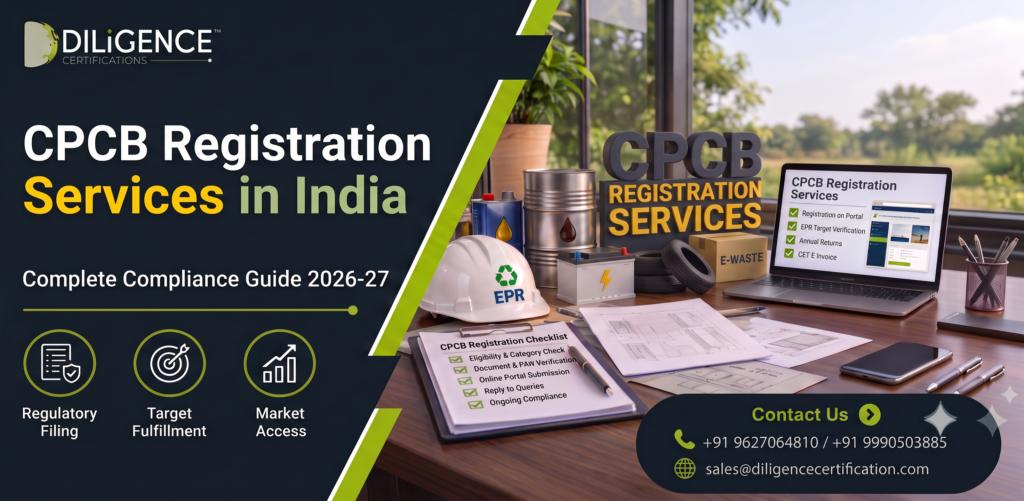
By - CPCB stands for Central Pollution Control Board, India’s central environmental pollution control authority.
- CPCB registration services help businesses that’re eligible to find out and finish the environmental registration processes that they need to do.
- Extended Producer Responsibility rules might be needed for producers, importers, brand owners and other companies that are watched by the rules.
- Documents that are often needed are PAN, GST information, papers about how the company was started details about the products and data, about sales or how much is made.
- Different rules apply to packaging, electronic waste, batteries, tyres and old oil.
Introduction
As an owner of a company that deals with packing, electronics, batteries or any other kind of waste, you will always be concerned about whether CPCB registration is required or not. In India there are many firms who have to comply with certain rules and regulations. I understand how difficult it may be for you to fill all the papers to find out how to register with CPCB and how to follow the guidelines.
The CPCB registration services are those that help your company determine which class of businesses you belong to and provide the paperwork for it. They also provide information regarding the guidelines. For instance, the businesses that deal with packaging should adhere to the Plastic Waste Management Guidelines, and those that handle batteries should adhere to the guidelines of battery waste management.
It is important to start CPCB registration process in advance to avoid possible problems with filling in all the papers. The following guide will help you to learn the types of CPCB registration and the documentation required.
What Are CPCB Registration Services?
CPCB registration services mean that a professional can help a business, with the registration and compliance steps that are run by CPCB. If the rules say so the same help can come from the State Pollution Control Board (SPCB) or a Pollution Control Committee (PCC).
CPCB registration services may also check if the business is eligible. They can spot the registration category prepare the needed papers fill out the application forms send the supporting information and answer any questions from the regulators.
Some businesses need CPCB registration because they make or bring in products that are covered. Other businesses need CPCB registration because they run a recycling or waste‑processing plant.
The CPCB registration process depends on the law in force. A business that handles packaging cannot simply copy the CPCB registration steps that a battery producer or an electronic waste recycler uses.
Professional help can organise the CPCB registration steps. The business must still give information and fulfil its own legal duties.
Which Businesses May Need CPCB Registration?
CPCB-related registration requirements depend on the type of business, its activities and the waste stream involved.
1. Plastic Packaging Businesses
Plastic packaging is often used in food products, personal care items, household goods, online orders and industrial packaging.
People who make bring in or own brands might have responsibilities under the Plastic Waste Management Rules and the related EPR system. Plastic waste processors also have rules for registration and reporting.
For example a company that sells shampoo in bottles should check its responsibilities based on where it stands in the supply chain. Making bottles through companies does not always remove all the responsibilities that may apply to the brand owner.
2. Electronic Equipment Businesses
Companies that deal with electrical and electronic equipment might have to follow the E-Waste Management Rules.
Depending on what they do this can include producers, manufacturers, importers and other businesses that are controlled. Facilities that process waste might have their registration rules.
An importer must find out the product type. Check whether their activities are covered by the rules before applying.
3. Battery Businesses
Battery makers that are covered by the Battery Waste Management Rules might need to register. They must follow EPR duties.
The rules can be different depending on the business role and the type of battery. Companies that work with batteries should look at the registration, reporting and waste management rules of using general plastic EPR information.
4. Waste Tyre Businesses
Tyre makers and other businesses that are covered might have responsibilities, under the tyre waste management system.
These responsibilities can include registration, EPR targets, records about recycling and reporting. The correct way to handle things depends on the business role and the current rules.
5. Used Oil Businesses
Companies that’re part of the used-oil EPR system should check the registration and compliance rules.
Importers, producers and other businesses that are controlled might have responsibilities. Companies must check if their work and products are included in the rules before starting an application.
Types of CPCB Registration and Compliance Services
CPCB registration services cover different environmental compliance pathways. The following table provides a basic overview.
| Registration area | Businesses that may be covered | Main purpose |
| Plastic packaging EPR | Covered producers, importers and brand owners | Meet applicable plastic packaging waste obligations |
| Plastic Waste Processor registration | Eligible recyclers and other covered processors | Register processing activities and meet relevant reporting requirements |
| E-waste EPR | Producers and other entities covered by the E-Waste Management Rules | Meet applicable electronic waste management obligations |
| Battery waste EPR | Covered battery producers | Meet battery waste management responsibilities |
| Waste tyre EPR | Covered tyre producers and regulated entities | Meet applicable tyre waste obligations |
| Used oil EPR | Entities covered by the used-oil framework | Meet relevant used-oil compliance requirements |
| Other environmental permissions | Businesses conducting regulated environmental activities | Obtain the specific consent or authorisation required by law |
What Is Extended Producer Responsibility (EPR)?
I believe Extended Producer Responsibility, commonly called EPR is a rule that puts waste-management duties onto businesses that bring covered products or packaging into the market.
I find that a company’s responsibility can go beyond just making or selling a product. Depending on the rules that apply the company may also need to support waste collection, recycling or other allowed waste-processing tasks. The company must report the company’s compliance.
I think of a company that sells household cleaning products in containers. The company may hire a third-party manufacturer to make and fill those containers. Still outsourcing manufacturing does not automatically remove any EPR duties that belong to the brand owner.
I see that an importer of products should not think that the overseas manufacturer’s paperwork alone meets Indian regulatory rules.
I understand that the rules that apply decide which entities are covered what targets are and how compliance must be shown.
Latest CPCB Registration Rules Businesses Should Know in 2026
Environmental requirements may vary depending on whether any amendment, notification, directions or guidance related to the portal has been issued. I am aware that it is essential for business owners to review the requirements pertaining to their categories prior to making an application or filing an annual return.
Plastic Waste Management Amendment Rules, 2026
The Ministry of Environment, Forest & Climate Change has issued the Plastic Waste Management (Amendment) Rules, 2026 through notification G.S.R. 237(E) on 31 March 2026.
The changes include rules, about recycled plastic content and other parts of waste management. Business owners who are affected by these changes should read the notification. Look at the schedule.
The specified recycled plastic content targets include the following:
| Plastic packaging category | 2025-26 | 2026-27 | 2027-28 | 2028-29 onwards |
| Category I | 30% | 40% | 50% | 60% |
| Category II | 10% | 10% | 20% | 20% |
| Category III | 5% | 5% | 10% | 10% |
These percentages are for the recycled-content obligations that’re part of the rules. They should not be seen as recycling goals that apply to every business or every kind of waste.
The 2026 amendments also include an exemption. This can be used when using packaging is not allowed by another law, regulation, Indian Standard or any other legal requirement. Businesses that want to use this exemption must look at the rule they are relying on and keep all the proof needed to support their claim.
If a company is subject to the regulations, some of the actions they can take are as follows: evaluating packaging types, verifying suppliers’ data, understanding the actual use of recycled materials, and maintaining records, among others.
Do not apply the plastic packaging rules to electronic waste, batteries, tyres or used oil. Each of these waste types has its set of rules. They must be assessed under their specific regulations.
Plastic EPR Registration and Reporting
The plastic EPR framework requires covered businesses and Plastic Waste Processors to complete registration and reporting obligations. The correct registration path depends on the applicant’s role the rules and the current instructions on the portal.
Businesses should also check if any exemption or alternative registration option applies to them. Before submitting it is important to refer to CPCB’s resources and the latest notifications. An older blog might not include changes or updates, to the application process.
Registration Is Only the Beginning
Obtaining registration does not automatically complete all future compliance requirements.
Depending on the applicable rules, a business may need to meet EPR targets, maintain production or sales data, submit annual returns, preserve supporting records or respond to regulatory queries.
Businesses should maintain a compliance calendar that covers both registration and ongoing obligations.
Documents Required for CPCB Registration Services
The exact document list depends on the registration category, applicant type and relevant authority. However, preparing basic business information in advance can make the process easier.
Basic Business Documents
Commonly relevant documents may include:
- PAN details of the business or relevant applicant.
- GST registration details, where applicable.
- Certificate of Incorporation or other business constitution documents.
- Registered office and operational address information.
- Details of the authorised representative.
- Authorisation letter or board resolution, where required.
- Existing registration or reference numbers, where applicable.
Product and Commercial Documents
Depending on the registration category, the business may need to provide:
- Product names and descriptions.
- Product category and specification details.
- Manufacturing or import information.
- Import Export Code (IEC) and import records, where relevant.
- Production, sales or market-placement data for the required period.
- Plastic packaging details and category information, where applicable.
- Previous registration and compliance records.
Additional Documents for Processing Facilities
Recyclers and other processing facilities may need additional information, such as:
- Facility address and operational details.
- Processing capacity and process flow.
- Relevant environmental consents or authorisations.
- Waste handling and recycling records.
- Equipment or process information requested by the authority.
- Other technical documents specified by the applicable rules.
This is a general checklist, not a universal mandatory list. Always confirm the documents required for the exact application.
Why Is Document Accuracy Important?
Imagine a company sends in an application that lists one address.. The supporting papers show a different address. The production numbers in the application might not match what the company recorded internally. These kinds of mismatches can cause confusion. They lead to requests for clarification. That means work, for everyone involved.
Before sending an application, double-check the company name. Double-check the address. Check the product descriptions. Look at the reporting periods. Review the quantities listed. Make sure all the information matches across every document. Keep all supporting records in order so the business can easily explain the details to the authority.
Never put in estimated numbers. Never make up figures just to finish the application. It’s better to be accurate than to guess.
CPCB Registration Process: Step-by-Step Guide
Although the exact process is different for each case the following steps can help you get started.
Step 1: Identify Your Business Category
I will find out what kind of business you have. Is it a producer, importer, brand owner, manufacturer, recycler or another type of business that is under control? Your business might have than one role. Every part of your business needs to be checked against the rules.
Step 2: Check the Rules That Apply
I will find out what type of waste your business deals with and what rules apply to that waste. I will find out the way to register which authority to contact, which online system to use and if there are any exceptions for your business. Your business should not think that all applications are done the way or go through the same online system.
Step 3: Get the Papers Ready
I will collect the information about your business details of your products, sales or production numbers and any other information needed for your type of business. I will check that all the documents match and that the numbers you give can be proven by your business records.
Step 4: Send the Application Online
I will fill in the application form for your business and upload the papers that are needed. I will pay the fee if one is required for your business. I will keep a copy of the confirmation the application number and the documents you sent for use.
Step 5: Answer Any Questions from the Authority
The authority might ask for papers, changes or explanations about your business. I will look at each question carefully. I will answer using relevant proof about your business. I will keep copies of my answers and the papers I used for your business.
Step 6: Look at the Registration and Rules
After the application is approved I will check the details of the registration and any conditions that apply to your business. I will make sure the information that is approved matches what your business does. If your business changes what it sells how it operates or any other important details I will check if you need to make changes or take steps.
Step 7: Stay in Line with the Rules
I will make a schedule for your business to report on EPR targets and other duties. I will work with the finance, sales, procurement and operations teams to keep the records up, to date for your business. It is easier to keep track of your compliance all the time than to try to collect all the information before a deadline.
How Long Does CPCB Registration Take?
There is no single processing time that applies to every CPCB-related registration.
The timeline may depend on the registration category, completeness of the application, the need for additional verification, regulatory queries and the authority handling the case.
Businesses can reduce avoidable delays by preparing accurate documents, selecting the correct category and responding promptly to requests for information.
A consultant should not guarantee approval or promise a fixed processing period without a valid basis. Ask for an estimate relevant to the specific application and distinguish document preparation time from regulatory processing time.
CPCB Registration Services Cost in India
The cost depends on the type of registration, documentation requirements, applicable government fees and professional support required.
A straightforward application with complete records may require less preparation than a case involving multiple product categories, incomplete historical data or complex regulatory queries.
Before hiring a consultant, clarify:
- Which registration or authorisation is included.
- Whether the official government fee is separate.
- Whether document preparation and application submission are included.
- Whether assistance with regulatory queries is covered.
- Whether annual returns and ongoing compliance are included.
- Which responsibilities remain with the business after registration.
Compare service proposals based on their actual scope rather than the quoted fee alone. A low initial fee may not include future compliance assistance.
Common Mistakes to Avoid During CPCB Registration
Choosing the Wrong Registration Category
A brand owner, importer and waste processor can have different responsibilities. Identify the actual business role before starting the application.
Relying on Outdated Information
Older articles may not reflect recent amendments, new reporting requirements or current portal instructions. Check official notifications before applying.
Submitting Inconsistent Documents
Differences in company names, addresses, product categories or reporting figures can create unnecessary queries. Reconcile the information before submission.
Ignoring Annual Compliance
Businesses sometimes focus only on obtaining the registration certificate. However, applicable targets, returns and recordkeeping obligations may continue after approval.
Assuming Outsourcing Removes Legal Responsibility
Using an external manufacturer, consultant or recycling partner does not automatically transfer every statutory responsibility. Confirm which obligations remain with your business.
Confusing Registration with Other Permissions
CPCB-related product registration may not replace the consents or authorisations required to operate an industrial facility. Review the requirements separately.
Failing to Keep Supporting Records
Maintain relevant invoices, sales records, production information, recycling documentation and application correspondence. These records help support reported information and address regulatory queries.
Why Choose Diligence Certifications for CPCB Registration Services?
Environmental registration can be difficult to manage when a business deals with different products, several waste categories and changing regulatory requirements. Identifying the correct route at the beginning can help reduce avoidable documentation errors.
Diligence Certifications offers certification and regulatory compliance assistance for businesses seeking CPCB-related services. Depending on the agreed scope, assistance may include identifying the relevant registration category, organising application documents, supporting submission and responding to registration-related queries.
Businesses should provide accurate information about their activities, products and existing registrations so the applicable requirements can be assessed.
You can visit the Diligence Certification to review its wider compliance services or explore the CPCB Certification service page for CPCB-related assistance.
Conclusion
CPCB registration services help businesses understand the rules that apply to their products their activities and their waste categories. Whether the business works with packaging, electronic waste, batteries, tyres or used oil choosing the registration category and preparing the right documents are essential steps.
Before applying check the rules get your business and product details ready and make sure you have the information that the relevant authority requires. Keep in mind that registration can also involve responsibilities, such, as EPR targets, annual reports and maintaining records.
If it is not clear which registration is needed for the business Diligence Certifications can help with understanding the CPCB registration process and the documents that are required. Starting with the information can help manage compliance more efficiently.
Frequently Asked Questions.
1. What are CPCB registration services?
CPCB registration services help eligible businesses identify the correct environmental registration, prepare documents, submit applications and understand applicable compliance requirements.
2. What is the full form of CPCB?
CPCB stands for Central Pollution Control Board. It is India's central environmental pollution control authority.
3. Which businesses may need CPCB registration?
Depending on their activities and the applicable rules, businesses dealing with plastic packaging, electronic waste, batteries, waste tyres and used oil may need registration or other environmental authorisations.
. What documents are required for CPCB registration?
Common documents may include PAN, GST details, company incorporation documents, authorised representative details, product information and production, sales or import records. The exact list depends on the registration category.
5. What is EPR in CPCB registration?
EPR stands for Extended Producer Responsibility. It places specified waste management and compliance responsibilities on businesses covered by the relevant rules, such as certain producers, importers and brand owners
6. How can I apply for CPCB registration online?
First, identify your business category and the applicable rules. Then prepare the required documents, use the relevant official registration portal, submit the application and respond to any queries from the authority.
7. Is CPCB registration mandatory for every business?
No. The requirement depends on the business's activities, products, role and applicable environmental regulations. Businesses should check whether their specific operations fall under a registration requirement.
8. How long does the CPCB registration process take?
The processing time varies according to the registration category, document accuracy, verification requirements and regulatory queries. There is no single timeline that applies to every application.
9. What is the cost of CPCB registration services in India?
The cost depends on the registration type, applicable government fees, documentation requirements and professional service charges. Confirm what is included in the service before proceeding.
10. Can Diligence Certifications help with CPCB registration?
Diligence Certifications can assist businesses with understanding CPCB-related registration requirements and documentation. The scope of support depends on the registration category and the service agreed upon.