 BIS Certification
 CDSCO
CDSCO
 PESO
PESO
 CPCB
CPCB
 LMPC
LMPC
 WPC Approval
 Global Approvals
 TEC
TEC
 ARAI
ARAI
 BEE
BEE
 ISO Certification
 DGCA Certification
 NOC For Steel
 APEDA Registration
















 Business Registration
 FSSAI Mark Certification










 (32).jpg)
 Legal Services
 Trademark Registration
 Copyright Registration
 Patent Registration
 By
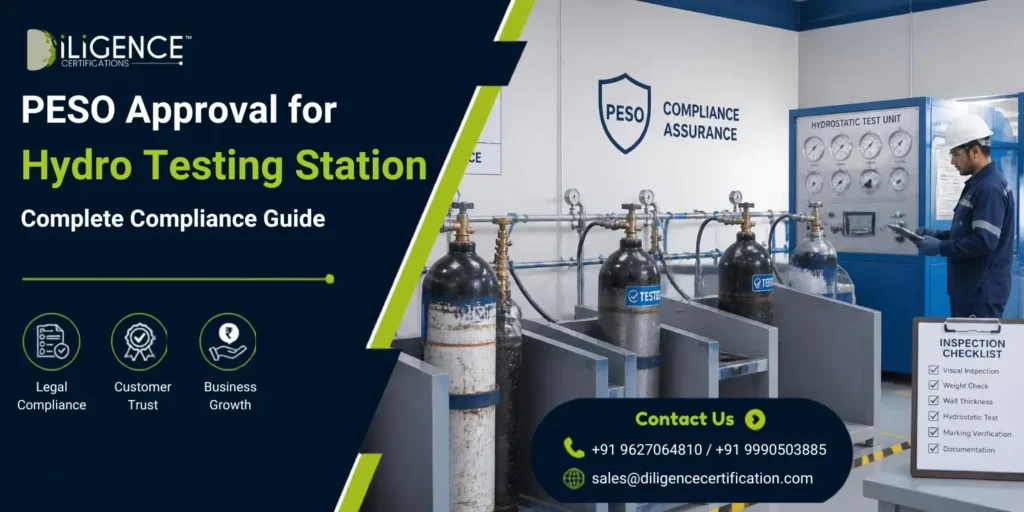
By - PESO Approval for Hydro Testing Station refers to the approval process for the stations which will perform the examination or testing of gas cylinders on a regular basis according to Gas Cylinders Rules, 2016.
- The Hydro Testing Stations require proper equipment, proper personnel, proper procedure, safety arrangements and facilities as prescribed in the relevant rules.
- Diligence Certifications can help organizations in fulfilling all these requirements.
Introduction
In the case of establishing a cylinder testing station, the initial approach to the project can be seen as purchasing some equipment: installing a hydro testing machine, arranging a compressor, hiring technicians, and starting the process of testing cylinders.
However, this can be problematic in the long run.
A cylinder testing station cannot be viewed as just a place where pressure vessels are being filled with water and pressurized. It is a regulated testing station which checks the condition and safety of gas cylinders before they are put back to use.
Take, for example, the business in Maharashtra which intends to test gas cylinders for several companies. The businessman already chose the location of the testing station and bought the necessary equipment, but during the regulation process, it became obvious that the proposed station is not equipped with all the necessary testing and safety measures.
The investment into equipment has been done. Making corrections now will require additional money and time.
Therefore, PESO Approval for Hydro Testing Station is to be considered right from the start of planning and designing.
PESO is responsible for administering the Gas Cylinders Rules, 2016, which include the recognition of cylinder testing stations. Recognition of cylinder testing stations and agencies responsible for the inspection/testing of cylinders are among the specific functions of PESO as highlighted in its Citizen Charter.
What Is PESO Approval for Hydro Testing Station?
PESO Approval for Hydro Testing Station refers to the recognition and regulatory approval of a facility that performs periodic examination and testing of gas cylinders in accordance with the Gas Cylinders Rules, 2016.
PESO stands for Petroleum and Explosives Safety Organisation. It is the regulatory organisation under the Government of India responsible for administering various laws and rules concerning petroleum, explosives, compressed gases and related hazardous substances.
Hydro testing normally includes hydrostatic testing in which a cylinder is put under controlled water pressure in order to determine the structural state of the cylinder. According to the nature of the cylinder and any other conditions, hydrostatic stretch testing and other tests may be necessary as well.
According to the Gas Cylinders Rules, 2016, the cylinders shall be subject to certain prescribed examination and hydrostatic/hydrostatic stretch test at periodic intervals prior to filling with compressed gas.
As per the regulations by the PESO, the cylinder testing station shall be recognized as a regulated activity, which shall be approved, inspected, and recognized by the PESO Circle Office whereas concerned Sub-Circle Office may inspect the premises and send its report to the Circle Office.
So a hydro testing station needs to be set up as an authorized cylinder testing station with the requisite equipment, competent manpower, and proper safety measures.
Why Is PESO Approval Important for a Hydro Testing Station?
The cylinder may appear normal externally but can contain flaws making it hazardous for further use.
Repetitive filling and emptying of the cylinders can make the cylinders susceptible to pressure, corrosion, wear and tear and other types of degradation. The use of an efficient test center ensures identification of cylinders fit for continued use and those to be disposed of according to the required regulation.
The objective of the recognition by PESO is thus associated with the capability, equipment, process and safety of the test center.
According to PESO, its role under the Gas Cylinders Rules encompasses approval, issuance, revision and renewal of licenses and recognition of test centers and inspection agencies for the testing of cylinders.
This will enable the business to have a legal framework for conducting tests on cylinders.
Which Rules Apply to a Cylinder Hydro Testing Station?
The principal regulatory framework is the Gas Cylinders Rules, 2016
PESO maintains the current Gas Cylinders Rules on its official website.
The rules address matters such as:
- Examination of cylinders
- Hydrostatic testing
- Hydrostatic stretch testing
- Testing intervals
- Testing station requirements
- Test records
- Marking of cylinders
- Safety arrangements
- Competent personnel
- Equipment and facilities
The rules also require testing stations to maintain complete records relating to cylinders tested at the facility. These records include information such as manufacturer, owner, serial number, specification, original test date, test pressure, working pressure, water capacity, tear weight, gas and valve details.
For this reason, documentation should be treated as part of the testing system itself.
PESO Approval for Hydro Testing Station: Step-by-Step Process
The process for PESO Approval for Hydro Testing Station generally begins with defining the cylinder-testing scope and continues through site preparation, equipment installation, inspection and recognition.
Step 1: Define Testing Scope
Select the cylinders that will undergo testing, such as LPG, CNG, oxygen, nitrogen, hydrogen, or industrial gas cylinders. Different regulations may be used based on cylinder types.
Step 2: Selection of Suitable Premises
Facilities shall prepare suitable areas for cylinder receipt, inspection, hydro testing, drying, segregation, storage and safe handling.
Step 3: Preparation of Layout
Prepare layout including hydrostatic test equipment, pressure gauges, volumetric equipment, inspection area, safety barrier, drying facility and movement path.
Step 4: Installation of Appropriate Equipment
Equipment required for the approved scope of testing shall be installed. This could include hydrostatic testing equipment, gauges, weighing scales, leak testing facility, drying facility and cylinder handling equipment.
Step 5: Arrangement of Competent Technicians
Technicians shall have appropriate skills in cylinder inspection, hydrostatic testing, defect detection and other relevant aspects.
Step 6: Filing of Application
Prepare the required documents and submit application through the relevant Petroleum and Explosives Safety Organisation (PESO).
Step 7: PESO Inspection
PESO may inspect the premises, equipment, technicians and other facilities as deemed necessary.
Step 8: Correction of Observation(s)
Appropriate action must be taken in case of any deficiency noted during the inspection process.
Step 9: Recognition
The testing facility will obtain the appropriate PESO recognition and work within the specified scope.
What Equipment Is Required for a PESO-Approved Hydro Testing Station?
The exact equipment depends on the scope of the testing station.
However, the Gas Cylinders Rules and related requirements provide for facilities necessary for identification, cleaning, inspection, testing and other required activities. PESO’s regulatory material specifically refers to hydrostatic testing apparatus comprising pressurising equipment, pressure gauges and volumetric measurement equipment.
A typical facility may therefore require:
Hydrostatic Test Apparatus
Used to subject cylinders to the prescribed hydrostatic test.
Pressure Gauges
Used to monitor test pressure accurately.
Volumetric Measurement System
Relevant where hydrostatic stretch testing and permanent volume change measurement are applicable.
Weighing Equipment
Used for assessing tare weight and relevant cylinder information.
Leak Testing Equipment
The applicable testing facility may require arrangements for leak testing at working pressure using compressed air or an inert gas source and suitable equipment.
Cleaning and Drying Equipment
Cylinders should be appropriately cleaned and dried after testing where required.
Inspection Tools
These help identify corrosion, dents, damage, thread defects and other conditions requiring assessment.
Safe Handling Equipment
Cylinder movement should be controlled to minimise dropping, impact or other mechanical damage.
What Documents Are Required for PESO Approval?
The exact document checklist depends on the proposed testing station and cylinder category.
Common documentation may include:
Business Documents
- Certificate of incorporation
- PAN
- GST details
- Business address
- Authorisation letter
- Applicant details
Premises Documents
- Ownership or lease documents
- Site plan
- Building layout
- Testing station layout
- Access details
Technical Documents
- Equipment list
- Hydro test equipment specifications
- Pressure gauge details
- Calibration certificates
- Volumetric measurement equipment details
- Leak-testing equipment details
- Safety equipment details
- Testing procedures
Personnel Documents
- Qualification records
- Experience details
- Training records
- Competency documents, where applicable
Operational Documents
- Testing procedure
- Cylinder identification procedure
- Inspection checklist
- Test record format
- Rejection procedure
- Safety procedure
- Emergency response procedure
PESO’s rules specifically require complete testing records for cylinders examined and tested at a testing station.
What Records Must a Cylinder Testing Station Maintain?
Record keeping is one of the areas that should be designed before the first cylinder arrives.
The Gas Cylinders Rules specify detailed information to be maintained for cylinders tested at a station.
Records can include:
- Cylinder manufacturer
- Cylinder owner
- Cylinder serial number
- Cylinder specification
- Original hydrostatic test date
- Manufacturer test reports
- Test pressure
- Maximum working pressure
- Water capacity
- Tare weight
- Actual tare weight
- Cylinder shell condition
- Gas name
- Valve type
- Remarks
The rules state that these particulars form the history card or record for each cylinder, with changes recorded over time.
This is important operationally. A testing station should be able to establish the testing history of a cylinder rather than treating every visit as an isolated transaction.
How Does Hydrostatic Testing Work?
Hydrostatic testing uses water as the test medium to evaluate the pressure integrity of a cylinder.
The cylinder is prepared, examined and connected to the appropriate test equipment. It is then subjected to the prescribed test pressure under controlled conditions.
Depending on the applicable test, the system may measure pressure behaviour and volumetric changes.
A cylinder may be considered to have failed if prescribed conditions such as leakage, unacceptable pressure reduction, visible bulging, deformation or other defects are identified. The applicable criteria depend on the cylinder and testing method.
After testing, the cylinder should be handled according to the applicable procedure, including drying and marking requirements.
Hydro testing is therefore not simply a matter of “checking whether the cylinder bursts.” It is a controlled examination designed to establish whether the cylinder remains suitable for service.
Which Cylinders Can a PESO Hydro Testing Station Test?
The permitted scope depends on the station’s approval and applicable regulatory requirements.
Potential categories may include:
- Industrial gas cylinders
- CNG cylinders
- LPG cylinders
- Oxygen cylinders
- Nitrogen cylinders
- Other compressed-gas cylinders
However, businesses should not assume that a general hydro-testing approval automatically authorises testing of every cylinder category.
PESO maintains separate lists of recognised testing facilities, including LPG testing stations and approved CNG cylinder testing stations The scope should therefore be established before investing in equipment.
PESO Approval for Hydro Testing Station for Different Industries
Industrial Gas Companies
Industrial gas companies may need testing arrangements for cylinders used to supply oxygen, nitrogen, argon, carbon dioxide and other gases.
The testing scope should be aligned with the cylinders actually handled by the business.
CNG Industry
CNG cylinders operate under demanding pressure conditions and require appropriate testing arrangements PESO maintains a dedicated list of approved CNG cylinder testing stations.
LPG Industry
LPG cylinder testing has specific regulatory requirements and should be handled through the applicable testing-station framework.
Cylinder Manufacturers
Manufacturers may require recognised testing facilities as part of their quality-control and regulatory processes.
Third-Party Testing Businesses
A business may establish a testing station specifically to provide testing services to cylinder owners and manufacturers For such businesses, understanding the approved scope is particularly important because the commercial offering should match the regulatory recognition.
Common Mistakes in Hydro Testing Station Approval
Buying Equipment Before Regulatory Assessment
This is one of the costliest mistakes.
A machine may be technically capable of testing cylinders but still not be sufficient for the complete regulatory requirements of the proposed station.
Ignoring the Testing Scope
A facility intended for LPG cylinders may have different requirements from one intended for industrial high-pressure cylinders.
Inadequate Layout
Poor separation between incoming cylinders, tested cylinders and rejected cylinders can create operational and safety problems.
Weak Record-Keeping
A testing station must maintain proper cylinder histories and test records.
Missing Calibration Records
Testing equipment is only useful when measurements can be relied upon. Calibration and equipment-control records should therefore be maintained appropriately.
Untrained Personnel
A pressure-testing station requires people who understand both the equipment and the hazards.
Treating Inspection as a Formality
The purpose of inspection is to establish whether the facility is genuinely ready to perform regulated testing.
Timeline, Cost and Validity of PESO Approval
There is no responsible single timeline or cost applicable to every hydro testing station.
| Timeline | Cost | Validity |
| Depends on the testing scope, documents, inspection and observations. | Depends on premises, testing equipment, calibration, safety systems and applicable PESO charges. | Depends on the recognition/approval granted under the applicable framework. |
| Site readiness can affect processing. | Additional equipment or corrective work can increase expenditure. | Renewal or extension requirements should be monitored according to the applicable approval. |
| Regulatory observations can affect processing time. | Professional consultancy and inspection-related expenses may vary. | Changes in scope or facility may require regulatory action. |
According to the PESO’s Gas Cylinder Regulations, there are provisions with regards to the validity of some of the testing-station approvals. According to these provisions, the approval for the test and hot reconditioning/repair of LPG and welded cylinders will have an initial validity period of one year and shall be renewable afterwards depending on the conditions, which include the issuance of a valid ISO Accreditation Certificate.
Since validity provisions vary depending on the category of testing stations, companies are advised to check the appropriate provision.
Current PESO Updates Relevant to Testing Stations
The regulatory framework for PESO is still evolving.
The latest circular page shows some new developments in relation to cylinder compliance, CNG cylinder test certificate verification, cryogenic gas cylinders, and other gas cylinders issues.
PESO has also issued 2026 updates on the amendments and proposals to make amendments to the Gas Cylinders Rules.
One thing that becomes very clear is: Do not design your application based on the old checklist or previous projects’ documentations only.
The applicant needs to verify the latest PESO regulations, SOP, forms, circulars and requirements of the testing stations before submission.
Benefits of PESO-Recognised Hydro Testing Station
A properly established testing station offers several practical benefits.
| Benefit | Business Value |
| Regulatory recognition | Supports lawful testing operations |
| Standardised testing | Creates consistent examination procedures |
| Proper records | Improves cylinder traceability |
| Qualified personnel | Reduces avoidable testing errors |
| Controlled facility | Supports safer cylinder handling |
| Defined testing scope | Helps avoid unauthorised testing |
For a third-party testing business, recognition can also improve credibility with cylinder manufacturers, gas companies and industrial customers.
Why Choose Diligence Certifications for PESO Approval?
Diligence Certifications supports businesses with PESO licensing and compliance requirements in India.
The company can help coordinate the regulatory side of a hydro testing station project with the technical information supplied by the applicant.
This is particularly useful where the applicant is dealing with equipment vendors, engineering consultants and testing personnel at the same time.
The focus should not be on obtaining a generic “PESO certificate.” The real objective is to establish the correct regulatory recognition for the specific testing activity.
Diligence Certifications can assist businesses in identifying that route and preparing the application accordingly.
Conclusion
“PESO Approval for Hydro Testing Station” is an important regulation that businesses need to consider when they want to inspect and test their gas cylinders in India.
The regulation is governed mainly by Gas Cylinders Rules, 2016, with PESO taking the responsibility for recognition and inspection of this regulation. The testing station needs to have the right equipment, the right people, premises, processes, and proper records of the cylinder.
The best course of action would be to define the extent of testing first and design the testing station according to the defined regulations. Purchase of equipment without knowing the regulation will only lead to unnecessary spending and extra work.
If a business wants to establish a testing station for its industrial gas cylinders, CNG, LPG, or any other regulated cylinder, Diligence Certifications can help in obtaining the required PESO Approval for Hydro Testing Station.
Frequently Asked Questions
What is PESO Approval for Hydro Testing Station?
It is the applicable PESO recognition/approval for a facility authorised to conduct periodic examination and testing of gas cylinders under the Gas Cylinders Rules, 2016.
Is PESO approval required for a cylinder hydro testing station?
A facility seeking recognition to periodically examine and test regulated gas cylinders needs to follow the applicable PESO recognition process under the Gas Cylinders Rules, 2016.
What is hydrostatic testing of a gas cylinder?
Hydrostatic testing is a controlled pressure test using water to assess the integrity of a cylinder; applicable testing may also involve hydrostatic stretch testing and other prescribed examinations.
What equipment is required for a hydro testing station?
Equipment can include hydrostatic test apparatus, pressure gauges, volumetric measurement equipment, inspection tools, leak-testing facilities, drying systems and safe cylinder-handling equipment, depending on the approved scope.
Can one testing station test every type of gas cylinder?
Not automatically. The permitted testing scope depends on the applicable approval, cylinder category, equipment and regulatory requirements.
What records should a cylinder testing station maintain?
Records can include cylinder identification, manufacturer, owner, specification, test dates, test pressure, working pressure, water capacity, tear weight, shell condition, gas and valve details.
Does PESO inspect the hydro testing station?
Yes. PESO's SOP provides for inspection of the premises as part of the recognition process, with the relevant Circle office responsible for approval and inspection arrangements.
How long does PESO approval for a hydro testing station take?
There is no universal timeline. Processing depends on the testing scope, documentation, site readiness, inspection and resolution of any observations.
Can Diligence Certifications help with hydro testing station approval?
Yes. Diligence Certifications can assist with regulatory assessment, documentation, application preparation, inspection readiness and PESO compliance support.
Can an approved testing station change its testing scope?
Changes should be reviewed against the applicable PESO requirements before the facility starts testing additional cylinder categories.