BIS Certification
 CDSCO
CDSCO
 PESO
PESO
 CPCB
CPCB
 LMPC
LMPC
 WPC Approval
 Global Approvals
 TEC
TEC
 ARAI
ARAI
 BEE
BEE
 ISO Certification
 DGCA Certification
 NOC For Steel
 APEDA Registration























 Business Registration
 FSSAI Mark Certification












 (32).jpg)
 Legal Services
 Trademark Registration
 Copyright Registration
 Patent Registration
 By
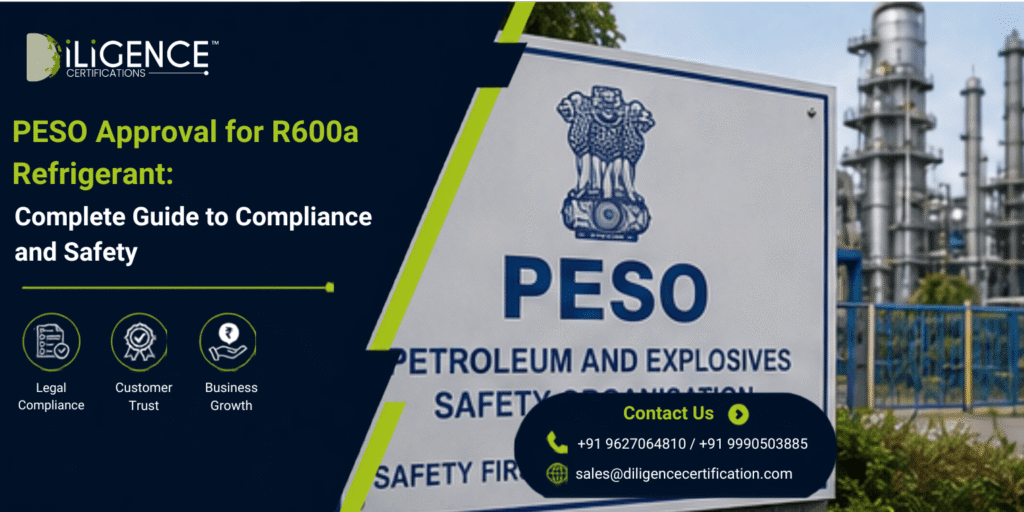
By - PESO Approval for R600a Refrigerant depends on how R600a is imported, stored, filled, transported or supplied, because R600a is isobutane, a flammable hydrocarbon refrigerant.
- In India, the relevant PESO requirements can arise under the Gas Cylinders Rules, 2016, depending on the cylinder, quantity, activity and manner in which the gas is handled.
- R600a is listed by BIS as isobutane (C₄H₁₀), and BIS standards specifically recognise R600a among refrigerants covered by refrigerant-property and specification work.
Introduction
A refrigeration equipment manufacturer may think of R600a simply as the gas that goes into a refrigerator or cooling system. From a regulatory perspective, the picture is different.
R600a is isobutane, a hydrocarbon refrigerant. It is classified as an A3 refrigerant under widely used refrigerant safety classifications, meaning it has higher flammability characteristics than non-flammable refrigerants.
This matters when the gas is handled in cylinders, stored in quantity, filled into cylinders, imported in gas cylinders or used in a commercial gas-filling operation.
Therefore, PESO Approval for R600a Refrigerant is not necessarily a single product certificate issued simply because a company sells R600a. The applicable requirement depends on the activity being carried out.
Why Is R600a Considered a Special Refrigerant for Compliance
R600a is not a fluorinated refrigerant. It is isobutane, with the chemical formula C₄H₁₀. BIS material identifies R-600a as isobutane and includes it among refrigerants covered by relevant Indian standardisation work.
For refrigeration engineers, this means the refrigerant has to be handled differently from a non-flammable refrigerant. Storage cylinders, valves, filling equipment, electrical arrangements, ventilation and ignition-source controls become important when R600a is handled in quantities that bring the activity within applicable regulatory requirements.
Is R600a Covered Under PESO Regulations in India
Potentially, yes, depending on the activity and manner of handling.
The relevant PESO framework can involve the Gas Cylinders Rules, 2016, particularly where R600a is stored, filled, imported or otherwise handled in cylinders.
PESO’s official website lists the Gas Cylinders Rules, 2016 and provides the associated forms and regulatory information.
However, it would be inaccurate to say that every refrigerator containing a small quantity of R600a automatically requires a separate PESO approval.
The regulatory applicability needs to be assessed based on factors such as:
- Quantity of R600a
- Form in which it is supplied
- Cylinder type
- Whether cylinders are filled or empty
- Import activity
- Storage activity
- Filling activity
- Manufacturing activity
- Transportation
- Industrial premises
- Intended use
- Applicable exemptions, if any
This is why a proper applicability assessment should come before filing an application.
R600a Refrigerant and Gas Cylinders Rules, 2016
The Gas Cylinders Rules, 2016 form an important part of the regulatory analysis for R600a when the refrigerant is handled in cylinders.
PESO’s official rules page provides the Gas Cylinders Rules, while its official SOP provides the framework for approvals and licences issued under those rules.
The rules cover matters such as:
- Manufacture of cylinders
- Import of cylinders
- Filling of cylinders
- Storage
- Possession
- Transport-related requirements
- Testing
- Inspection
- Marking
- Labelling
- Safety requirements
The exact provisions applicable to a particular R600a operation should be established from the current rules and applicable amendments.
This point is especially relevant because the Gas Cylinders Rules have been amended over time, including amendments published by the Government. PESO currently also lists a Gas Cylinders (Amendment) Rules, 2026 page.
Therefore, businesses should avoid relying on an old compliance checklist downloaded several years ago.
What Documents Are Required for PESO Approval for R600a Refrigerant
The exact documentation depends on the application.
A typical compliance file may include the following.
Company Documents
- Certificate of incorporation
- PAN
- GST registration
- Authorisation letter
- Factory registration details
- Ownership or lease documents
Gas Details
- R600a product specification
- Safety Data Sheet
- Gas composition
- Purity specification
- UN classification details where applicable
- Quantity to be stored
- Quantity to be filled
Cylinder Documents
- Cylinder specification
- Cylinder test certificate
- Manufacturer details
- Valve details
- Cylinder approval information
- Inspection and test records
- Marking and labelling information
Site Documents
- Site layout
- Storage layout
- Filling-area layout
- Safety-distance details
- Ventilation arrangements
- Fire-safety provisions
- Emergency arrangements
- Electrical layout where relevant
Process Documents
- Process Flow Diagram
- Piping and Instrumentation Diagram
- Filling procedure
- Gas-handling procedure
- Emergency shutdown arrangement
- Safety operating procedure
The exact documents should be confirmed against the applicable PESO service rather than assuming one universal checklist.
What Is the PESO Approval Process for R600a
A practical compliance process can be divided into several stages.
Step 1: Regulatory Applicability Assessment
First identify what the company is actually doing with R600a.
Is it importing
Storing
Filling
Manufacturing
Transporting
Using the gas only as a component of a finished appliance
This is the starting point.
Step 2: Review Gas and Cylinder Specifications
Confirm that the R600a specification, cylinder and valve arrangement are appropriate for the intended activity.
Step 3: Prepare the Site Layout
For storage or filling operations, prepare the required layout and safety arrangements.
Step 4: Prepare Technical Documents
Prepare the process description, drawings, specifications, safety arrangements and supporting certificates.
Step 5: Submit the PESO Application
The applicable application is filed through the prescribed PESO process.
PESO provides online systems and official information for approvals and licences under the Gas Cylinders Rules.
Step 6: Inspection and Verification
Where applicable, PESO inspection verifies whether the actual installation corresponds with the submitted documentation and safety requirements.
Step 7: Address Observations
If regulatory observations are raised, the applicant must provide the required clarification or corrective action.
Step 8: Obtain the Applicable Approval or Licence
Once the authority is satisfied, the applicable licence or approval is issued according to the regulatory route.
Step 9: Maintain Compliance
Compliance continues after approval through testing, inspection, renewal and controlled operation.
Common Compliance Mistakes With R600a
Treating R600a Like a Non-Flammable Refrigerant
R600a’s flammability should be reflected in the safety design.
Importing Before Checking Cylinder Requirements
The gas may be technically suitable while the cylinder documentation is not.
Using an Ordinary Storage Room
Storage arrangements should be assessed for the quantity and flammable nature of the gas.
Ignoring Valve Compatibility
The cylinder valve is a critical part of the gas-containment system.
Using Incorrect Labelling
Gas cylinders require appropriate identification and warnings under the applicable rules.
How Diligence Certifications Helps With PESO Approval for R600a Refrigerant
R600a compliance can involve more than a licence application.
The business may need to coordinate gas specifications, cylinders, site layout, storage arrangements, filling systems, technical documents and regulatory submissions.
Diligence Certifications can assist businesses with:
- PESO applicability assessment
- Gas Cylinders Rules compliance
- R600a storage compliance
- R600a filling-licence support
- Import compliance
- Technical-document preparation
- Site-layout review
- PESO application support
- Inspection preparation
- Regulatory query responses
- Licence renewal
- Amendment support
- Ongoing compliance guidance
For companies dealing with several regulated gases, an integrated compliance review can be more practical than applying for individual approvals without understanding the complete regulatory picture.
Conclusion
PESO Approval for R600a Refrigerant needs to be approached as an activity-specific compliance question rather than as a generic certificate for the refrigerant.
R600a is isobutane and a flammable A3 refrigerant. When businesses import, store or fill the gas in cylinders, the applicable requirements under the Gas Cylinders Rules, 2016 become particularly important. PESO’s official framework includes dedicated procedures for cylinder imports and for licensing activities involving filling and storage of compressed gases.
For refrigeration manufacturers, the key is to separate the compliance requirements for R600a gas handling from those applicable to the finished refrigeration product. This avoids both unnecessary applications and, more importantly, missed regulatory requirements.
Frequently Asked Questions
What is PESO Approval for R600a Refrigerant?
PESO Approval for R600a Refrigerant refers to the applicable PESO approval or licensing requirements associated with activities such as importing, filling, storing or handling R600a in regulated gas cylinders. The exact requirement depends on the activity, quantity, cylinder and premises.
Is R600a a flammable refrigerant?
Yes. R600a is isobutane and is classified as A3 under commonly used refrigerant safety classifications.
Is R600a covered under the Gas Cylinders Rules, 2016?
The applicability depends on how R600a is handled. Where the activity involves regulated compressed-gas cylinders, the Gas Cylinders Rules, 2016 should be assessed. PESO administers the relevant regulatory framework.
Does importing R600a cylinders require PESO approval?
Import requirements depend on the nature of the cylinder and gas shipment. PESO states that cylinders filled or intended to be filled with compressed gas require the applicable licence route for import under the Gas Cylinders Rules.
Does an R600a filling plant need a PESO licence?
A business filling and/or storing compressed gas in cylinders should assess the applicable licence under the Gas Cylinders Rules. PESO lists Form-C for the grant, amendment or renewal of a licence to fill and/or store compressed gas in cylinders.
Is BIS certification the same as PESO approval?
No. BIS and PESO have different regulatory functions. BIS certification relates to conformity with applicable Indian Standards and becomes mandatory for products when required by the relevant legal order, while PESO administers specific safety and licensing frameworks.
What documents are required for R600a PESO approval?
Depending on the activity, documents can include gas specifications, SDS, cylinder and valve details, test certificates, site layouts, storage/filling drawings, process documents, safety arrangements and company documents.
Can R600a be stored in an ordinary warehouse?
The storage arrangement should not be assumed to be acceptable simply because the cylinders are commercially available. The quantity, cylinder type, flammability, ventilation, ignition sources and applicable Gas Cylinders Rules requirements need to be assessed.
Does a refrigerator manufacturer need PESO approval for every R600a appliance?
Not necessarily. The regulatory position depends on how the refrigerant is handled. A factory storing and charging bulk R600a requires a different regulatory assessment from a finished appliance containing a sealed refrigerant charge.
How can Diligence Certifications help with R600a compliance?
Diligence Certifications can assist with regulatory applicability, Gas Cylinders Rules compliance, documentation, PESO application support, site preparation, inspection coordination, regulatory queries, licensing and ongoing compliance.