 BIS Certification
 CDSCO
CDSCO
 PESO
PESO
 CPCB
CPCB
 LMPC
LMPC
 WPC Approval
 Global Approvals
 TEC
TEC
 ARAI
ARAI
 BEE
BEE
 ISO Certification
 DGCA Certification
 NOC For Steel
 APEDA Registration

















 Business Registration
 FSSAI Mark Certification







 (32).jpg)
 Legal Services
 Trademark Registration
 Copyright Registration
 Patent Registration
 By
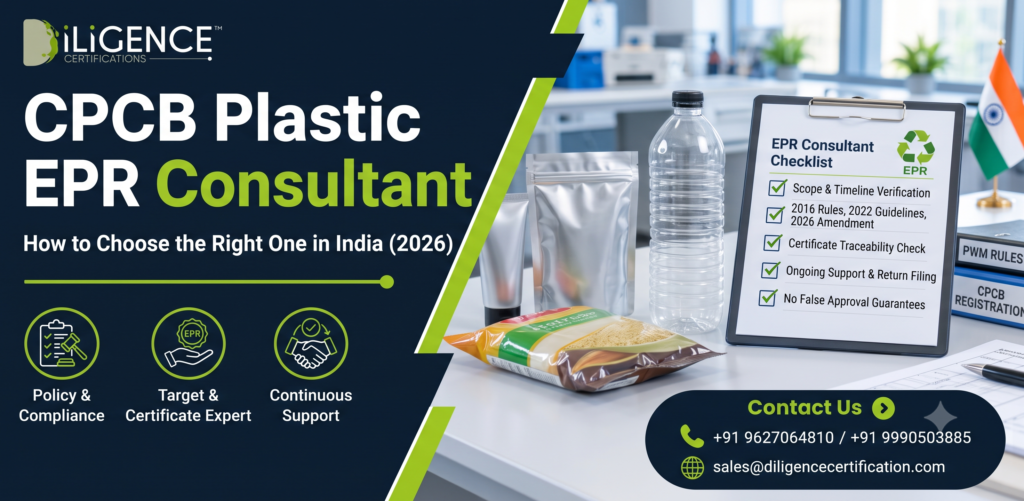
By - A CPCB plastic EPR consultant helps producers, importers and brand owners register on the CPCB portal, understand their targets, arrange EPR certificates and file annual returns.
- Plastic EPR applies to PIBOs and plastic waste processors, including brand owners who get their products made and packed by others.
- The rules keep changing, so check that your consultant follows the 2016 rules, the 2022 EPR guidelines and the 2026 amendment.
- Before hiring, ask for a clear written scope. Ask who does the work, how certificates are arranged, and what support you get after registration.
- Avoid anyone who promises fixed approvals or timelines, because the final decision always rests with the authority.
Introduction
Last year, a small snack brand owner called us in a hurry. His products were selling well on two online marketplaces. Then one marketplace asked him for his plastic EPR registration number. He had never heard of it. His packets were plastic, his packers were outside, and nobody had told him that he was responsible for the waste those packets create.
This is a very common story. Many founders learn about plastic EPR only when a buyer, marketplace, or notice asks for it. If you are in the same place, a CPCB plastic EPR consultant can save you time and confusion. But only if you pick the right one.
This guide explains the work in simple words. You will see who needs registration, what a consultant does, what you still have to do yourself, and how to choose without getting trapped.
What Is a CPCB Plastic EPR Consultant?
A CPCB plastic EPR consultant is a compliance expert who helps businesses register on the CPCB EPR portal, understand their plastic packaging targets, arrange EPR certificates, and file returns on time. In short, the consultant handles the paperwork and the rules, so you can focus on running your business.
EPR means Extended Producer Responsibility. The idea is simple. If your business puts plastic packaging in the market, you must make sure an equal amount is collected and recycled or properly processed.
Who Needs Plastic EPR Registration in India?
Under the Plastic Waste Management Rules, 2016, registration is needed for Producers, Importers and Brand Owners. These are called PIBOs. Plastic waste processors, such as recyclers, also need to register.
You may fall in this group if you:
- make plastic packaging, like pouches, bottles, films or carry bags
- import plastic packaging, or import goods that come in plastic packaging
- sell products under your own brand, even if someone else makes and packs them
- sell on e-commerce platforms with plastic packaging
First-time sellers often think, “I only buy packaging, so I am not the producer.” That is not correct in many cases. A brand owner is also covered. If you are unsure, ask for a quick check before you decide anything.
What Does a CPCB Plastic EPR Consultant Actually Do?
Good consultants do more than file one form. The work usually looks like this:
- Check if you are covered. They look at your business type and your packaging.
- Sort your packaging into categories. Plastic packaging is grouped as rigid, flexible, multi-layered and compostable. Biodegradable plastic has its own rules too.
- Prepare your documents. They tell you what is needed and catch mistakes early.
- Handle the registration. They fill the online application and answer queries from the authority.
- Work out your targets. Based on the plastic you put in the market, they help you understand what you must fulfil.
- Arrange EPR certificates. Certificates come from registered processors who have actually processed plastic waste.
- File annual returns. They prepare the data and submit it before the due date.
- Keep you updated. Rules change often. A consultant should tell you what changed and what it means for you.
What You Still Have to Do Yourself
No consultant can do everything for you. Be ready to:
- share true and complete data about your packaging
- keep purchase and sales records in order
- check what is being filed in your name
- respond when something is asked of you
Plastic EPR Rules in 2026: What Changed
The rules have moved quite a bit in the last few years. A short timeline helps:
- 2016: The Plastic Waste Management Rules were notified and brought in the idea of EPR for plastic packaging.
- February 2022: EPR guidelines were added. These brought mandatory targets, the central CPCB portal, and the certificate system.
- 2024: Amendments separated biodegradable plastic from compostable plastic and gave it separate requirements.
- 31 March 2026: The Plastic Waste Management (Amendment) Rules, 2026 were notified. Reports on this amendment point to recycled content targets, reuse rules for some rigid packaging, audits by registered environment auditors, and a carry-forward option for some unmet targets.
How Plastic EPR Registration Works, Step by Step
The details differ by entity type, but the flow is usually like this.
- Create your account on the CPCB EPR portal for plastic packaging.
- Choose your entity type: producer, importer, brand owner or processor.
- Fill in business details such as name, address, PAN, GST and other basic data.
- Declare your plastic packaging by category and quantity.
- Upload documents and submit the application.
- Respond to queries if the authority asks for clarity.
- Receive registration once the application is approved.
- Plan your targets and certificates for the financial year.
- File the annual return on the portal.
The registration is the start, not the end. The real work is every year after that.
Documents Usually Needed
The exact list depends on who you are. In general, businesses keep these ready:
- PAN and GST details of the business
- Certificate of incorporation or proof of business constitution
- Importer Exporter Code, if you import
- State pollution board consent, where it applies to your unit
- Details of plastic packaging, category-wise
- Purchase, sales or import records that show quantities
- An authorised person’s details for the application
Do You Really Need a Consultant?
Honestly, not always. A very small business with simple packaging and good records may be able to register by itself. But a consultant is useful when:
- you have many SKUs or mixed packaging types
- you use multi-layered packets and are unsure about categories
- you import goods and packaging together
- you are short of time or staff
- you got a notice or a marketplace request and need to act fast
- you want year-round help, not just a one-time filing
Think of it like filing income tax. You can do it yourself. But when the numbers get complex, an expert saves more than they cost.
7 Checks Before You Hire a CPCB Plastic EPR Consultant
1. Ask which rules they are following today. A good answer names the 2016 rules, the 2022 EPR guidelines and the 2026 amendment, without fumbling.
2. Ask who will actually do the work. Some firms sell you the service and pass the job on. Know who your point of contact is.
3. Ask how they get EPR certificates. The certificates should come from registered processors and should be traceable on the portal. Do not accept vague answers.
4. Ask for a clear scope in writing. Registration only? Targets? Certificates? Annual returns? Unclear scope is the reason for most disputes later.
5. Ask how they handle your data. You should get copies of everything filed in your name.
6. Ask what happens after registration. Plastic EPR is a yearly job. A consultant who disappears after the certificate is not much help.
7. Ask what they cannot do. An honest consultant will tell you that approvals are decided by the authority, not by them.
Common Mistakes Businesses Make
The most common mistake is waiting. Many businesses start only after a notice arrives. By then, they are working under pressure.
The second mistake is wrong categories. A multi-layered pouch is not the same as a plain bottle. Wrong classification leads to wrong targets.
The third is weak records. If you cannot show how much plastic you used, it becomes hard to defend your numbers.
The fourth is treating EPR as a one-time job. Returns, audits and target tracking continue every year. If you miss your obligations, you can face action, which may include environmental compensation.
Why Choose Diligence Certifications for CPCB plastic EPR consultant Certification?
At Diligence Certifications, we try to keep compliance simple for business owners who are not experts in regulations. We explain each step in plain language, tell you what is needed from your side, and keep you updated when rules change.
Here is how we like to work:
- Clear scope first. You know what is included before you start.
- Packaging-first approach. We look at your actual packaging before suggesting a path.
- Honest advice. We will tell you if something is not needed, and we do not promise approvals, because the decision rests with the authority.
- Support after registration. Targets, certificates and annual returns need attention every year.
- Plain communication. No heavy jargon, only steps you can follow.
If you want to see how the process works for your business, you can read about our CPCB plastic EPR registration service and then speak with our team.
Conclusion
Plastic EPR is not meant to scare anyone. It is a legal duty, and like every duty, it is easier when you start early and keep records clean. A good CPCB plastic EPR consultant will explain your position, show you the road, and stay with you after registration.
Use the seven checks in this guide before you sign with anyone. Ask direct questions, ask for things in writing, and match their answers with the official portal.
If you want clear guidance for your own packaging, talk to the Diligence Certifications team today and get your questions answered in simple words.
Frequently Asked Questions
1. What is plastic EPR in India?
Plastic EPR means Extended Producer Responsibility. Businesses that put plastic packaging in the market must make sure an equal amount of plastic waste is collected and recycled or properly processed.
2. Who needs plastic EPR registration?
Producers, Importers and Brand Owners (PIBOs) who place plastic packaging in the market need it. Plastic waste processors, such as recyclers, also register on the CPCB portal.
3. Does a small business or a startup need plastic EPR registration?
t depends on whether you place plastic packaging in the market as a producer, importer or brand owner. Size alone does not decide it, so check your status early.
4. What documents are needed for plastic EPR registration?
Usually PAN, GST details, proof of business registration, IEC for importers, and category-wise details of your plastic packaging. The exact list depends on your entity type, so match it with the portal.
5. What are the categories of plastic packaging under EPR?
Rigid plastic, flexible plastic, multi-layered plastic and compostable plastic. Biodegradable plastic has separate requirements.
6. What is an EPR certificate?
It is a certificate issued by a registered plastic waste processor on the CPCB portal. It shows that a certain quantity of plastic waste has been processed. Brands use these certificates to meet their targets.
7. Do online sellers on Amazon or Flipkart need EPR registration?
If you sell branded products in plastic packaging, you may be covered as a brand owner. Marketplaces often ask sellers for their EPR registration number, so check your status.
8. Can I do EPR registration without a consultant?
Yes, it is possible. A business with simple packaging and clean records can try it on its own. A consultant is more useful when you have many products, mixed packaging or imports.
9. What happens if I do not follow plastic EPR rules?
You can face action from the authorities, which may include environmental compensation and other steps under the rules.
10. How do I choose the right CPCB plastic EPR consultant?
Ask which rules they follow today, who will do the work, how they arrange certificates, what is covered in writing, and what support you get after registration. Avoid anyone who promises fixed approvals.