 BIS Certification
 CDSCO
 PESO
 CPCB
 LMPC
 WPC Approval
 Global Approvals
 TEC
 ARAI
 BEE
 ISO Certification
 DGCA Certification
 NOC For Steel
 APEDA Registration





















 Business Registration
 FSSAI Mark Certification











 (32).jpg)
 Legal Services
 Trademark Registration
 Copyright Registration
 Patent Registration
 By
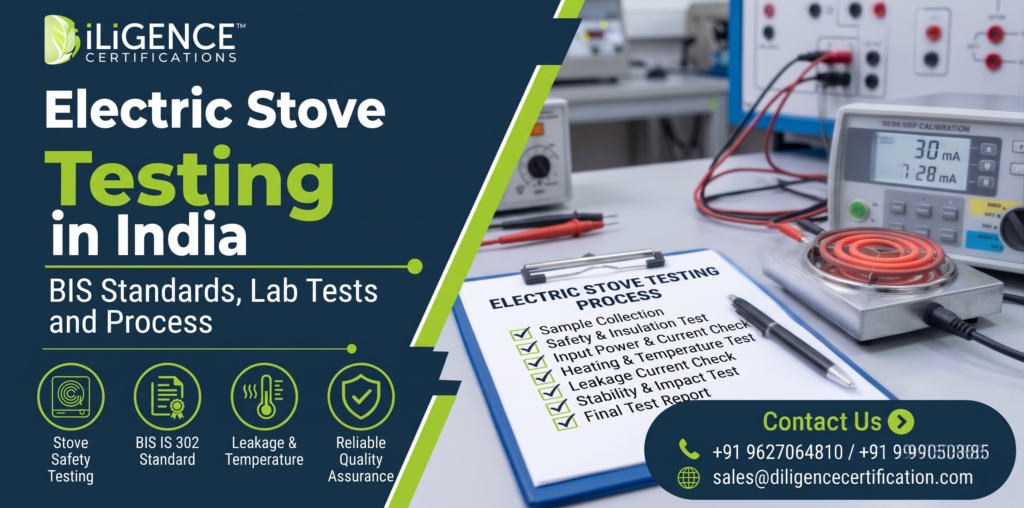
- Electric stove testing checks whether your stove is safe to use at home and works the way you claim on the box.
- In India, the safety side is mostly checked against IS 302 (the general part plus the part meant for electric stoves and hot plates).
- Testing is done in a lab that BIS recognises, and a factory lab alone is not enough for the final report.
- Most stoves fail on small things like marking, earthing, hot surface temperature and leakage current, not on big design problems.
- Always check the latest standard version and the current certification status on the BIS website before you apply.
- Good preparation before sending samples saves weeks of time and the cost of a second round.
Introduction
Think of it like a pressure cooker. You trust it every day because someone tested the valve, the gasket and the body before it ever reached your kitchen. Nobody wants to be the first person to find out the valve was weak.
An electric stove works the same way. It runs on 230 volts, it gets very hot, and it sits near water, oil and kids. So before it is sold, somebody has to prove it won’t give a shock, won’t melt its own wire and won’t catch fire.
That proof is what electric stove testing is all about. In this blog, we’ll go through it in very simple words: what standards apply, what tests happen, how the process runs, and where people usually go wrong.
What Is Electric Stove Testing?
Electric stove testing is a set of checks done on a stove sample in a laboratory. The lab runs the stove under normal use and also under bad conditions, and then compares the results with an Indian Standard.
Simple. If the stove passes every check in the standard, the lab gives a test report. That report is then used for BIS registration or licence, depending on the route you come under.
Testing usually covers two big areas.
- Safety: shock protection, heat, fire, strength of the body, wiring and earthing.
- Performance: how fast it heats, how well it holds temperature, and whether the power rating matches what is printed.
A safe stove that heats badly will get bad reviews. A fast stove that is unsafe can hurt someone. Good testing looks at both.
Electric Stove, Hot Plate and Induction Cooktop: What Is the Difference?
People use these words in the same breath, but for testing they are not the same. The standard changes with the product type, so first get this right.
| Product | How it heats | Usually checked under |
|---|---|---|
| Electric stove (coil or spiral type) | Open or covered heating element gets hot and heats the vessel | IS 302 Part 1 with the electric stove part |
| Electric hot plate | Flat plate or ring heated by a built-in element | IS 302 Part 1 with the hot plate part, and a separate performance standard |
| Cooking range, hob or oven | Built-in or standalone cooking units, often with more than one burner | IS 302 Part 1 with the range, hob and oven part |
| Induction cooktop | Magnetic field heats the vessel itself | Different standard route, so confirm before you apply |
If you are not sure where your product falls, ask before you start testing. Testing under the wrong standard is the most expensive mistake on this list.
Which Standards Apply to Electric Stove Testing?
In India, household electrical appliances are covered by the IS 302 series. IS 302 Part 1 gives the general safety rules. Then a Part 2 section gives the extra rules for each product type.
| Standard | What it covers |
|---|---|
| IS 302 Part 1 | General safety requirements for household and similar electrical appliances |
| IS 302 Part 2, Section 202 | Particular safety requirements for electric stoves |
| IS 302 Part 2, Section 207 | Particular safety requirements for electric hot plates |
| IS 302 Part 2, Section 6 | Cooking ranges, hobs, ovens and similar appliances |
| IS 365 | Performance requirements for electric hot plates |
Here is a simple example. Suppose you make a two-coil electric stove for homes. The lab will test it against IS 302 Part 1 and the electric stove section together. Part 1 sets the base rules, and the stove section adds rules that are special to this product, like abnormal heating without a vessel.
A small warning. IS 302 Part 1 has been revised in recent years, and the product sections are also being updated from time to time. Before you book a lab slot, check which version BIS is accepting for your product on its website. Do not trust an old PDF a friend forwarded.
Why Is Electric Stove Testing Important?
Many sellers think testing is just a paper formality. It is not. Here is why it matters.
- Shock protection: A cracked body or loose wire can put live voltage on the metal parts. Testing catches this early.
- Fire safety: Stoves can overheat when they run empty or when a switch fails. Lab abnormal tests copy these cases on purpose.
- Legal safety: Selling a product that is covered under compulsory certification without the proper registration can create serious trouble.
- Customer trust: A certified mark on the box tells the buyer that someone independent checked the product.
- Marketplace entry: Many online platforms and big retail chains ask for the test report or licence before they list the product.
- Fewer returns: A stove that is tested for strength and heating gives fewer complaints after sale.
What Tests Are Conducted in Electric Stove Testing?
The lab follows the clauses of the standard one by one. Below is a simple table so you know what to expect. The exact list depends on the standard version and the product type.
| Test group | What the lab checks | In simple words |
|---|---|---|
| Marking and instructions | Rating plate, voltage, wattage, symbols, warnings, manual | Is everything printed, readable and correct? |
| Protection against live parts | Can a finger or probe touch anything live? | Can a person get a shock by touching it? |
| Input power and current | Measured power against rated power | Does it draw what the label says? |
| Heating | Temperature rise on handles, knobs, body, cord, nearby surface | Is it too hot to touch where it should be cool? |
| Leakage current and electric strength | Current leaking to the body and insulation strength at working temperature | Is the insulation still safe after getting hot? |
| Moisture resistance | Behaviour after spills and damp conditions | What if water or milk spills on it? |
| Abnormal operation | Running without vessel, stuck control, blocked heat | What happens if things go wrong? |
| Stability and mechanical hazards | Tilting, sharp edges, moving parts | Will it tip over or hurt the user? |
| Mechanical strength | Impact on body and parts | Will it survive a small knock? |
| Construction and internal wiring | Wire size, routing, joints, clearances | Is it built neatly and safely inside? |
| Supply connection and cord | Power cord, plug, cord anchorage, pull and twist | Will the cord come loose after use? |
| Earthing | Earth continuity and connection | Is the metal body properly earthed? |
| Creepage and clearances | Gaps between live and touchable parts | Is there enough distance inside? |
| Heat and fire resistance | Plastic parts near the heat, glow wire test | Will it catch fire or melt? |
| Resistance to rusting | Corrosion on important metal parts | Will it rust and become unsafe? |
This list looks big, but each test has a clear pass or fail. Once you know the clauses, nothing is a surprise.
Performance Parameters Explained in Simple Words
Safety is only half the story. For hot plates, a separate performance standard also applies, and buyers care about this a lot. Here is a quick way to understand it.
| Parameter | What it means | Why people care |
|---|---|---|
| Rated power | The watts printed on the stove | Decides your electricity usage and heating speed |
| Heating time | How long it takes to heat a standard test load | Faster usually means happier customers |
| Temperature control | Does the knob really change the heat? | Cooking needs low, medium and high settings |
| Power consistency | Does power stay near the rating over time? | Cheap elements drift and heat slowly |
| Surface finish | Coating on the plate or body | Affects look, cleaning and rust |
A simple tip. If your printed wattage and your measured wattage are far apart, fix the element first. The lab will flag it in the first hour.
Two Kinds of Testing: Factory Lab and Recognised Lab
People often mix these two up, so let’s make it clear.
Factory lab testing is what you do in your own plant. It is for routine checks on every batch, like insulation resistance, earth continuity and basic heating checks. BIS expects a working in-house lab for licence holders.
Recognised lab testing is done in an outside laboratory that BIS recognises. The lab takes the sample, tests it fully and issues the official report. This report is what goes into your application.
The factory lab keeps your daily quality in shape. The recognised lab proves your product on paper. You need both, not either.
Step-by-Step Process for Electric Stove Testing
Here’s how it normally goes. Timelines will vary by lab and by how ready your product is.
- Confirm the product type. Decide if you have an electric stove, hot plate, hob or something else.
- Find the applicable standard. Check the latest version and the current certification status for your product on the BIS website.
- Do an internal pre-check. Test marking, earthing, heating and leakage in your own lab first.
- Choose a recognised lab. Pick one that has the scope for your product and standard.
- Prepare samples. Send the number of samples the lab asks for, in finished condition with manual and packaging.
- Submit the application and documents. Fill the lab form with model details, ratings and circuit diagram.
- Testing happens. The lab runs all the clauses and records the readings.
- Review the report. If something fails, fix it and retest only what is needed, as per lab rules.
- Use the report for registration. Attach the report to your BIS application and move to the next stage.
Do not skip step 3. A pre-check costs very little compared to a failed official test.
Which BIS Registration Is Needed?
The route depends on who you are and where the stove is made. Always check the current rules at the time of applying, because schemes and deadlines can change.
| Business type | Usual route |
|---|---|
| Indian manufacturer | Product licence from BIS after factory inspection and sample testing |
| Foreign manufacturer selling in India | Licence under the foreign manufacturers scheme through an authorised Indian representative |
| Importer who is not the manufacturer | Sells only products made by a licence holder, or arranges the right route with the brand owner |
| Private label seller | Works with a licensed manufacturer, and the licence and marking need to be in order |
| Export-only manufacturer | Indian licence may not be needed for goods that are only exported, but check the destination country rules |
A licence may need to be updated when you change the model, the factory location, the rating or the brand. Ask before you change, not after.
Documents Required
Keep these ready before you send the sample. A missing paper can hold up the whole job.
Company documents
- Business registration or incorporation proof
- Factory address proof
- Authorised person details and ID
- Authorisation letter if a consultant files for you
Product documents
- Model list with ratings and variants
- Circuit diagram and parts list
- Photos of the product, rating plate and packaging
- User manual and safety instructions
- List of critical parts with makes and ratings (element, switch, cord, plug)
Testing records
- Internal test results for the same model
- Calibration records of your lab equipment
- Earlier test reports, if any
- Critical component test reports or certificates
How Long Does Electric Stove Testing Take?
There is no fixed answer. The lab slot, the number of models, and whether anything fails will all change the time.
A clean sample with all documents ready usually moves faster. A sample that fails once adds the time needed to fix, resend and retest. Some labs also have queues, so ask for the expected slot before you send the sample.
As a rule of thumb, plan some buffer. Do not promise a launch date to your buyer on the day you send the sample.
What Decides the Cost?
Cost is not one number. It depends on these things.
- Number of models and variants you send for testing
- Lab charges per standard and per clause group
- Number of samples the lab asks for
- Courier and sample preparation
- Retesting if the first round fails
- BIS fees and factory inspection costs, if you apply for a licence
- Consultant support, if you take it
Ask the lab and your consultant for a written breakup. A clear breakup avoids surprise bills later.
Common Failures and Easy Fixes
Most failures are small. Here is what we usually see.
| Failure | Why it happens | Easy fix |
|---|---|---|
| Marking is incomplete | Missing voltage, wattage or symbol | Check the rating plate against the standard before printing |
| Earth continuity fails | Loose screw or thin earth wire | Use proper earth terminal and correct wire size |
| Handle gets too hot | Poor insulation or short handle | Improve handle material and add distance from the element |
| Leakage current is high | Moisture in insulation material | Use better insulating material and dry the parts well |
| Cord anchorage fails | Weak clamp or poor cord grip | Use a proper cord clamp and test pull before sending |
| Plastic part melts near heat | Wrong grade of plastic | Use heat resistant material with the right rating |
| Power is off from rating | Element quality changes | Check element resistance in every batch |
| Rust on important parts | Poor coating or plating | Improve coating and test with salt spray in your own lab |
Common Mistakes to Avoid
These eight mistakes cause most delays.
- Testing under the wrong standard because the product type was not clear.
- Using an old standard version without checking the latest one.
- Sending a prototype that is different from the final production model.
- Printing the rating plate before checking the clauses on marking.
- Skipping internal pre-testing to save a few days.
- Changing the element supplier after the sample was tested.
- Sending very few samples when the lab asked for more.
- Ignoring the lab’s feedback after the first failure and resending the same sample.
Who Needs Electric Stove Testing?
- Manufacturers who make stoves, hot plates or hobs in India.
- Importers who bring stoves from other countries and need test proof for the product.
- Private label brands who get their stove made by a factory and sell under their own name.
- Overseas manufacturers who want to sell in the Indian market.
- Export-only units who need reports for the destination country, even if no Indian licence is needed.
Why Choose Diligence Certifications for electric stove testing Certification?
Paperwork and lab coordination can eat a lot of time, especially if you are doing it for the first time. Diligence Certifications helps businesses understand the right standard, get ready for testing and handle the documents, step by step.
Here is how we help.
- We help you identify the right standard and scheme for your stove type.
- We guide you through the pre-check list so small mistakes are caught early.
- We help you with the documents, the application and the lab coordination.
- We keep you updated at every stage in simple language.
If you want to know more about our support for product testing and registration, you can look at our certification services page. We do not promise approvals, because the final decision always rests with the lab and the authority. What we promise is honest guidance and a clean file.
After Registration: Market Checks
Getting the licence is not the end of the story. BIS can pick up samples from the market and from your factory to check if the product still follows the standard.
So keep these habits.
- Keep batch records and test records for every production lot.
- Do not change the critical parts without informing the right people.
- Print the mark and the licence details exactly as allowed.
- Keep calibration of your lab equipment up to date.
A product that passes once and then slips in quality can still get into trouble later.
Tips to Pass in the First Attempt
- Read the standard clauses once, with the product in front of you.
- Do a full internal test round on three or more units, not just one.
- Check the rating plate and the manual against the marking clauses.
- Use critical parts that come with proper test reports or certificates.
- Test the abnormal case yourself: run the stove with no vessel and watch the temperatures.
- Check earth continuity and insulation resistance on every sample.
- Pack the samples properly so that nothing breaks in transit.
- Keep a single point of contact who can answer lab queries quickly.
Quick Checklist Before Sending Samples
- Product type and standard confirmed
- Latest standard version checked on the BIS website
- Rating plate and marking checked
- Earthing and insulation tested in-house
- Handle and body temperature checked
- Power cord and plug checked
- Critical parts list and reports ready
- Manual and packaging ready
- Circuit diagram and photos ready
- Application form filled correctly
Conclusion
Electric stove testing may look heavy at first, but it is just a set of clear checks. Know your product type, pick the right standard, test it yourself first, and then go to a recognised lab with your papers in order.
Most delays come from small errors and not from big technical problems. Fix those early, and the rest of the journey is much smoother.
Whenever you plan a new stove or a new model, check the latest standard and the current certification rules before you start. Rules do change, and it is always better to know first.
Frequently Asked Questions
1. What is electric stove testing?
It is a set of safety and performance checks done in a laboratory on an electric stove sample, based on the applicable Indian Standard.
2. Which standard applies to electric stove testing in India?
The general rules come from IS 302 Part 1, and the product rules come from the relevant Part 2 section for electric stoves. Always confirm the latest version on the BIS website.
3. Is BIS registration compulsory for electric stoves?
It depends on the current rules for your specific product type. Check the latest notification on the BIS website or ask a consultant before you launch.
4. What is the difference between an electric stove and a hot plate?
They look similar, but the standards and the performance checks can be different. The product type decides which sections apply.
5. Can I test an electric stove in my own factory lab?
You can do routine and pre-checks in your own lab, but the official report comes from a recognised laboratory.
6. How many samples are needed for testing?
The lab decides this. It depends on the standard and the number of models, so ask the lab before you send anything.