BIS Certification
 CDSCO
 PESO
 CPCB
 LMPC
 WPC Approval
 Global Approvals
 TEC
 ARAI
 BEE
 ISO Certification
 DGCA Certification
 NOC For Steel
 APEDA Registration























 Business Registration
 FSSAI Mark Certification












 (32).jpg)
 Legal Services
 Trademark Registration
 Copyright Registration
 Patent Registration
 By
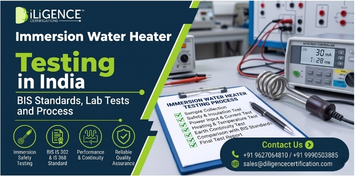
- Immersion water heater testing checks whether the rod is safe to use and heats water the way it claims to.
- In India, electric immersion water heaters come under the BIS ISI Mark scheme, so testing is not optional.
- Safety is covered by IS 302 (Part 2/Sec 201), and performance is covered by IS 368.
- Tests are done on sample units in a lab. Earth continuity, electric strength, power input and heating are some of the main ones.
- Most failures come from small things like poor earthing, weak insulation or wrong marking, and these are easy to fix before testing.
- Always check the latest version and amendments of the standards on the BIS portal before you apply.
Introduction
But think about it for a second. A metal rod is sitting inside a bucket of water, and it is connected to 230 volt supply. If even one thing is wrong inside, like a crack in the insulation or a loose earth wire, it can give a serious shock. That is why this small product needs proper testing.
Some people think of it like a pressure cooker. You never see the safety valve being tested, but you trust it because it was checked before the cooker reached your kitchen. Immersion water heater testing works in the same way. It happens quietly in a lab, and you only notice it when something goes wrong.
In this blog, we will explain the whole thing in very simple words. What testing means, which standards apply, which tests are done, how the process goes, and what mistakes you should avoid.
What Is Immersion Water Heater Testing?
Immersion water heater testing means checking sample units of an electric immersion heater in a lab against the Indian Standards. The lab looks at two big things. First, is the product safe? Second, does it actually do its job properly?
In India, electric immersion water heaters are covered under the compulsory BIS ISI Mark scheme. This means a manufacturer cannot sell the product with the ISI Mark unless it has a valid BIS licence, and to get that licence, the product has to pass the required tests.
Testing is also not a one-time thing. Even after you get the licence, BIS expects regular testing at your own factory lab and also surveillance checks. So think of it as a habit, not a one-day event.
Which Standards Apply?
Two Indian Standards are mainly talked about for immersion heaters. Both do different jobs.
| Standard | What it covers | In simple words |
|---|---|---|
| IS 302 (Part 2/Sec 201):2008 | Safety of electric immersion water heaters (works along with IS 302 Part 1 for general safety requirements) | Will it shock, burn or catch fire? |
| IS 368 | Performance of electric immersion water heaters | Does it heat water properly and last? |
The safety standard itself says that it does not cover performance requirements. Those are in the separate standard, IS 368. So when someone asks “which standard is for immersion rod?”, the honest answer is that both are important.
A simple example. Suppose your 1500 watt rod heats water very fast, but the body gets live when water enters the joint. It passes the performance side but fails safety. And the reverse can also happen. So both sides matter.
Important note: Standards get revised and amended from time to time. BIS has also issued circulars about amended standards and the testing arrangements firms must declare. Before you apply, please check the current version of the standard, the latest amendments and the scheme requirements on the BIS website.
Why Is Immersion Water Heater Testing Important?
- User safety. Water and electricity are a risky mix. Testing reduces the chance of shock and fire.
- Legal requirement. The product comes under the BIS compulsory scheme, so selling without the ISI Mark can bring action under the law.
- Customer trust. The ISI Mark tells buyers that the product was tested against Indian Standards.
- Fewer complaints. Rods that fail in the field mean returns, replacements and a bad name. Testing catches problems early.
- Better quality control. When you test regularly, you spot weak parts or bad batches before they reach the market.
- Smooth market entry. Dealers, e-commerce platforms and bulk buyers often ask for the licence details first.
What Tests Are Conducted?
The exact list depends on the standard and the scheme of testing and inspection (SIT) for the product. But in general, you can expect these test groups.
1. Marking and instructions check
- Rated voltage, rated power input, manufacturer details and the ISI Mark must be marked clearly.
- The marking must stay readable after rubbing with water and with a cloth. Cheap stickers that peel off are a common problem.
2. Protection against access to live parts
- The lab checks that a person cannot touch any live part during normal use.
- Test probes are used to check gaps, openings and joints.
3. Power input and current
- The lab measures the actual power the rod draws and compares it with the marked rating.
- If a rod says 1500 watt but draws far more or far less than the allowed deviation, it fails.
4. Heating test
- The heater is run under the conditions given in the standard and the temperature rise of the parts is measured.
- The idea is to check that nothing gets dangerously hot, including the handle, the plug and the cable.
5. Electric strength test
- A high voltage is applied between live parts and accessible metal parts for a fixed time.
- If the insulation breaks down, the product fails.
6. Earth continuity test
- This checks that the earth connection is solid and has low resistance.
- For a metal sheathed heater, a good earth is what saves a life when something goes wrong.
7. Functional test
- A simple but important check that the heater works correctly as designed.
8. Performance checks under IS 368
- Tests related to heating performance, such as how the heater behaves while heating water, and other points mentioned in the standard.
- Ask your lab for the full current test list, because requirements can change with revisions.
Simple View: Test Area and What the Lab Checks
| Test area | What the lab checks | In simple words |
|---|---|---|
| Marking | Voltage, wattage, ISI Mark, durability of print | Can the user read it and trust it? |
| Live part access | Probes on openings and joints | Can a finger touch something live? |
| Power input | Measured watts versus marked watts | Is it honest about its rating? |
| Heating | Temperature rise of parts | Will it burn the user or melt the cable? |
| Electric strength | High voltage on insulation | Is the insulation really strong? |
| Earth continuity | Resistance of earth path | Will earthing work when needed? |
| Functional test | Normal working | Does it do what it should? |
Two Kinds of Testing: Factory Lab and Recognised Lab
People often get confused here, so let us keep it simple.
Factory lab testing. BIS expects the manufacturer to have basic test facilities at the factory. You test products from your daily production, usually on a routine basis, as per the scheme. This is how you keep an eye on every batch.
Recognised lab testing. Here, samples are tested in a BIS recognised laboratory. This is the independent check. For licence purposes, BIS also draws samples during the factory inspection and gets them tested in the lab.
The scheme also talks about a control unit. For electric immersion water heaters, a control unit is generally the heaters of one type and rating made in a day. So if you make three ratings, you should plan testing for each of them, not only one.
Step-by-Step Process
- Check the product scope. Confirm that your product is an electric immersion water heater under the BIS scheme and note down your models and ratings.
- Study the standards. Read the latest IS 302 (Part 2/Sec 201), IS 302 Part 1 and IS 368, along with the current scheme of testing and inspection.
- Set up your factory test facility. You need basic instruments and trained people. Keep calibration records ready.
- Do internal pre-testing. Test your own samples first. This saves time and money later.
- Prepare the documents. Company papers, factory details, product details and test records. We have listed them in the next section.
- Apply on the BIS portal. The application goes through the BIS online system under the ISI Mark scheme.
- Factory inspection. A BIS officer visits the factory, checks the process and quality control, and draws samples.
- Lab testing of samples. The samples go to a BIS recognised lab for testing as per the standards.
- Grant of licence. If the factory inspection and test reports are in order, BIS can grant the licence, and then you can use the ISI Mark as per the rules.
No one can promise the approval or the exact time, because it depends on your documents, your factory and the test results. Be careful with anyone who does.
Documents Required
Company documents
- Proof of the business, such as registration or incorporation papers
- Factory address proof and ownership or rent papers
- Authorised person details and identity proof
- Organisation chart or list of key people
Product documents
- List of models, ratings and variants
- Product drawings and circuit or construction details
- Bill of materials with the supplier names of main parts, like the heating element, sheath, terminals and cable
- Marking details and the instruction leaflet
Testing and quality records
- List of test equipment and calibration certificates
- Factory test reports of your own production
- Quality control plan and process flow chart
- Earlier test reports, if any
How Long Does It Take?
There is no single answer. The time depends on how ready your factory is, how clean your documents are, the lab schedule, and whether any sample fails. A manufacturer who has already done pre-testing and has good records usually moves faster than one who is starting from zero.
Foreign manufacturers follow a separate route and generally need more time, so they should plan well in advance.
Cost: What Decides the Fees?
We are not giving any figures here because they change with time and with the case. But these are the main factors.
- Government application and licence fees
- Lab testing charges for each model and rating
- Cost of setting up or upgrading your factory test equipment
- Retesting charges if a sample fails
- Travel and inspection related costs
- Consultant fees, if you take professional help
Always ask for a clear breakup before you start. It saves a lot of surprises later.
Common Failures and Easy Fixes
| Common problem | Why it happens | Easy fix |
|---|---|---|
| Weak earth connection | Loose or thin earth wire, poor crimping | Use proper wire size and check every joint |
| Insulation breakdown | Moisture or poor filling inside the element | Improve sealing and control the filling process |
| Wrong power input | Element resistance varies too much | Tighten the supplier tolerance and test each batch |
| Parts getting too hot | Poor terminal or cable quality | Use better rated terminals and cables |
| Marking fades | Low quality print or sticker | Use durable marking and test rubbing yourself |
| Gaps near live parts | Poor design of the cap or joint | Redesign the cap and check with a test probe |
Common Mistakes to Avoid
- Selling with a fake or copied ISI Mark. This is a serious offence.
- Skipping pre-testing and sending samples straight to the lab.
- Sending a golden sample that is better than the real production.
- Using a different supplier for parts after the licence without informing BIS.
- Not keeping calibration records for your test equipment.
- Testing only one rating when you make many.
- Reading an old version of the standard and missing the latest amendment.
- Taking a consultant’s promise of guaranteed approval as final truth.
Who Needs This?
- Manufacturers in India. You need the BIS licence before you use the ISI Mark.
- Importers. If you bring in immersion heaters, the product still has to meet the Indian rules, and the foreign manufacturer generally needs to hold the BIS licence.
- Private label sellers. If you sell under your own brand but someone else makes the product, the licence and the brand details must match properly.
- Overseas manufacturers. If you want to export to India, you follow the foreign manufacturer route.
- Export only units. Check the rules of your destination country, because the Indian requirement and the export requirement are not always the same.
Why Choose Diligence Certifications for Immersion Water Heater Testing Certification?
If this all feels like a lot, you are not alone. Many first time applicants struggle with documents, test planning and the inspection stage. This is where a good guide helps.
At Diligence Certifications, the team helps you understand the standards, prepare your documents, plan your pre-testing and get ready for the factory inspection. You can read more about the service on the electric immersion water heater certification page.
One honest point. No consultant controls the final decision. BIS decides on the licence based on your factory, your documents and your test results. What a good consultant can do is make you well prepared, so you do not lose time on avoidable mistakes.
Tips to Pass in the First Attempt
- Read the latest standards before you finalise the design.
- Choose good quality heating elements and sheath material from reliable suppliers.
- Keep the earth path simple and strong.
- Run your own insulation and earth tests on every batch.
- Check the actual wattage against the marked wattage regularly.
- Use marking that does not fade or peel.
- Keep your records neat and dated.
- Do a full pre-test of every rating before the lab visit.
Quick Checklist Before Sending Samples
- Latest standards and amendments checked
- Models and ratings listed clearly
- Samples taken from normal production
- Earth continuity and electric strength tested internally
- Power input checked against the marked value
- Marking is clear and durable
- Calibration certificates are ready
- Bill of materials and drawings are updated
Conclusion
Immersion water heater testing may look like just another paperwork task, but it is really about the person standing in a bathroom with a bucket and a metal rod. A few small checks in the lab can save someone from a serious accident.
If you are a manufacturer, importer or brand owner, start early. Understand the standards, do your own pre-testing, keep your records clean, and always verify the latest rules on the BIS website. Do these basics right and the whole process becomes much easier.
Frequently Asked Questions
1. What is immersion water heater testing?
It is the lab checking of sample immersion heaters against Indian Standards to confirm they are safe and perform as claimed.
2. Is BIS certification compulsory for immersion water heaters?
Yes, electric immersion water heaters come under the BIS ISI Mark scheme. Please confirm the latest notification on the BIS website.
3. Which standard is used for immersion water heater safety?
IS 302 (Part 2/Sec 201), along with IS 302 Part 1 for general requirements.
4. Which standard covers performance?
IS 368 covers the performance requirements of electric immersion water heaters.
5. What are the main tests done?
Marking, protection against live parts, power input and current, heating, electric strength, earth continuity and functional tests, along with performance checks.
6. How many samples are needed?
The scheme of testing and inspection decides this. Check the current scheme or ask your lab before sending samples.
7. Can I test only one rating and sell all ratings?
No. Different types and ratings are usually treated separately, so plan testing for each of them.