 BIS Certification
 CDSCO
CDSCO
 PESO
PESO
 CPCB
CPCB
 LMPC
LMPC
 WPC Approval
 Global Approvals
 TEC
TEC
 ARAI
ARAI
 BEE
BEE
 ISO Certification
 DGCA Certification
 NOC For Steel
 APEDA Registration












 Business Registration
 FSSAI Mark Certification



 (32).jpg)
 Legal Services
 Trademark Registration
 Copyright Registration
 Patent Registration
 By
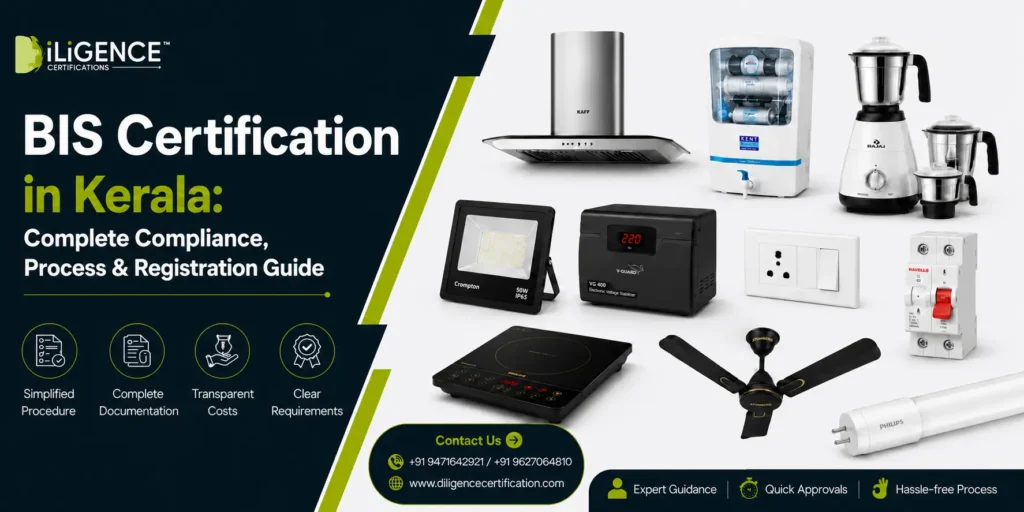
By - BIS Certification in Kerala is a mandatory regulatory approval for a wide range of products that fall under Indian quality and safety standards.
- In India, product compliance is not optional for regulated categories. Any business dealing with such products must obtain BIS certification before placing goods in the market.
- Non-compliance can lead to product seizure, penalties, import restrictions, and in some cases, complete market ban.
Introduction
BIS Certification in Kerala has become increasingly important due to the state’s evolving industrial ecosystem and rising consumer market demand. Kerala has a strong presence in sectors such as electronics distribution, construction materials, packaged food, electrical equipment, healthcare products, and renewable energy solutions.
Earlier, many small and medium enterprises believed BIS certification applied mainly to large manufacturing states. However, with centralized enforcement of standards across India, BIS regulations are uniformly applicable in all states, including Kerala.
For example, a distributor supplying LED lighting systems for smart city projects in Kochi or Thiruvananthapuram must ensure that the products have valid BIS certification before they are installed. Even if the product meets internal quality benchmarks, it cannot be legally sold if it falls under a mandatory BIS category without certification.
The Bureau of Indian Standards, operating under the Ministry of Consumer Affairs, Food & Public Distribution, Government of India, is responsible for setting and enforcing product standards. Bureau of Indian Standards
BIS Certification in Kerala ensures that only standardized, tested, and verified products reach consumers, thereby improving safety, reliability, and trust in the marketplace.
What is BIS Certification?
BIS Certification in Kerala is an official approval granted by Bureau of Indian Standards that confirms a product conforms to relevant Indian Standards (IS codes).
It is essentially a quality assurance system that validates whether a product meets predefined safety, performance, and reliability benchmarks before entering the Indian market.
Key Objectives of BIS Certification
- Ensuring product safety for end users
- Maintaining uniform manufacturing standards
- Preventing substandard and unsafe products
- Enhancing consumer confidence
- Supporting regulatory compliance in trade
Depending on the product category, BIS certification may be mandatory or voluntary. For notified products listed under government regulations, certification is compulsory before sale or distribution in Kerala and across India.
Types of BIS Certification in Kerala
BIS operates multiple certification schemes depending on product type, manufacturing origin, and regulatory requirements.
1. ISI Mark Certification
ISI Mark Certification is one of the oldest and most widely recognized certification schemes under BIS. It applies primarily to manufacturing-based products that require factory inspection and product testing.
Applicable Products
- Cement and construction materials
- Steel and structural products
- Electrical appliances and wiring devices
- Kitchen and household equipment
- Packaged drinking water and food containers
Process Highlights
- Factory inspection is mandatory
- Product samples are tested in BIS-approved labs
- Manufacturing process is evaluated for consistency
- ISI mark is granted only after full compliance
ISI certification is considered highly strict because it ensures continuous quality monitoring, not just one-time approval.
2. BIS CRS Registration
The Compulsory Registration Scheme (CRS) applies mainly to electronics and IT hardware products. It is particularly important in Kerala due to high demand for consumer electronics.
Applicable Products
- Mobile phones and smartphones
- Laptops and tablets
- LED lighting products
- Power adapters and chargers
- Batteries and power banks
- Smart electronic devices
Under CRS, manufacturers must test their products in BIS-recognized laboratories and register them before selling in India. Without CRS approval, electronic goods cannot legally enter the Indian market.
3. FMCS Certification
The Foreign Manufacturer Certification Scheme (FMCS) applies to overseas manufacturers exporting products to India.
Foreign companies must comply with BIS standards before their goods can be imported and sold in Kerala or any other Indian state. This ensures imported goods meet the same safety and quality standards as domestic products.
4. Hallmarking Certification
Hallmarking certification is mandatory for gold and precious metal jewellery. It ensures purity verification and protects consumers from fraud or substandard jewellery products.
This certification is particularly important in Kerala due to high demand for gold ornaments in retail markets.
Importance & Benefits of BIS Certification in Kerala
| Importance | Benefits |
| Ensures compliance with Indian quality regulations | Builds strong brand credibility |
| Mandatory for regulated product categories | Enables legal product sales in India |
| Required for government tenders and projects | Improves eligibility for contracts |
| Prevents legal penalties and seizures | Reduces compliance risk |
| Standardizes product quality | Improves customer satisfaction |
| Supports market expansion | Enhances business scalability |
| Strengthens manufacturing discipline | Improves operational efficiency |
BIS certification not only fulfills legal requirements but also strengthens long-term business trust and market positioning.
Industries Requiring BIS Certification in Kerala
BIS Certification in Kerala applies to multiple industries where safety, durability, and performance are critical.
Key Industry Sectors
- Electrical and electronics manufacturing
- Construction and infrastructure development
- Automotive components and mechanical engineering
- Consumer durable goods
- Renewable energy systems such as solar equipment
- Food packaging and bottled drinking water industries
With Kerala’s rapid urban development and increasing infrastructure projects, BIS compliance is becoming essential for both local manufacturers and external suppliers.
BIS Certification Process in Kerala
The BIS certification process follows a structured compliance workflow:
Stage 1: Product Identification
The correct Indian Standard (IS code) is identified based on product category and usage.
Stage 2: Application Submission
The applicant submits required documents, business details, and product information to BIS authorities.
Stage 3: Product Testing
Product samples are tested in BIS-approved laboratories to ensure compliance with safety and performance standards.
Stage 4: Factory Inspection
For ISI mark certification, BIS officials may visit the manufacturing facility to verify production systems and quality control measures.
Stage 5: Evaluation Process
Test reports, inspection findings, and submitted documents are reviewed for compliance validation.
Stage 6: Certification Approval
Once all conditions are satisfied, BIS issues the certification license allowing legal manufacturing, import, and sale.
Documents Required for BIS Certification in Kerala
Business Documents
- GST registration certificate
- PAN card
- Certificate of incorporation
- MSME registration (if applicable)
Manufacturing Documents
- Factory layout diagram
- Machinery list and capacity details
- Production flow chart
- Quality control procedures
Technical Documents
- Product specifications
- Raw material details
- Test reports from BIS-approved laboratories
- Engineering drawings (if required)
Additional Documents
- Authorized signatory information
- Trademark certificate (if applicable)
- Utility bills and address proof
Incomplete documentation is one of the most common reasons for delays in BIS Certification in Kerala applications.
Timeline, Cost & Validity
| Timeline | Cost | Validity |
| CRS Certification: Few weeks depending on product testing and documentation approval | Low cost (mainly laboratory testing fees + government charges) | Renewable after validity period subject to compliance |
| ISI Certification: Moderate timeline due to mandatory factory inspection and detailed evaluation | Medium to high cost depending on product category and testing requirements | Renewal required periodically to maintain license validity |
| FMCS Certification: Longest timeline due to foreign factory inspection and additional verification steps | Highest cost due to international inspection, testing, and compliance process | Subject to periodic audits and continuous compliance requirements |
Common Challenges Faced by Businesses
Businesses often face several challenges during BIS certification, including:
- Incorrect IS code selection leading to rejection
- Incomplete or inaccurate documentation
- Failure in product testing in laboratories
- Delays in factory inspection scheduling
- Lack of awareness regarding BIS compliance rules
- Misclassification of product categories
Proper planning and expert guidance can significantly reduce these risks.
Why Choose Diligence Certification for BIS Certification in Kerala
Choosing the Diligence Certification partner is important for smooth and timely approval. BIS certification involves technical documentation, regulatory coordination, and strict compliance steps.
Key Reasons
1. End-to-End Support
Complete assistance from application filing to final BIS approval.
2. Correct IS Code Mapping
Ensures accurate classification of products to avoid rejection.
3. Documentation Verification
All documents are reviewed before submission to reduce errors.
4. Laboratory Coordination
Coordination with BIS-approved labs for testing and reporting.
5. Inspection Preparation
Support for factory readiness during ISI inspections.
Conclusion
BIS Certification in Kerala is a mandatory compliance requirement for regulated products and plays a vital role in ensuring product safety, reliability, and legal market access in India.
With Kerala’s expanding industrial and commercial environment, businesses must prioritize BIS certification to avoid legal risks and ensure uninterrupted market operations.
Beyond compliance, BIS certification strengthens brand reputation, improves consumer trust, and supports long-term business growth in competitive markets
Frequently Asked Questions
Who can apply for BIS Certification in Kerala?
Manufacturers, importers, and foreign producers can apply depending on product category and applicable BIS scheme.
Is BIS Certification mandatory in Kerala?
Yes, for products listed under compulsory BIS notification, certification is legally required.
How long does BIS Certification take?
It generally takes 15 to 90 days depending on product type and testing requirements.
What is the cost of BIS Certification in Kerala?
Cost depends on product category, testing fees, and government charges.
Can importers apply for BIS Certification?
Yes, importers must ensure BIS compliance before selling regulated products in India.
What happens without BIS Certification?
Non-compliance can result in penalties, product seizure, import restrictions, and legal action.
Which products require BIS Certification?
Electronics, construction materials, electrical appliances, and several consumer goods require certification.
Is factory inspection always required?
Factory inspection is mandatory for ISI certification but not for CRS registration.
Can BIS Certification be renewed?
Yes, renewal is required before expiry to maintain compliance validity.
Why is BIS Certification important?
It ensures legal compliance, product safety, and market access in India


