 BIS Certification
 CDSCO
CDSCO
 PESO
PESO
 CPCB
CPCB
 LMPC
LMPC
 WPC Approval
 Global Approvals
 TEC
TEC
 ARAI
ARAI
 BEE
BEE
 ISO Certification
 DGCA Certification
 NOC For Steel
 APEDA Registration























 Business Registration
 FSSAI Mark Certification












 (32).jpg)
 Legal Services
 Trademark Registration
 Copyright Registration
 Patent Registration
 By
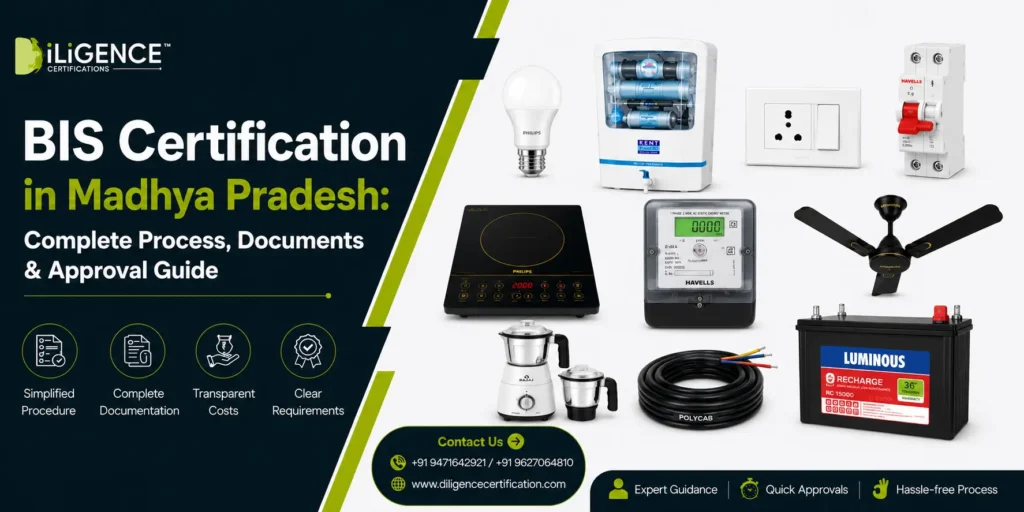
By - BIS Certification in Madhya Pradesh is a compulsory approval which a number of products need to comply with Indian Safety and Quality norms.
- In India, product compliance is mandatory for all regulated goods. Every manufacturer or distributor of the notified products should obtain BIS certification before putting the products into the Indian market.
- It is mandatory for regulated products like electronics, construction, and consumer goods
Introduction
The significance of BIS certification in Madhya Pradesh has become prominent owing to the industrial growth that is taking place in cities such as Indore, Bhopal, Gwalior, Jabalpur, and Ujjain. Madhya Pradesh has seen an increase in its manufacturing industry, construction industry, electrical components providers, and consumer goods distribution.
In the past, most companies considered that BIS certification is primarily needed in big industrial zones such as Maharashtra and Gujarat. However, BIS certification rules are applicable to all regions of India, including Madhya Pradesh.
As an illustration, a manufacturing company providing electrical switches for house building projects in Indore must make sure that the switches comply with BIS standards before selling them to consumers. Even if the switch complies with the quality standards of the company, it will not be legal to sell without the certification of BIS, in case if it comes under the categories of BIS.
What is BIS Certification?
BIS Certification in Madhya Pradesh is an official certification provided by Bureau of Indian Standards for a product which conforms to the relevant Indian standards.
It is a process through which the product is assessed in terms of quality criteria in order to determine its suitability for sale within India.
Key Objectives of BIS Certification
- Product safety for consumers
- Uniform manufacturing standards
- Substandard or unsafe products are avoided
- Building consumer confidence
- Regulatory compliance
The requirement of BIS certification is determined by the product type and can be either mandatory or voluntary. In notified products, compliance becomes mandatory before selling in Madhya Pradesh and other Indian states.
Types of BIS Certification in Madhya Pradesh
BIS operates multiple certification schemes based on product type and compliance requirements.
1. ISI Mark Certification
ISI Mark Certification is one of the oldest BIS schemes applicable to manufacturing-based products requiring factory inspection.
Applicable Products
- Cement and construction materials
- Steel and structural products
- Electrical appliances and wiring devices
- Kitchen and household equipment
- Packaged drinking water
Process Highlights
- Factory inspection is mandatory
- Product samples tested in BIS-approved labs
- Manufacturing process evaluation
- Continuous compliance monitoring
ISI certification ensures long-term quality consistency rather than one-time approval.
2. BIS CRS Registration
Compulsory Registration Scheme (CRS) applies mainly to electronics and IT products, widely relevant in Madhya Pradesh due to rising demand for digital devices.
Applicable Products
- Mobile phones
- Laptops and tablets
- LED lighting products
- Chargers and adapters
- Power banks and batteries
Manufacturers must test products in BIS-recognized labs before registration. Without CRS approval, electronic products cannot be legally sold in India.
3. FMCS Certification
Foreign Manufacturer Certification Scheme applies to overseas manufacturers exporting goods to India.
Foreign companies must comply with BIS standards before selling in Madhya Pradesh or any Indian market. This ensures imported goods meet the same safety standards as domestic products.
4. Hallmarking Certification
Hallmarking applies to gold and precious metal jewellery to ensure purity standards.
This is highly relevant in Madhya Pradesh’s jewellery markets, especially in cities like Indore and Bhopal where gold demand is high.
Importance & Benefits of BIS Certification in Madhya Pradesh
| Importance | Benefits |
| Ensures compliance with Indian standards | Builds strong brand credibility |
| Mandatory for regulated products | Enables legal market access |
| Required for government tenders | Improves business eligibility |
| Prevents legal penalties | Reduces compliance risks |
| Standardizes product quality | Enhances customer satisfaction |
| Supports industrial expansion | Improves business scalability |
| Strengthens manufacturing discipline | Increases operational efficiency |
BIS certification is not only a legal requirement but also a long-term business advantage for companies operating in Madhya Pradesh.
Industries Requiring BIS Certification in Madhya Pradesh
BIS Certification applies to multiple industries, especially those involving safety-sensitive products.
Key Industry Sectors
- Manufacturing electrical & electronic equipment
- Civil engineering
- Auto parts
- Durable consumer goods
- Food packaging, Bottled water
- Renewable energy equipment like solar systems
Due to the increasing number of infrastructure projects in Madhya Pradesh, BIS certification has become increasingly important.
BIS Certification Step-by-Step Process in Madhya Pradesh
The BIS certification process follows a structured compliance workflow:
Step 1: Product Identification
Identification of correct Indian Standard (IS code) based on product type.
Step 2: Application Submission
Submission of application along with company details and product information.
Step 3: Product Testing
Samples are tested in BIS-approved laboratories.
Step 4: Factory Inspection
BIS officials may inspect manufacturing units (for ISI certification).
Step 5: Evaluation Process
Test reports and inspection findings are reviewed.
Step 6: Certification Approval
Final approval is granted upon successful compliance verification.
Documents Required for BIS Certification in Madhya Pradesh
Business Documents
- GST registration certificate
- PAN card
- Certificate of incorporation
- MSME registration (if applicable)
Manufacturing Documents
- Factory layout plan
- Machinery list
- Production flow chart
- Quality control procedures
Technical Documents
- Product specifications
- Raw material details
- Laboratory test reports
- Engineering drawings
Additional Documents
- Authorized signatory details
- Trademark certificate (if any)
- Utility bills and address proof
Incomplete documentation often leads to delays or rejection.
Timeline, Cost & Validity
| Timeline | Cost | Validity |
| • CRS Certification: Few weeks depending on testing and documentation approval • ISI Certification: Moderate timeline due to mandatory factory inspection and evaluation • FMCS Certification: Longest timeline due to foreign inspection and verification process | • CRS Certification: Low cost (mainly lab testing fees + government charges) • ISI Certification: Medium to high cost depending on product category and testing requirements • FMCS Certification: Highest cost due to international inspection, testing, and compliance process | • CRS Certification: Renewable after validity period subject to compliance • ISI Certification: Renewal required periodically to maintain license validity • FMCS Certification: Subject to periodic audits and continuous compliance requirements |
Common Challenges Faced by Businesses
- Incorrect IS code selection
- Incomplete documentation
- Product failure in testing
- Delay in factory inspection
- Lack of BIS regulatory knowledge
- Misclassification of products
Proper planning significantly reduces these risks.
Why Choose Diligence Certification for BIS Certification in Madhya Pradesh
Selecting the Diligence Certification compliance partner ensures faster approval and reduced rejection risk.
Key Reasons
1. End-to-End Support
Complete assistance from application to final approval.
2. Accurate IS Code Mapping
Correct classification of products under BIS standards.
3. Documentation Verification
Pre-check of documents before submission.
4. Lab Coordination
Assistance with BIS-approved testing laboratories.
5. Inspection Preparation
Guidance for factory readiness during BIS audits.
Conclusion
Certification under BIS in Madhya Pradesh is a vital compliance issue for companies that sell regulated products in the state. The procedure is not only a formality but a regulatory procedure whose aim is to ensure that products in the market satisfy the specified criteria of safety, quality, and performance as laid down by the Bureau of Indian Standards (BIS).
To those who manufacture, import, and distribute regulated products in Madhya Pradesh, Certification under BIS in Madhya Pradesh affects their ability to do business. This is because non-compliance means that you will not be able to market your products, distribute them, or use them in both government and private sector projects.
From an industry point of view, BIS certification in Madhya Pradesh is useful to establish a common quality standard for the sectors like electronics, construction, consumer goods, electrical, food packaging, and renewable energy. The establishment of uniform quality standard makes sure that there is no inferior product present in the market, and the consumers get safe products in their hands.
Finally, BIS certification helps businesses from being caught up in future legal battles while also giving them the edge of competition in Madhya Pradesh’s industrial market environment.
Frequently Asked Questions
Who is eligible for BIS Certification in Madhya Pradesh?
Manufacturers, importers and foreign manufacturers depending upon product types.
Is BIS Certification mandatory in Madhya Pradesh?
Yes, only for notified product categories under BIS rules.
How long does it take to obtain BIS Certification?
Generally it takes 15 to 90 days, depending upon product type.
What is the fee for BIS Certification?
It depends upon testing of products and fees charged by the government.
Can Importers go for BIS Certification?
Yes, Importers need to go for BIS certification prior to sale in India.
What are the consequences of non-compliance?
The products might get seized and fines could be levied.
What products are eligible for BIS Certification?
Electronics, construction materials, electrical products and many other categories.
Is Factory Inspection necessary all the time?
No, only for ISI mark and not for CRS.
Can BIS Certification be renewed?
Yes, renewal is required periodically.
Why is BIS Certification important?
BIS Certification is important from compliance and legal perspective.


