BIS Certification
 CDSCO
CDSCO
 PESO
PESO
 CPCB
CPCB
 LMPC
LMPC
 WPC Approval
 Global Approvals
 TEC
TEC
 ARAI
ARAI
 BEE
BEE
 ISO Certification
 DGCA Certification
 NOC For Steel
 APEDA Registration























 Business Registration
 FSSAI Mark Certification












 (32).jpg)
 Legal Services
 Trademark Registration
 Copyright Registration
 Patent Registration
 By
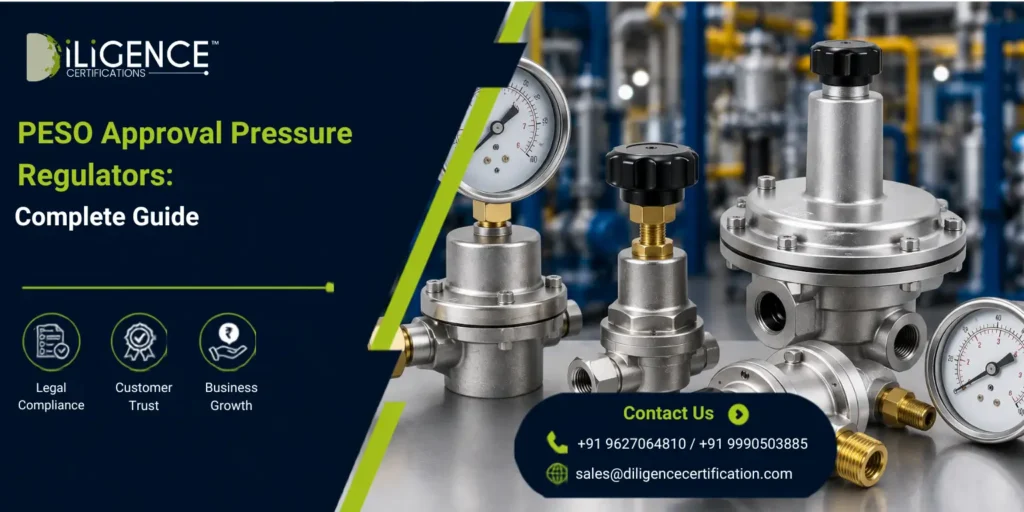
By - PESO Approval for Pressure Regulators is relevant when a regulator falls within the scope of regulated gas-cylinder equipment, particularly LPG regulators covered under the Gas Cylinders Rules, 2016.
- Manufacturers generally need approval for the regulator design and manufacturing facility, with technical drawings, calculations, testing, inspection and quality-control evidence forming an important part of the application.
- For imports, the regulatory position is different from manufacturing approval; applicable approval or licence requirements must be established before the regulator is imported into India.
Introduction
A pressure regulator reduces and controls gas pressure before the gas reaches downstream equipment. In a regulated gas installation, that small component can be just as important as the cylinder, valve or storage system because a regulator failure can result in uncontrolled pressure, leakage or unsafe gas release.
For businesses manufacturing or importing regulated gas regulators, PESO Approval for Pressure Regulators is therefore not simply a commercial certification exercise. It is a technical approval process governed by the applicable safety regulations.
One important clarification is needed at the beginning: not every pressure regulator sold in India automatically requires the same PESO approval. The applicability depends on the regulator’s type, intended gas service, connection to the cylinder or gas system, manufacturing activity, import status and the regulatory framework applicable to the equipment.
For LPG regulators and specified regulator equipment associated with gas cylinders, the Gas Cylinders Rules, 2016 are particularly important. PESO’s current guidance expressly covers approval for manufacturing cylinders, valves and regulators, including LPG regulators.
Why Is PESO Approval for Pressure Regulators Required
Pressure regulators are safety-critical components because they control the pressure entering downstream equipment.
Consider an LPG cylinder supplying a burner or industrial appliance. The cylinder may contain gas at a considerably higher pressure than the equipment is designed to receive. The regulator performs the controlled pressure-reduction function.
If the regulator is incorrectly designed, improperly manufactured or unsuitable for the intended gas service, the consequences can include:
- Gas leakage
- Excessive downstream pressure
- Regulator malfunction
- Fire hazards
- Equipment damage
- Unsafe cylinder operation
- Product rejection during inspection or import
- Regulatory objections
- Delays in commercialisation
PESO’s statutory role includes administering safety regulations covering compressed gases, cylinders, valves and LPG regulators. Its published material specifically identifies approval of manufacturing units for cylinders, valves and LPG regulators as part of its regulatory work.
This is why technical conformity matters more than simply having a company registration or a generic quality certificate.
Which Rules Govern Pressure Regulator Approval in India
For regulators associated with gas cylinders, the principal regulatory reference is the Gas Cylinders Rules, 2016 (GCR 2016).
PESO publishes the Gas Cylinders Rules, 2016 and related SOPs on its official website. The current regulatory environment should also be checked for amendments because PESO has published amendments to the Gas Cylinders Rules in 2025 and 2026.
Official PESO Gas Cylinders Rules
The GCR framework is relevant to equipment such as:
- Gas cylinders
- Valves
- LPG regulators
- Certain fittings and associated equipment
- Gas filling and storage activities
- Importation of regulated cylinders, valves and LPG regulators
PESO’s current SOP states that a person intending to manufacture LPG regulators attached to self-closing valves, multi-function valves and other specified fittings must obtain approval from the Chief Controller of Explosives and submit prescribed particulars, scrutiny fees, design drawings and calculations endorsed by the inspecting authority.
That distinction is important for businesses selling a generic “pressure regulator”. The exact product construction and intended application need to be reviewed before deciding the regulatory route.
PESO Approval for Pressure Regulators: Manufacturing Approval
For an Indian manufacturer, the approval process is substantially technical.
PESO’s published SOP describes an approval route involving scrutiny of technical documentation, physical evaluation of manufacturing and quality-control capabilities, prototype production and type testing.
Step 1: Product and Regulatory Assessment
The first stage is to establish the exact regulator category.
The applicant should prepare a technical description covering the regulator’s construction, gas service, pressure range, connection arrangement, materials, operating characteristics and intended use.
This information determines which regulatory provisions and technical standards need to be considered.
Step 2: Prepare Design Drawings
Design drawings are one of the most important parts of the application.
PESO’s SOP states that design drawings should show relevant manufacturing code, design parameters, raw-material details, company information, valve and thread details, gas service and other applicable technical information. The drawings and design calculations are to be duly endorsed by the inspecting authority/TPIA.
A drawing should therefore not be treated as a simple manufacturing sketch.
It should be a controlled engineering document that corresponds with the prototype, calculations and testing records.
Step 3: Submit Technical and Manufacturing Particulars
The applicant needs to provide information about its manufacturing capability.
PESO’s SOP includes details such as:
- Manufacturing experience
- Product specifications
- Applicable codes
- Organisational structure
- Technical personnel
- Manufacturing process
- Quality-control checks
- Testing equipment
- Gauges and measuring equipment
- Relevant inspection facilities
- Independent inspecting authority
- Test records
- Quality-system information
- Site and layout plans
This is why a regulator manufacturer should prepare the compliance file before filing the application rather than trying to create documents after a query is raised.
Documents Required for PESO Approval for Pressure Regulators
The exact document list can vary according to the product and application, but the PESO SOP provides a useful framework for regulator manufacturing approvals.
Common technical and business documents can include:
Corporate Documents
- Certificate of incorporation or business constitution documents
- Applicant details
- Authorisation letter
- Nomination of responsible personnel
- Legal possession documents for the manufacturing premises
Technical Documents
- Product description
- Design drawings
- Design calculations
- Manufacturing code/specification
- Material details
- Gas-service information
- Pressure ratings
- Valve and thread details
- Component specifications
- Technical literature
Manufacturing Documents
- Manufacturing process flow
- Machinery list
- Quality-control procedures
- Testing facilities
- Inspection procedures
- Calibration records
- Technical manpower details
Testing and Inspection Documents
- Prototype test records
- Test and inspection certificates
- TPIA documentation
- Type-test evidence
- Inspection reports
PESO Approval Process for Pressure Regulators
Step 1: Determine applicability
Confirm whether the product is within the relevant GCR regulator scope.
Step 2: Freeze the technical design
Do not submit a drawing while the engineering team is still making substantial design changes.
Step 3: Prepare drawings and calculations
Ensure the drawings, calculations, material specifications and product data are internally consistent.
Step 4: Engage the appropriate inspecting authority
The technical inspection and testing route should be aligned with PESO’s applicable requirements.
Step 5: Submit the application
The application and prescribed documents are submitted through the applicable PESO online system.
PESO launched an online module specifically for approval of regulators under the Gas Cylinders Rules, 2016 in November 2024.
Step 6: Prototype and testing
Manufacture the prototype according to the submitted and accepted design and complete the required testing.
Step 7: Inspection and evaluation
PESO and/or the relevant inspecting authority evaluate the manufacturing capability, testing arrangements and compliance.
Step 8: Address observations
Any technical observations should be answered with controlled, evidence-based documentation.
Step 9: Grant of approval
Once the required conditions are satisfactorily fulfilled, PESO can grant the applicable approval.
PESO’s SOP states that approval for cylinder, valve and regulator manufacturing is initially granted for a specified period and can subsequently be extended based on satisfactory performance.
Common Reasons for Delay in PESO Regulator Approval
Incorrect Product Classification
Calling a product a “pressure regulator” is not enough. Its actual function and intended application determine the regulatory route.
Inconsistent Drawings and Calculations
If the design drawing says one material while the test report identifies another, the application can attract technical queries.
Inadequate Prototype Control
The prototype should represent the final proposed design rather than an experimental version that is later changed.
Weak Testing Documentation
Test reports should clearly identify the tested product, design, model and relevant parameters.
Poor Traceability
A manufacturer should be able to establish which materials and components went into a particular product batch.
How Diligence Certifications Can Help With PESO Approval for Pressure Regulators
Diligence Certifications assists businesses with PESO-related compliance, including applicability assessment, documentation, technical coordination, application support and regulatory follow-up.
For companies working with gas-cylinder equipment, it is also useful to understand the wider Gas Cylinders Rules framework rather than treating the regulator as an isolated component. Diligence Certifications provides PESO-related compliance support across GCR, SMPV(U) and petroleum regulatory areas.
A typical consultancy engagement can involve:
- Product applicability assessment
- Regulatory route identification
- Document checklist preparation
- Technical-document review
- Design and drawing coordination
- TPIA coordination
- Application filing assistance
- PESO query responses
The important part is not simply submitting the application. It is making sure the technical file tells the same story as the actual product and manufacturing process.
Conclusion
PESO Approval for Pressure Regulators is an important compliance requirement for applicable LPG regulators and other regulated equipment falling under PESO’s jurisdiction. The process can involve technical drawings, design calculations, prototype testing, inspection, manufacturing capability assessment and detailed documentation.
A common mistake is to start the application before confirming the exact regulatory category of the product. The better approach is to first assess the regulator, intended gas service and application, then prepare the technical file around the applicable PESO requirements.
PESO requirements can also change through amendments, updated procedures and digital application systems. Therefore, manufacturers and importers should verify the latest applicable requirements before submitting an application.
Frequently Asked Questions
What is PESO Approval for Pressure Regulators?
PESO Approval for Pressure Regulators is the applicable regulatory approval for pressure-regulating equipment falling within PESO's jurisdiction. Specified LPG regulators associated with gas-cylinder applications are regulated under the Gas Cylinders Rules, 2016.
Is PESO approval mandatory for LPG regulators?
Yes, specified LPG regulators covered under the Gas Cylinders Rules, 2016 require the applicable PESO approval. The exact requirement depends on the regulator design, application and regulatory classification.
Who needs PESO approval for pressure regulators?
Manufacturers of applicable regulated pressure regulators may need PESO approval before manufacturing them commercially. Foreign manufacturers and importers may also have separate approval or import-related requirements.
What documents are required for PESO regulator approval?
Common documents include product specifications, technical drawings, design calculations, material details, manufacturing information, quality-control documents, testing records, inspection documents, factory details and applicable business documents.
Is prototype testing required for PESO pressure regulator approval?
Where required under the applicable approval procedure, prototype evaluation and type testing form an important part of the approval process. The prototype should correspond with the submitted technical design.
Can an imported pressure regulator receive PESO approval?
Yes, applicable imported regulators can be subject to PESO approval and import-related requirements. Importers should determine the applicable regulatory procedure before bringing the product into India.
Is BIS certification the same as PESO approval?
No. BIS certification and PESO approval address different regulatory requirements. Depending on the product and applicable legislation, a pressure regulator may need to comply with one or potentially both frameworks.
How long does PESO approval for pressure regulators take?
The timeline depends on the product, completeness of documentation, technical scrutiny, testing, inspection, manufacturing facility evaluation and regulatory queries. An exact timeline should be determined after reviewing the specific product and application.
Can the regulator design be changed after PESO approval?
Design changes should not be implemented without checking their impact on the existing approval. Changes to critical design parameters, materials, dimensions or other approved specifications may require regulatory review or approval.
How can Diligence Certifications help with PESO approval?
Diligence Certifications can assist with PESO applicability assessment, documentation, technical coordination, application support, inspection coordination, regulatory queries and follow-up for applicable pressure regulator approvals.