BIS Certification
 CDSCO
CDSCO
 PESO
PESO
 CPCB
CPCB
 LMPC
LMPC
 WPC Approval
 Global Approvals
 TEC
TEC
 ARAI
ARAI
 BEE
BEE
 ISO Certification
 DGCA Certification
 NOC For Steel
 APEDA Registration























 Business Registration
 FSSAI Mark Certification












 (32).jpg)
 Legal Services
 Trademark Registration
 Copyright Registration
 Patent Registration
 By
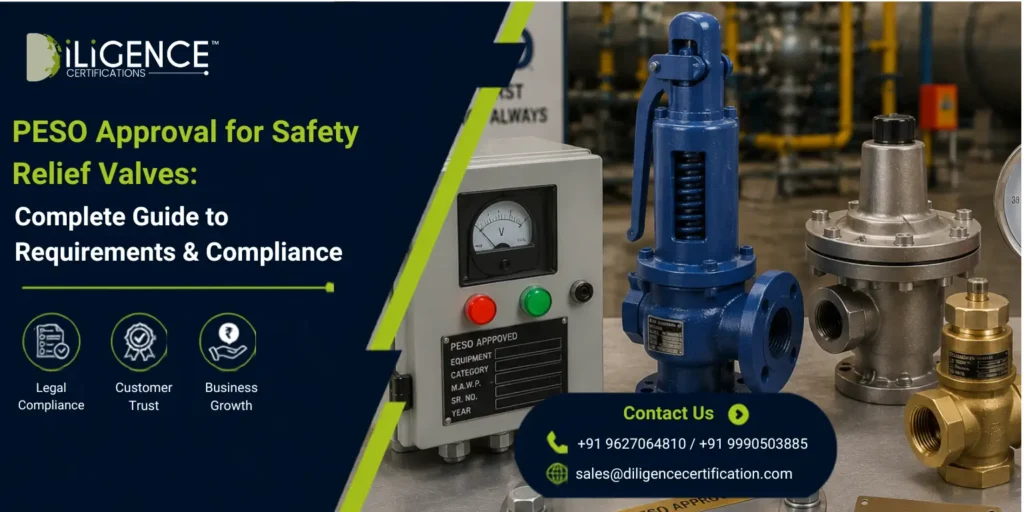
By - PESO Approval for Safety Relief Valves is closely associated with the safety requirements applicable to pressure vessels under the Static and Mobile Pressure Vessels (Unfired) Rules, 2016.
- Safety relief valves protect pressure vessels by releasing excess pressure when the vessel approaches an unsafe pressure condition; their design, setting, testing and installation must meet the applicable regulatory requirements.
- Under the SMPV(U) framework, safety relief valves fitted to pressure vessels are subject to testing requirements under Rule 18, with testing and certification involving a recognised Competent Person.
Introduction
A safety relief valve may be a relatively small component compared with the pressure vessel it protects, but its role is critical.
Imagine an LPG storage vessel, ammonia vessel or industrial-gas installation operating under pressure. If pressure rises beyond the safe design limit, the relief system must respond before the vessel reaches a dangerous condition. A relief valve is one of the key safeguards designed for this purpose.
In India, the regulatory position for safety relief valves depends on where and how the valve is used. For safety relief valves fitted to pressure vessels governed by the Static and Mobile Pressure Vessels (Unfired) Rules, 2016 [SMPV(U) Rules, 2016], PESO requirements are particularly important.
Why Are Safety Relief Valves Important for Pressure Vessels
A pressure vessel is designed to operate within defined pressure limits. A safety relief valve provides a controlled means of relieving excess pressure when the pressure rises beyond the permitted operating range.
The purpose is straightforward: prevent the vessel from reaching a pressure that could compromise its structural integrity.
The consequences of an inadequate relief system can be severe:
- Vessel rupture
- Gas release
- Fire
- Explosion
- Toxic exposure
- Equipment damage
- Production shutdown
- Environmental incidents
- Regulatory action.
Which Rules Govern Safety Relief Valve Compliance in India
The principal regulatory framework for safety relief valves installed on pressure vessels is the Static and Mobile Pressure Vessels (Unfired) Rules, 2016.
PESO publishes the SMPV(U) Rules, 2016 on its official website.
The Rules cover the safe storage and transportation of compressed gases and cryogenic liquids in static and mobile pressure vessels.
For safety relief valves, Rule 18 is particularly relevant because it deals with the testing of safety relief valves fitted to pressure vessels. PESO’s own material identifies recognition of Competent Persons under Rule 18 for testing safety relief valves.
PESO also maintains a list of recognised Competent Persons and approved entities under the SMPV(U) framework.
What Does the SMPV(U) Rules Say About Safety Relief Valves
The regulatory requirements are more detailed than simply saying “install a safety valve.”
The SMPV(U) Rules require pressure vessels to have pressure-relieving devices according to the applicable design code. They also specify requirements concerning the type, setting, capacity and arrangement of relief valves.
Among the important provisions are:
- Relief valves should be spring-loaded.
- Weight-loaded relief valves are not permitted under the stated provision.
- The valve should be designed to prevent inadvertent loading beyond the set pressure.
- The valve must have sufficient relieving capacity.
- Safety relief valves must be set within the prescribed pressure limits.
- The valve should be appropriately marked.
- Connections must be adequately sized for the required discharge.
These requirements demonstrate why a pressure-vessel safety relief valve cannot be selected solely on the basis of pipe size or purchase price.
What Documents Are Required for PESO Safety Relief Valve Compliance
The exact documentation depends on the application, but a technical compliance file may include:
Product Documents
- Safety relief valve datasheet
- Manufacturer details
- Model number
- Material specifications
- Size
- Pressure rating
- Set pressure
- Discharge capacity
- Gas-service details
Technical Documents
- Valve drawing
- Dimensional drawing
- Sectional drawing
- Design calculations
- Material certificates
- Technical specifications
- Applicable design-code references
Testing Documents
- Test certificate
- Set-pressure test report
- Discharge-capacity test evidence, where applicable
- Inspection report
- Competent Person certificate
- Calibration records
PESO’s current SMPV(U) SOP specifically identifies a Safety Relief Valve certificate issued under Rule 18 as a document used for revalidation of pressure-vessel approvals.
PESO Approval Process for Safety Relief Valves
The practical compliance process can be understood in stages.
Step 1: Identify the Regulatory Scope
First determine whether the valve is being used with a pressure vessel governed by SMPV(U) Rules, 2016.
Step 2: Review the Vessel
The valve should be assessed against the protected vessel’s:
- Design pressure
- Maximum allowable working pressure
- Capacity
- Stored gas
- Design code
- Operating conditions
Step 3: Review Valve Specifications
Confirm the valve’s:
- Set pressure
- Relieving capacity
- Size
- Material
- Connection
- Temperature range
- Gas compatibility
- Construction
Step 4: Review Technical Drawings
The valve drawing should correspond with the actual product.
Changes in spring, nozzle, orifice, material or setting arrangement should not be made casually after technical approval or testing.
Step 5: Testing
The safety relief valve is tested through the applicable procedure.
PESO recognises Competent Persons for Rule 18 testing.
Step 6: Certification
The required certificate or test documentation is prepared in the applicable format.
PESO’s 2024 SMPV(U) SOP states that certificates relating to safety relief valve testing are issued online within the applicable compliance system.
Step 7: Installation Verification
The valve’s installation should be checked against the pressure-vessel design and applicable requirements.
Step 8: Periodic Testing
Testing does not end with initial installation. The SMPV(U) Rules require safety relief valves to be tested by a Competent Person at least once every year, with records maintained.
Common Compliance Mistakes
Choosing a Valve Only by Pressure Rating
A valve’s nominal pressure rating alone does not establish that it is suitable.
Set pressure, capacity, temperature, fluid compatibility and installation arrangement also matter.
Ignoring Discharge Capacity
The relief valve must be capable of relieving the pressure adequately.
A small valve with an attractive price is not a substitute for correctly calculated relieving capacity.
Treating Testing as a One-Time Activity
The applicable SMPV(U) provision requires periodic testing, including annual testing by a Competent Person.
How Diligence Certifications Helps With PESO Compliance
Diligence Certifications provides regulatory support for businesses dealing with pressure vessels, LPG, industrial gases and other PESO-regulated activities.
For businesses working with pressure vessels, our related PESO License for Pressure Vessels guide covers the wider SMPV(U) compliance framework, including vessel documentation, testing, inspection and safety fittings.
Our Static Pressure Vessel License guide also explains the compliance considerations for fixed pressure-vessel installations and safety devices.
For a safety relief valve project, Diligence Certifications can assist with:
- Regulatory applicability assessment
- SMPV(U) compliance review
- Technical-document coordination
- Safety relief valve documentation
- Pressure-vessel document review
- Testing and inspection coordination
- Competent Person coordination
- Application assistance
- PESO query support
- Compliance documentation
- Renewal and revalidation assistance
The objective is to make sure that the valve, pressure vessel and regulatory documents remain technically consistent.
Conclusion
PESO Approval for Safety Relief Valves should not be viewed as a simple product-documentation exercise. For pressure vessels governed by the SMPV(U) Rules, 2016, relief protection is closely connected with the vessel’s design pressure, operating medium, relieving capacity, installation arrangement and testing requirements.
Rule 18 makes safety relief valve testing an important part of ongoing compliance, while the wider SMPV(U) framework governs pressure-vessel safety, inspection and operation.
For manufacturers, EPC contractors and plant operators, the practical lesson is simple: select the correct valve, establish the correct set pressure and relieving capacity, maintain proper technical documentation, use the applicable inspection/testing route and keep periodic testing records up to date.
PESO’s regulatory framework continues to evolve, including digital certification processes and amendments for specialised pressure-vessel applications. Businesses should therefore verify the latest applicable rules and procedures before commissioning new equipment or renewing existing compliance.
Frequently Asked Questions
Is PESO Approval required for safety relief valves?
The requirement depends on the application. Safety relief valves fitted to pressure vessels governed by the SMPV(U) Rules, 2016 are subject to specific regulatory requirements, including testing under Rule 18. The exact approval or certification route depends on the valve, vessel and application.
What is Rule 18 for safety relief valves?
Rule 18 of the SMPV(U) Rules, 2016 deals with the testing of safety relief valves fitted to pressure vessels. PESO recognises Competent Persons to perform this prescribed testing activity.
How often should a safety relief valve be tested under PESO rules?
For the applicable SMPV(U) provision, safety relief valves must be tested by a Competent Person at least once every year, and records of the test must be maintained.
Who can test a safety relief valve under SMPV(U) Rules?
Testing under Rule 18 is performed by a Competent Person recognised under the applicable PESO framework.
What pressure should a PESO-regulated safety relief valve be set at?
The setting depends on the design pressure or maximum working pressure of the protected vessel and the applicable provisions. The SMPV(U) Rules state that the valve should start to discharge at a pressure not exceeding 110% of the design pressure or maximum working pressure for the applicable vessel provisions.
Is a safety relief valve required on every pressure vessel?
Pressure vessels within the SMPV(U) framework are subject to pressure-relieving requirements, but the exact configuration depends on the vessel type, design code and applicable rule provisions. The Rules require every applicable vessel to have pressure-relieving devices in accordance with the prescribed design requirements.
What documents are required for safety relief valve compliance?
Typical documentation can include valve specifications, drawings, set-pressure details, material information, test certificates, inspection records, calibration evidence and, where relevant, pressure-vessel drawings and design documents. The exact documents depend on the application.
Does safety relief valve testing mean the pressure vessel is automatically approved?
No. Safety relief valve testing is one part of pressure-vessel compliance. The vessel itself may have separate requirements relating to design, fabrication, inspection, installation, testing, licensing and periodic examination.
Are cryogenic safety relief valves subject to special requirements?
Yes. The SMPV(U) Rules contain specific requirements for relief devices on cryogenic pressure vessels, including requirements relating to the outer vessel, pressure settings and relieving arrangements.
How can Diligence Certifications help with PESO safety relief valve compliance?
Diligence Certifications can assist with regulatory applicability, SMPV(U) documentation, technical coordination, testing and inspection coordination, PESO application support, query responses and ongoing compliance requirements.